Walk a trade show or scroll a sourcing platform and you will meet the word Bluetooth attached to two completely different objects: a battery-powered portable speaker built for personal listening, and a mains-powered professional active cabinet built to cover an audience. For a buyer assembling a rental inventory, fitting out a venue, or planning an own-brand loudspeaker programme, the difference between the two is not a matter of taste — it is a matter of inputs, continuous output, deployment hardware and serviceability. This guide sets out, from the manufacturer's side of the table, what separates a consumer Bluetooth speaker from a professional active speaker, and how to convert that difference into a clear specification when you source live sound equipment from a factory.
Some context first. Audfine is a pro audio manufacturer established in 2009 in Ningbo, China, building active line arrays, PA speakers, powered subwoofers, raw speaker transducers and studio monitoring headphones, with products exported to more than sixty countries. The active PA speakers range this article refers to covers 12-inch and 15-inch powered cabinets intended for live sound, events and fixed installation. Everything below applies to that category.
One word on the label, two product categories
A consumer Bluetooth speaker is engineered around a single task: reproduce a streamed signal at personal listening distance, on battery power, in a sealed enclosure small enough to carry. Its defining components are a rechargeable battery, a small full-range driver or two, and a wireless receiver. It has no microphone inputs, no line-level connections, no pole socket, and its output is specified for a listener a metre or two away.
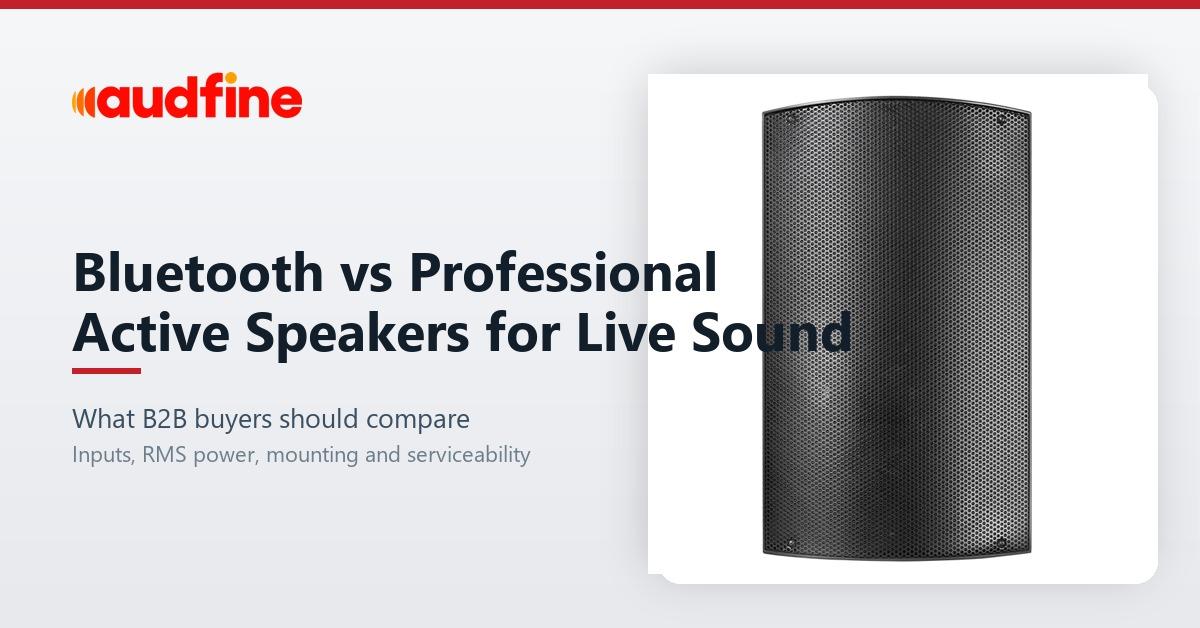
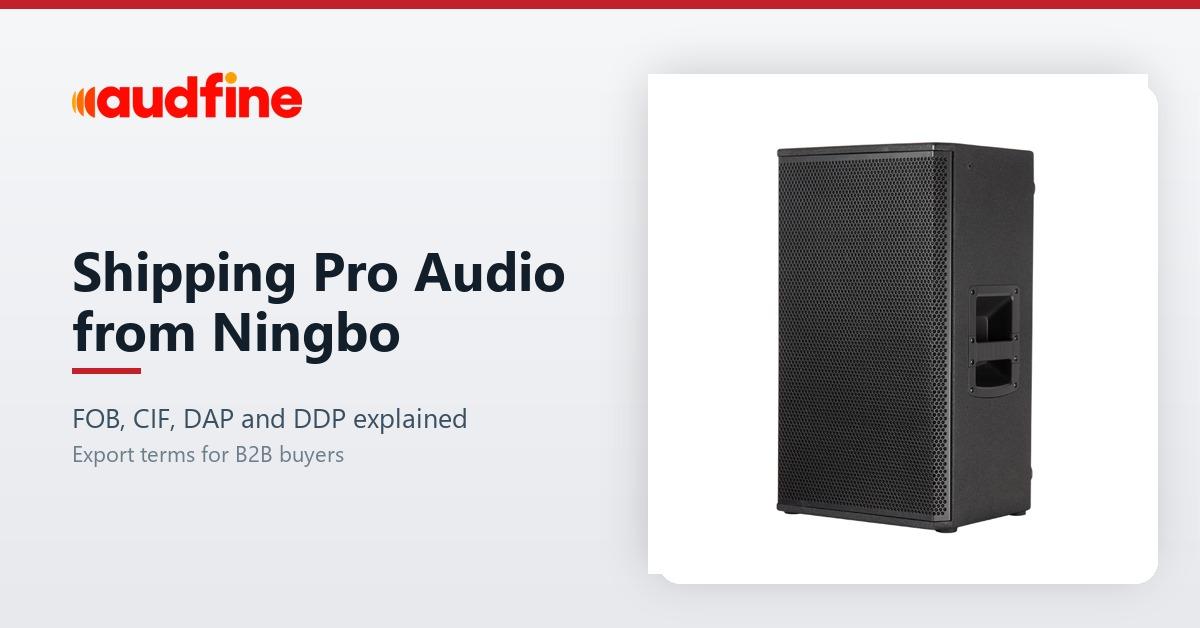
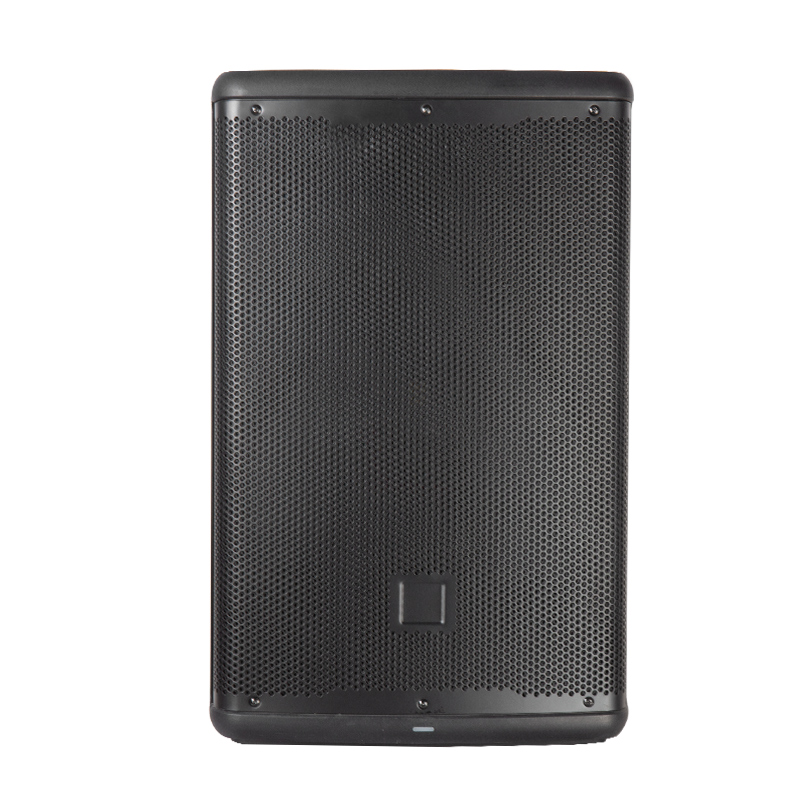
A professional active speaker is engineered around a different task: deliver speech and music at program level to a room or an outdoor area, all day, from sources that live sound actually produces — mixing consoles, microphones, playback devices. The amplification, the crossover and the driver complement are matched inside one cabinet, the cabinet is mains powered, and the enclosure carries the hardware a deployment needs: a pole socket, side handles, and in many models a floor-wedge monitor angle. The NX-915 powered loudspeaker sits in this class — 400W RMS, 800W peak, 97 dB sensitivity and a 123 dB maximum SPL at 1 metre, figures printed directly on its product page. Bluetooth, where a professional active cabinet includes it at all, is a convenience input sitting alongside the wired connections — useful for break music between sets, never the primary signal path a show depends on.
Inputs and signal path: what live sound actually plugs in
The clearest dividing line between the two categories is the input panel. A live sound cabinet must accept balanced microphone and line signals, because a show is assembled from sources: a vocal microphone, a DI box from an instrument, a mixing console output. That is why professional active speakers provide combo XLR/jack sockets with mic/line switching, level controls per channel, and often a link output that passes the mixed signal to a second cabinet for coverage on the other side of a stage.
A consumer Bluetooth speaker accepts one signal — the streamed one. When a buyer specifies cabinets for a programme without checking the input panel, this is the gap that surfaces first on site: there is simply nowhere to plug the microphone in. When you evaluate any active PA speaker, read the input panel before the power figure: how many combo sockets, whether mic and line gain stages are switchable, whether a link or pass-through output exists for multi-cabinet setups.
Amplification and continuous output: reading the power figures
The second dividing line is what the amplifier is built to sustain. Live sound duty means running at program level for hours, with bass-heavy material and heat building inside the cabinet. Professional ratings therefore separate RMS (continuous) power from peak power — in the range below, every model states both, for example 400W RMS and 800W peak on the 15-inch powered LSA-15A and its NX-915 counterpart, and 700W RMS with 1400W peak on the two EON 15-inch models. The RMS figure is the one that describes all-night duty; the peak figure describes short transients.
Consumer portable speakers rarely publish a comparable RMS rating at all, because the listening duty cycle they are designed for — an hour here and there — never demands one. For a buyer, that absence is itself information: if a specification sheet does not state continuous power, it is not describing a live sound cabinet.
What the printed numbers tell a buyer
The table below lists the six professional active speakers currently published on this site, with figures quoted exactly as printed on the product pages. Sensitivity is measured at 1 watt input at 1 metre; Max SPL is stated at 1 metre. As a planning estimate, sound pressure in a free field falls by roughly 6 dB each time listening distance doubles, so a figure quoted at 1 metre should be reduced when you think about audience rows several metres back — treat that arithmetic as orientation, not as a coverage promise, and confirm coverage assumptions with the factory during specification.
| Model | Configuration | Power | Sensitivity | Max SPL @ 1m | Frequency response | Crossover |
|---|---|---|---|---|---|---|
| HD-15A | 15" powered loudspeaker | 400W RMS / 800W peak | 96 dB | 123 dB | 45 Hz – 20 kHz | 2.0 kHz |
| EON-915 | 15" active PA speaker | 700W RMS / 1400W peak | 95 dB | 123 dB | 45 Hz – 20 kHz | 2.0 kHz |
| EON-715 | 15" active PA speaker | 700W RMS / 1400W peak | 95 dB | 123 dB | 45 Hz – 20 kHz | 2.0 kHz |
| NX-915 | 15" powered loudspeaker | 400W RMS / 800W peak | 97 dB | 123 dB | 45 Hz – 20 kHz | 1.8 kHz |
| LSA-15A | 15" powered loudspeaker | 400W RMS / 800W peak | 95 dB | 123 dB | 45 Hz – 20 kHz | 2.0 kHz |
| LSA-12A | 12" powered loudspeaker | 400W RMS / 800W peak | 95 dB | 121 dB | 50 Hz – 20 kHz | 2.0 kHz |
Three reading notes. First, all six cabinets reach down to 45–50 Hz, which covers full-range music duty for speech, background and mid-size event programmes; sub-bass extension below that belongs to a dedicated subwoofer paired through the crossover, not to the full-range cabinet alone. Second, the 12-inch LSA-12A trades 2 dB of maximum SPL against a smaller, lighter cabinet — a trade worth naming explicitly when a programme involves frequent one-person transport, whereas the HD-15A keeps the 123 dB figure on a 15-inch chassis. Third, where two models print identical figures — the EON-915 and EON-715, for instance — the differences that matter move to the enclosure, the input panel and the deployment hardware, which is exactly what a supplier conversation should settle.
Enclosures, mounting and deployment hardware
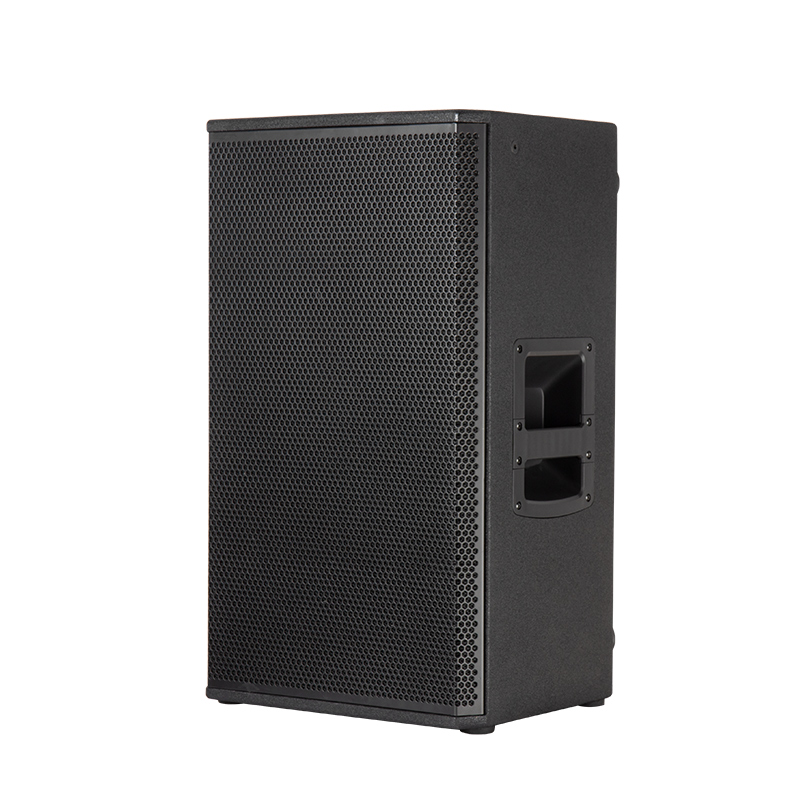
Deployment is where category differences become physical. A professional active cabinet carries a standard 35 mm pole socket for use on a speaker stand, tribars or a subwoofer pole mount; many models add a monitor wedge angle so the same cabinet serves as a floor return for a performer. Handles are positioned for two-person or one-person lifts on enclosures in the 15-inch class. The cabinet materials in this range — moulded polypropylene or plywood builds, depending on model — exist to survive transport cases, vehicle loading and repeated setup cycles that define rental and touring work.
A consumer portable speaker has none of this: no pole socket, no wedge angle, no provision for permanent installation hardware. If a venue or rental programme involves stands, flown or wall-mounted positions, the mounting provisions belong in the specification from the first enquiry — confirm which brackets and mounting accessories the factory can supply for the cabinet you select, and have any structural or rigging question reviewed by qualified personnel on your side before installation.
Serviceability over a programme's life
A rental fleet or an installation programme lives for years, and over that horizon the question changes from "what does it do on day one" to "what happens in year three when a driver fails". Professional active speakers are built as serviceable systems: the woofer and compression driver are discrete replaceable components, and raw transducers of matching impedance and diameter are available as spare parts — this factory manufactures its own speaker transducers, which shortens that conversation considerably. Amplifier modules and input panels are separate assemblies from the acoustic section.
For a buyer, the practical specification points are: whether replacement drivers of the correct impedance and power rating can be ordered alongside the cabinets, whether grille and cabinet finish parts are available, and whether the wiring between amplifier module and drivers is documented. A consumer Bluetooth speaker, by contrast, is a sealed unit — when it fails, the programme replaces the whole device, which at fleet scale turns every fault into a full hardware replacement.
Specifying professional active speakers when you source from a China manufacturer
The comparison above converts directly into a specification sheet. Buyers who send the eight points below with their first enquiry to a China speaker manufacturer get quotations that can be compared line against line, and they surface the deployment details that generic enquiries leave out:
- Configuration — 12-inch or 15-inch full-range cabinet, and whether a matching subwoofer enters the system later through the crossover.
- Power figures — RMS and peak stated separately for every model quoted.
- Input panel — number of combo XLR/jack sockets, mic/line switching, link or pass-through output for multi-cabinet setups.
- Target application — live sound, fixed installation or rental duty, with the audience area and typical programme material described, so sensitivity and Max SPL can be discussed against real coverage.
- Mounting — pole-socket use, floor-wedge monitoring or bracket installation; state which positions the programme needs.
- Cabinet construction — moulded polypropylene or plywood build, finish and grille specification.
- Branding and OEM requirements — logo placement, cabinet colour, packaging; this factory performs OEM to customer samples and designs customized products.
- Spares and service — availability of replacement drivers and amplifier modules through the life of the fleet.
Send the same eight points to several suppliers and the responses become comparable by construction — which is the condition under which a sourcing decision can be made honestly. You can consolidate the conversation with the contact form, attaching the application description and the deployment details.
FAQ
Can a professional active speaker also stream over Bluetooth?
Where a professional cabinet includes Bluetooth, it operates as a convenience input for break music and playback, sitting alongside the wired mic and line connections a show depends on. The reverse arrangement — a consumer portable speaker standing in for live sound duty — fails at the input panel first: there is no balanced microphone or line input to plug a console or microphone into.
How many cabinets does my room need?
That follows from audience area, program level and coverage geometry rather than from a single figure. As a planning estimate, sound pressure falls about 6 dB per doubling of distance in a free field; use it to shape assumptions, then state the room and the application in the RFQ so the factory can advise on configuration, including whether subwoofers should enter the system.
Can I evaluate a sample before committing to a programme?
Yes. Sample orders and trial orders for quality testing are accepted, which lets you bench-test the cabinet, its input panel and its output against your own programme material before fleet-scale decisions.
Which models suit a rental fleet and which suit fixed installation?
Both duties are served by the active range in the table above; the deciding factors are transport frequency, mounting positions and spare-parts policy rather than the acoustic figures alone. Describe the deployment in your enquiry and the recommendation follows from it — see the professional active speaker range for the published configurations.
Do you build active speakers under our own brand?
OEM production to customer samples and customized product design are part of this factory's standard service, covering branding, finishes and packaging on the active speaker lines as well as other product groups.
Bringing the comparison into your next enquiry
The word Bluetooth on a label describes a connection, not a duty class. When the programme is live sound — a rental inventory, a venue, an own-brand cabinet line — the specification that matters is written in the input panel, the RMS power figure, the mounting hardware and the spares policy. Those are exactly the lines a speaker manufacturer can answer in detail, and the eight-point enquiry list above is designed to make the first conversation productive on both sides.