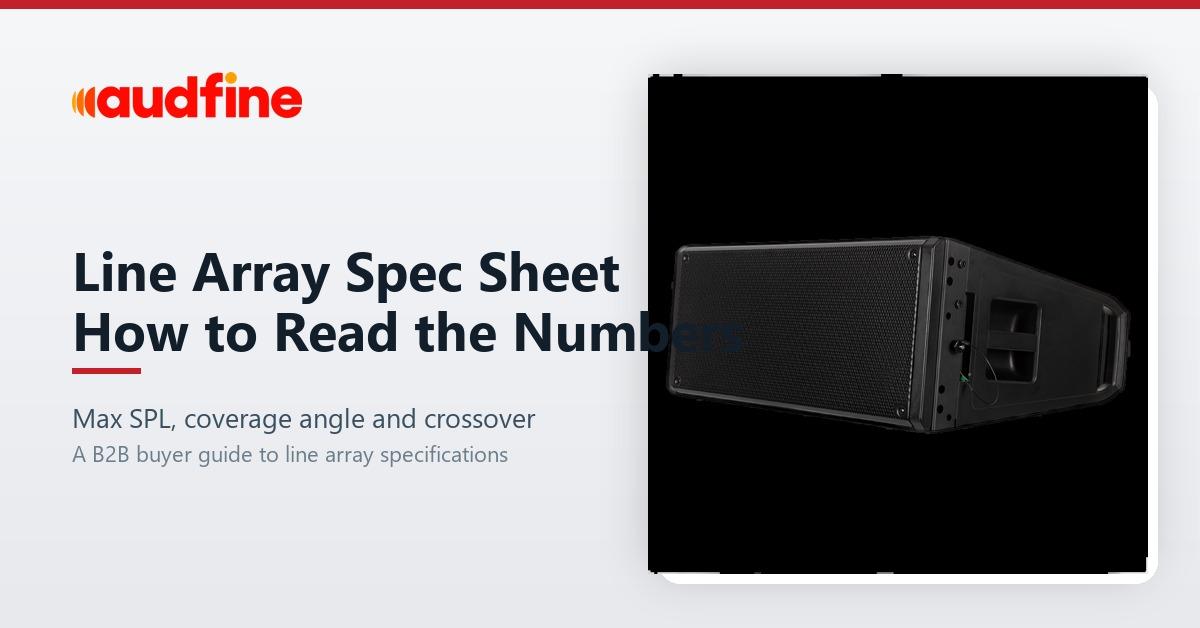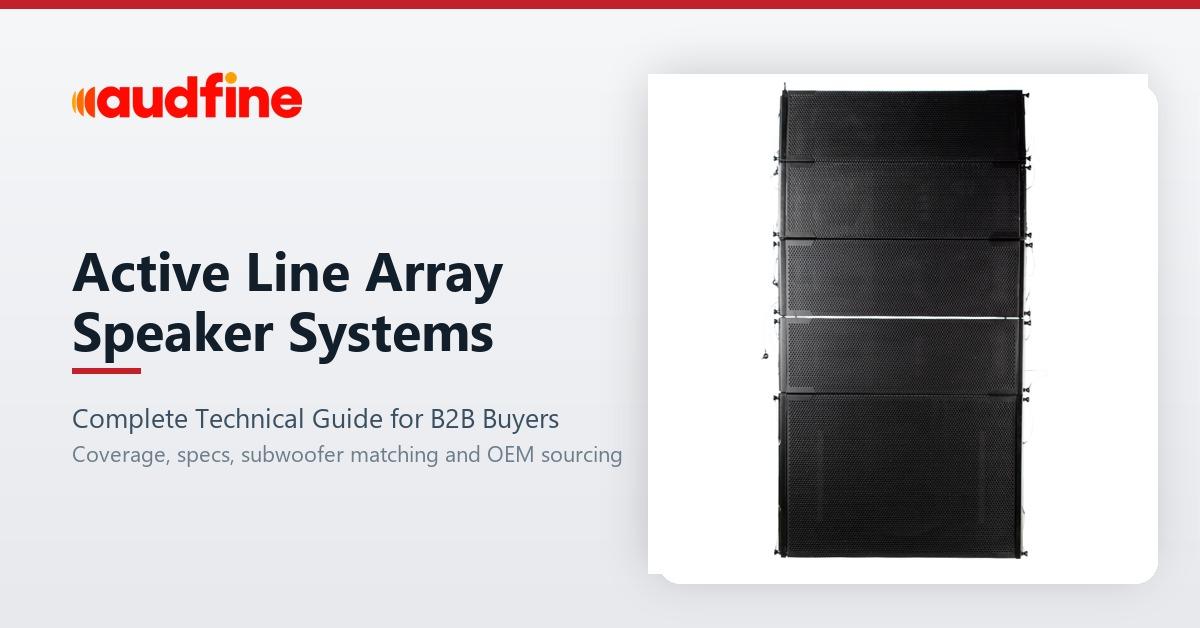
Two buyers can read the same line array specification sheet and arrive at opposite conclusions, because the sheet does not explain itself. A maximum SPL figure printed without a measurement distance, a coverage angle quoted for a single cabinet when the buyer is comparing complete systems, a power rating given only in peak watts - each of these is common in quotations from multiple suppliers, and each one distorts a purchasing decision. Reading the sheet correctly is therefore not a technical nicety. It is the step that decides whether the system you order does the job the venue requires.
This guide is written for B2B buyers evaluating a line array speaker manufacturer in China: rental companies, installation contractors, distributors and brand owners comparing an OEM line array supplier against its competitors. It walks through the numbers that matter - maximum SPL, coverage angle, frequency response, sensitivity, power and crossover - explains what each figure does and does not tell you, and ends with the specification questions to put in an RFQ. Every example is taken from a published Audfine product page for a current model.
First, check what the number describes
Before comparing any figure, establish whether it was measured on a single cabinet or on a complete system. The two are not interchangeable. A single two-way element in the current Audfine range is published at 100 x 60 (H x V) coverage, while the bundled PL210 line array system - four 10-inch cabinets plus an 18-inch subwoofer - is published at 90 x 90 (H x V) as a package. Neither number is wrong. They describe different objects, and a buyer who compares the 90 x 90 system figure against a competitor's single-cabinet figure is comparing two different products.
The same applies to power and SPL. When a supplier quotes a system, ask which components the figures include and how the power is distributed. The PL210 package, for example, allocates 1000W RMS to the subwoofer and 700W RMS to each of the four array cabinets - five figures, not one.
Maximum SPL: a single-cabinet reference, not a room measurement
Maximum SPL in a line array specification is the output the cabinet produces at a reference distance of one metre under stated conditions. It is not the level you will measure at the back of a 40-metre room, and it is not a promise about how the system sounds at program power. Its value to a buyer is as a common basis for comparing cabinets and as a sanity check on a design: if the room calculation demands more output than the published SPL supports at the throw distance, the configuration needs revisiting before the order is placed, not after.
Across the current range, the two-way cabinets are published between 130 dB and 131 dB, and the HDL50-A three-way active line array at 140 dB. Where a supplier's sheet does not state the measurement conditions - signal type, weighting, distance - ask for them in writing. A number that cannot be reproduced is not a specification; it is a claim.
Coverage angle: horizontal is the fan, vertical is the format
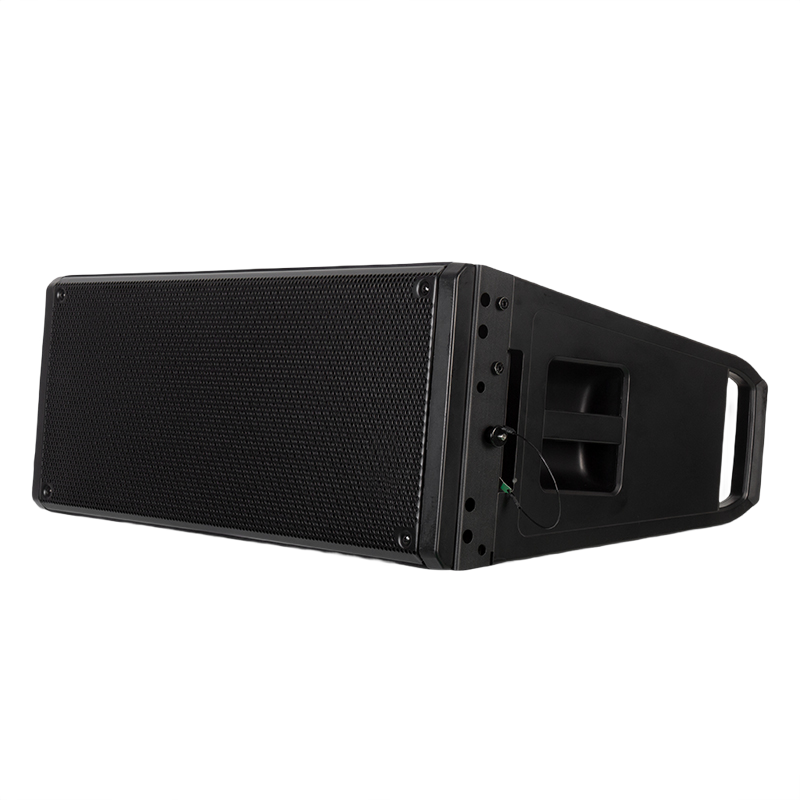
Coverage is published as two numbers, horizontal x vertical, and each half answers a different question. The horizontal figure decides how wide an area one hang or one stack can fill - 100 degrees across every cabinet in this range. The vertical figure describes how tightly the energy is controlled from front to back, and it is where cabinet formats differ most.
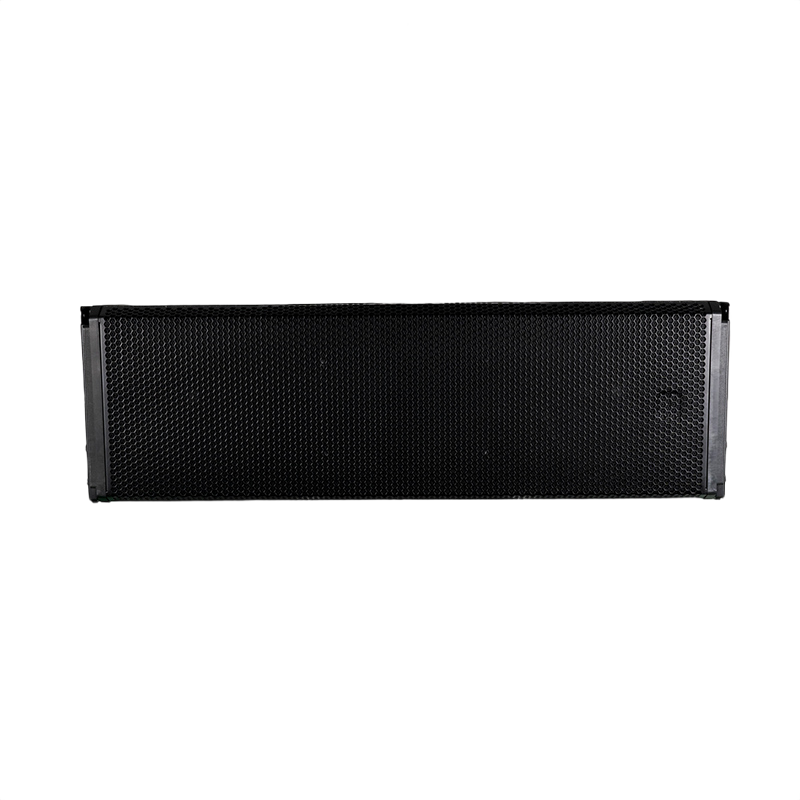
A standalone two-way cabinet such as the HDL28 or the HDL210 is published at 60 degrees vertical, suited to pole-mounted or stacked deployment over a defined seating area. The HDL50-A is published at 100 x 10: a deliberately narrow vertical pattern that only makes sense when several elements are coupled into a single hang, where the array's combined vertical control - not the single cabinet's - shapes the coverage. If a quotation shows a 10-degree vertical figure, that does not make the cabinet unsuitable; it signals a design intended for flown multi-element arrays.
One further point belongs in every RFQ: coverage angles are quoted at a stated attenuation from the on-axis level, and the convention is not universal. Ask the supplier at which level the angle is measured so that figures from different factories can be compared on the same basis.
Frequency response: the lower limit defines the subwoofer's job
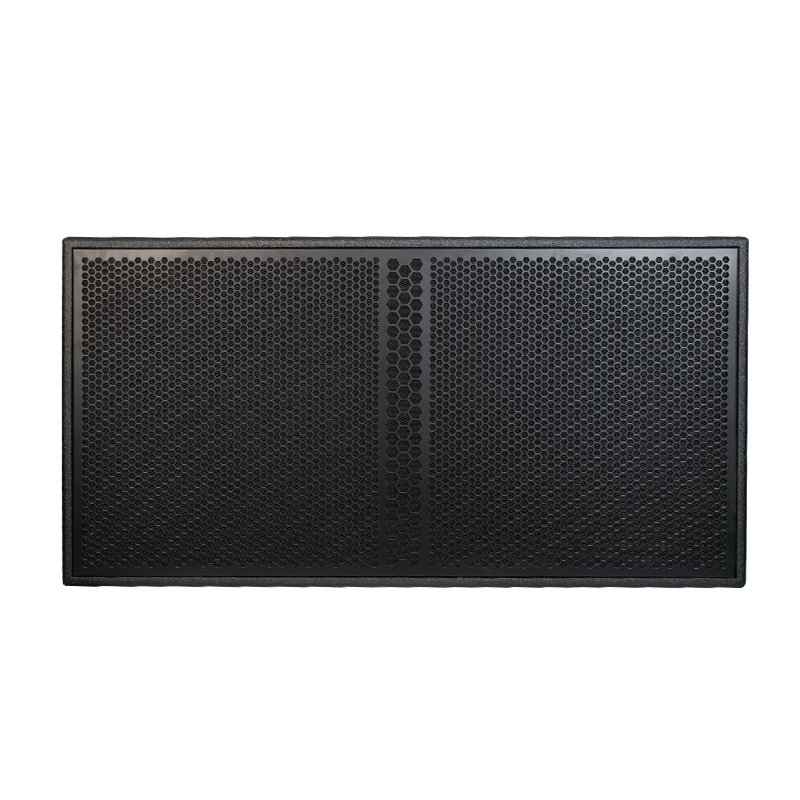
The stated frequency range tells you how much of the bass spectrum the cabinet handles itself and how much is handed to a subwoofer. The spread within one product family is the clearest illustration: the PL210LA runs from 45Hz, the HDL210 from 75Hz, the HDL28 from 85Hz, and the HDL26 from 95Hz. A cabinet specified from 95Hz requires everything below that point to come from another source; a cabinet specified from 45Hz already covers a useful part of the low end on its own.
The measurement point behind the quoted limits matters as much as the limits themselves. A response quoted at the -10 dB points reads wider than the same cabinet quoted at -3 dB. Where the sheet is silent, ask which convention applies. Then match the subwoofer to what is actually left: the DS218A dual 18-inch powered subwoofer is published from 35Hz to 180Hz with a 90 Hz crossover point, which sets a clean handover for cabinets starting at 75Hz or 85Hz and covers the bottom octaves for a 45Hz cabinet.
Sensitivity and amplifier power: read them together
Sensitivity, in dB, describes the output a cabinet produces for a given input; amplifier power, in watts, describes what is available to drive it. Neither figure predicts loudness alone. A high-sensitivity cabinet with a modest amplifier and a lower-sensitivity cabinet with a large amplifier can arrive at similar output, which is why the published range here - from 95 dB on the HDL26 to 104 dB on the HDL50-A - should be read next to the power column rather than instead of it.
Power itself is published two ways and both belong in the comparison. RMS describes sustained output and is the figure to use when sizing mains distribution: every cabinet in this range runs on AC 110V~220V, so the RMS sum across the system is what a generator or distro must supply. Peak describes short-term headroom. When comparing quotations, treat a peak-only power figure as incomplete until the RMS value is supplied.
Crossover: where the cabinet divides the work
The crossover frequency states where the signal is divided between the low-frequency and high-frequency sections, and it is a quick indicator of the topology behind the sheet. Two-way models in this range are published between 2.0 kHz and 2.1 kHz - one division point, between the woofer pair and the titanium-diaphragm compression driver. The HDL50-A, as a three-way design, publishes two points, 200 Hz and 800 Hz, because it adds a dedicated midrange section between the woofers and the drivers covering the top of the range.
The related line to read is the DSP section. Each cabinet in the range carries its own DSP and limiter with thermal and RMS protection, and the HDL26 publishes four named modes - speech, live music, DJ playback and monitor - selected from the rear panel. For an OEM programme, the DSP preset set is a customization question, not a fixed fact: if your market expects different voicing, raise it in the first enquiry.

Specification comparison
| Model | Configuration | Power (RMS / Peak) | Max SPL @ 1 m | Frequency response | Sensitivity | Crossover | Coverage (H x V) |
|---|---|---|---|---|---|---|---|
| HDL50-A | Three-way, 2 x 12" + 4 x 6.5" mid, NEO | 2200W / 4400W | 140 dB | 45Hz - 18000Hz | 104 dB | 200Hz, 800Hz | 100 x 10 |
| HDL210 | Two-way, 2 x 10", 2.5" v.c. | 700W / 1400W | 131 dB | 75Hz - 20000Hz | 99 dB | 2.0 kHz | 100 x 60 |
| HDL28 | Two-way, 2 x 8", 2.5" v.c. | 700W / 1400W | 131 dB | 85Hz - 20000Hz | 98 dB | 2.0 kHz | 100 x 60 |
| PL210LA | Two-way, 2 x 10", 2" v.c. | 700W / 1400W | 130 dB | 45Hz - 20000Hz | 98 dB | 2.1 kHz | 100 x 60 |
| HDL26 | Two-way, 2 x 6.5", 2" v.c. | 250W / 500W | 131 dB | 95Hz - 20000Hz | 95 dB | 2.0 kHz | 100 x 60 |
| PL210 system | 4 x 10" array + 18" subwoofer | 1000W + 700W x 4 RMS | 130 dB | 45Hz - 20000Hz | 98 dB | Not published for the system | 90 x 90 |
| DS218A | Dual 18" powered subwoofer, 4" v.c. | 2000W / 4000W | 131 dB | 35Hz - 180Hz | 98 dB | 90 Hz | Not applicable |
Specification questions for a line array speaker manufacturer in China
Reading a sheet tells you what a supplier published; asking the right questions tells you what they can actually build. When the evaluation moves to sourcing, these are the specification questions that separate a manufacturing partner from a catalogue reseller:
- At which attenuation and distance are SPL and coverage quoted? Getting every bidder onto one measurement basis is the first step of a fair comparison.
- Are the figures cabinet-level or system-level? If system-level, which components and which power allocation are included?
- Can the DSP presets be changed for the target market? Ask for the preset list in writing and confirm it survives firmware updates.
- Which parts of the design are configurable? On this range, cabinet colour, logo application, printed retail packaging and voicing adjustments are all open to OEM customers, and engineering drawings are produced for customer-specific versions. ODM development is available where an existing platform does not fit the requirement.
- Can the build be evaluated before committing? Samples are available for evaluation and trial orders are accepted ahead of a full order, with FOB, CIF, DAP and DDP terms settled by TT, LC or credit card.
- How does output scale? Current production for the loudspeaker category runs at approximately 3,000 cabinets per month, and capacity can be scaled for volume programmes - ask how a step-up would be scheduled before you need it.
Our active line array technical guide for B2B buyers covers the full sourcing process, and the 300-500 person venue configuration guide shows how these numbers are applied to a real room. The complete range sits under active line arrays.
Red flags when comparing supplier specification sheets
A few patterns in a quotation deserve a second look before the purchase order goes out:
- Peak-only power figures. Without an RMS value, mains planning and like-for-like comparison are impossible.
- SPL without measurement conditions. Distance, signal and weighting should be stated or supplied on request.
- System figures mixed with cabinet figures. A 90 x 90 package number pasted next to single-cabinet coverage makes the comparison meaningless.
- Missing sensitivity. Without it, the power rating cannot be interpreted.
- Claims that cannot be traced to a published page. Every figure in this article is traceable to a product page; expect the same from any supplier you shortlist.
FAQ
What does 100 x 60 mean on a line array spec sheet?
It is the coverage pattern, horizontal x vertical: 100 degrees in the horizontal plane and 60 degrees in the vertical, as published for the two-way cabinets in this range. It describes where the cabinet's output falls to the stated attenuation, not a promise of identical level everywhere inside the angle.
Is maximum SPL the level at the back of the room?
No. It is a single-cabinet reference at one metre. Level at a listener position follows from the throw distance, the number of elements and the array's vertical control, and it is always lower than the reference figure.
Why do two cabinets with the same driver size have different low-frequency limits?
Cabinet volume, tuning, driver engineering and DSP all move the lower limit. In this range, 10-inch two-way cabinets are published from 45Hz to 75Hz depending on the model, which is why the limit - not the driver size - should drive the subwoofer decision.
What should an RFQ for line array cabinets contain?
Application and venue type, throw distance and coverage required, programme material, preferred subwoofer configuration, cabinet material preference, target quantities and destination market, branding and packaging requirements, and the trade terms you want quoted. Asking for the measurement basis of every published figure belongs in the same document.
Request a quote or samples
Audfine is the audio brand of Ningbo Lesound Electronics Co., LTD., a professional audio manufacturer and exporter established in 2009 in Ningbo, China, with products exported to more than 60 countries. If you are comparing specification sheets from a line array speaker manufacturer, send us your application, throw distance and target quantities, or request a quote and samples to evaluate the HDL50-A, HDL210, HDL28, PL210LA, HDL26, PL210 and DS218A against your requirement before placing an order.