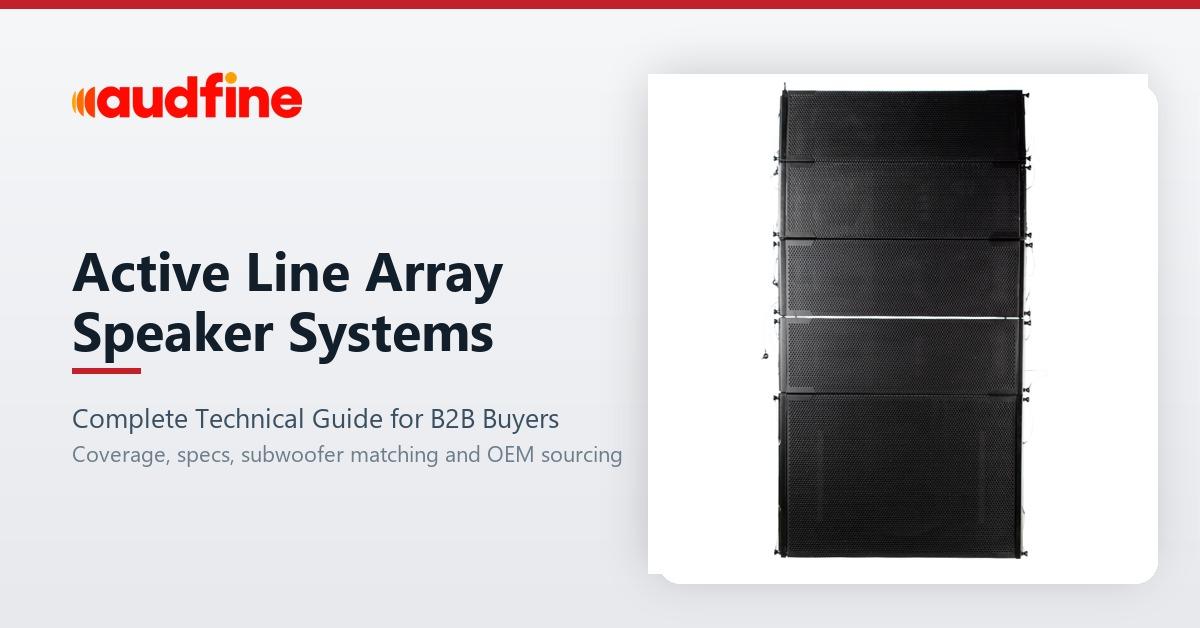
An active line array speaker system puts the amplifier, the digital signal processor and the protection circuitry inside every cabinet. That single design decision changes what a buyer specifies, what a warehouse ships, and what a rental desk can promise a customer on site. It removes the amplifier rack and the speaker processor from the quotation, it removes a class of wiring errors, and it makes each cabinet a self-contained unit that can be tested on the bench before it is packed.
This guide is written for buyers sourcing from a line array speaker manufacturer in China - rental companies refreshing inventory, installers building a fixed system, distributors building a private-label range, and brand owners comparing an OEM line array supplier against an ODM partner. It explains what the published numbers on a specification sheet actually describe, how a two-way and a three-way cabinet differ, where the subwoofer fits, and which questions belong in an RFQ. Every specification quoted here is taken from the relevant Audfine product page.
What makes a line array system "active"
In a passive system the amplifier and the processing live outside the cabinet. In an active system each cabinet carries its own amplifier module, its own DSP and its own limiter, and accepts a line-level input. All of the Audfine line array cabinets discussed here follow that pattern: a Class-D digital amplifier, DSP with a limiter, and thermal and RMS protection as standard.
The practical consequences are worth stating plainly. A crew no longer needs to match amplifier channels to cabinet impedance, or to carry a processor rack and the associated patching. A single XLR or combo lead carries signal into the first cabinet, and the male XLR output on the rear panel passes it on to the next cabinet or to a powered subwoofer. Because the DSP is fixed inside the cabinet, the voicing the manufacturer set in the factory is the voicing the customer hears, which is precisely why buyers evaluating an OEM line array supplier should ask how those presets can be adjusted.
There is a trade-off. Every cabinet needs mains power, so distribution becomes part of the system design rather than something confined to the amp room. All cabinets covered here run on AC 110V~220V, which matters for rental stock that travels between regions.
How a line array controls coverage
A line array is not simply a column of speakers. The point of the format is coupling: when several cabinets are stacked or hung at small angles to each other, their outputs combine, and the vertical dispersion narrows while the horizontal dispersion stays roughly that of a single cabinet. The energy is aimed at the audience instead of the ceiling and the back wall.
Horizontal coverage
This is the figure that decides how wide a fan one hang or one stack can fill. Every two-way model in the current range is published at 100 horizontal. The HDL210 dual 10-inch line array cabinet and the HDL28 dual 8-inch cabinet both specify 100 x 60 (H x V), as does the PL210LA and the HDL26.
Vertical coverage and the three-way exception
Vertical coverage is where the formats diverge, and where a buyer can misread a spec sheet. A single two-way cabinet is typically published at 60 vertical. The HDL50-A three-way active line array is published at 100 x 10 (H x V), a deliberately narrow vertical figure that reflects the cabinet's role as an element in a larger hang rather than as a standalone box on a pole. If you are comparing that figure against a 60 two-way cabinet, you are comparing two different deployment models, not two versions of the same product.
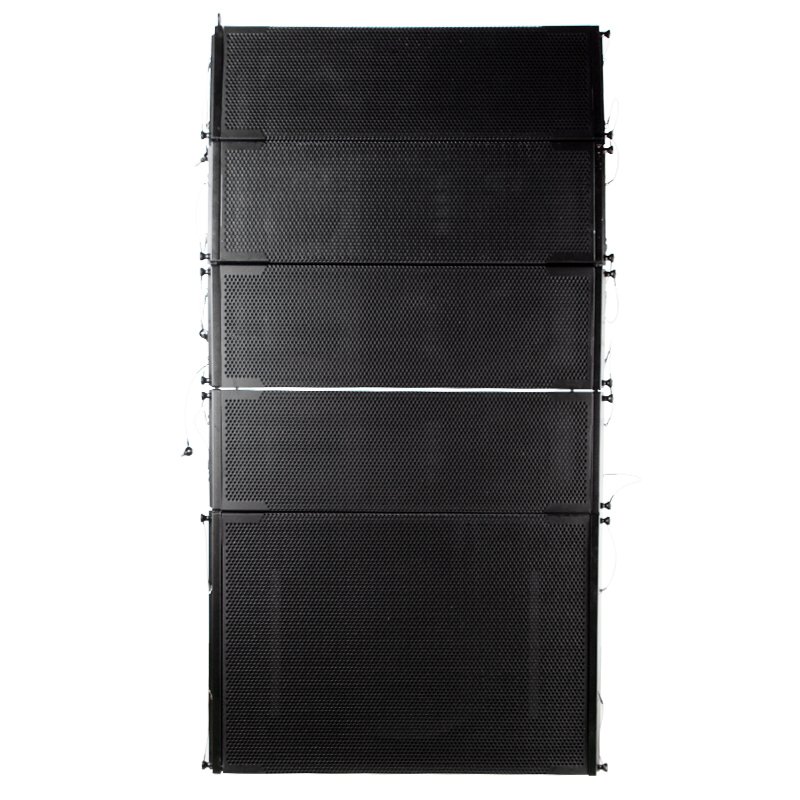
The bundled PL210 line array system is measured as a complete package (four 10-inch array cabinets plus an 18-inch subwoofer) and is published at 90 x 90 (H x V). A system-level figure and a cabinet-level figure are not interchangeable; check which one a supplier is quoting.
Reading the specification sheet
Four lines on a spec sheet survive contact with a real room. Everything else is context.
Amplifier power
Power is published two ways, and both matter. RMS is the figure to use when planning mains distribution and when comparing sustained output; peak describes short-term headroom. The HDL210 and HDL28 are both listed at 700W RMS with a 1400W peak rating. The HDL50-A is listed at 2200W RMS with a 4400W peak. The PL210 system allocates its power across the package: 1000W RMS for the subwoofer and 700W RMS for each of the four array cabinets. Add the RMS figures, not the peak figures, when you size a generator or a distro.
Maximum SPL
This is a single-cabinet reference measured at one metre, not the level you will measure at the back of a 40-metre room. It is useful for comparing cabinets on a common basis and for sanity-checking a design. In the current range the two-way cabinets are published between 130 dB and 131 dB, and the HDL50-A at 140 dB.
Frequency response
This number decides whether the array needs a subwoofer and how much work that subwoofer has to do. The spread across the range is wide: the PL210LA and the PL210 system both run 45Hz-20000Hz, the HDL210 runs 75Hz-20000Hz, the HDL28 runs 85Hz-20000Hz and the HDL26 starts at 95Hz. A cabinet with a 95Hz lower limit hands everything below 95Hz to something else; a cabinet that reaches 45Hz already covers a useful part of the bass range on its own.
Sensitivity and crossover
Sensitivity, expressed in dB, describes how much output the cabinet produces for a given input and is worth reading alongside power rather than instead of it: a high-sensitivity design with a modest amplifier and a low-sensitivity design with a large amplifier can land in a similar place. Published figures here run from 95 dB on the HDL26 to 104 dB on the HDL50-A.
The crossover frequency tells you where the cabinet hands over from the low-frequency section to the high-frequency section. Two-way models in the range are published between 2.0 kHz and 2.1 kHz. The HDL50-A, being a three-way design, publishes two crossover points: 200 Hz and 800 Hz.
Two-way and three-way configurations
A two-way cabinet divides the signal once, between a woofer section and a compression driver on a horn. In this range that means a pair of 6.5-inch, 8-inch or 10-inch woofers paired with a titanium-diaphragm compression driver: 36mm on the PL210LA and HDL26, 51mm on the HDL210 and HDL28.
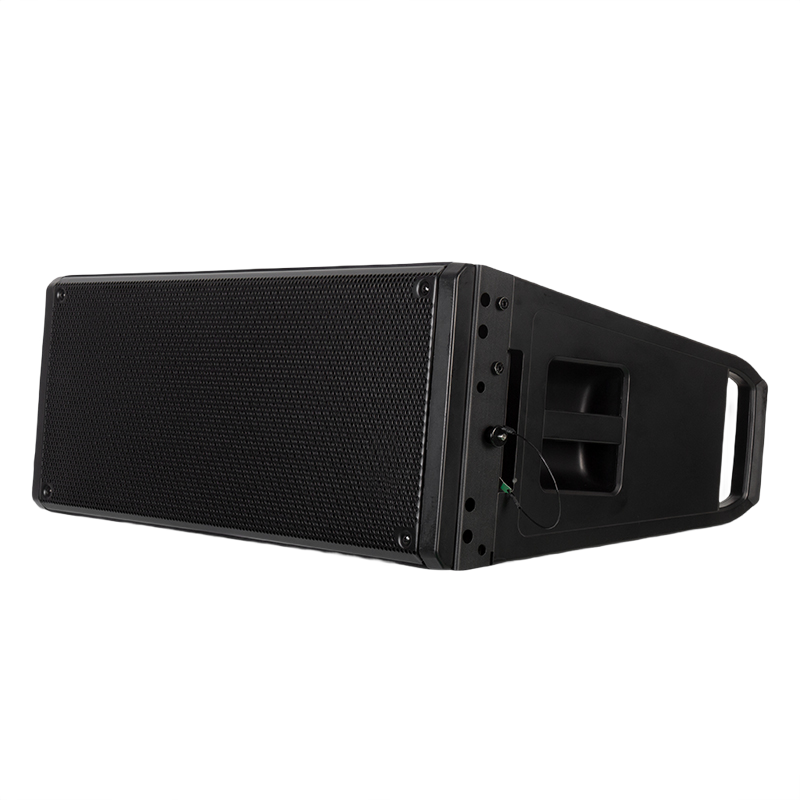
A three-way cabinet divides the signal twice, adding a dedicated midrange section between the woofers and the compression driver. The HDL50-A does this with two 12-inch woofers using 3-inch voice coils on neodymium magnets, four 6.5-inch midrange drivers with 2-inch voice coils, and two 75mm titanium-diaphragm neodymium compression drivers. The extra band exists to keep vocal-range content on drivers sized for it, and it is the reason a three-way cabinet carries more amplifier power and a higher published SPL than a two-way cabinet of similar footprint.
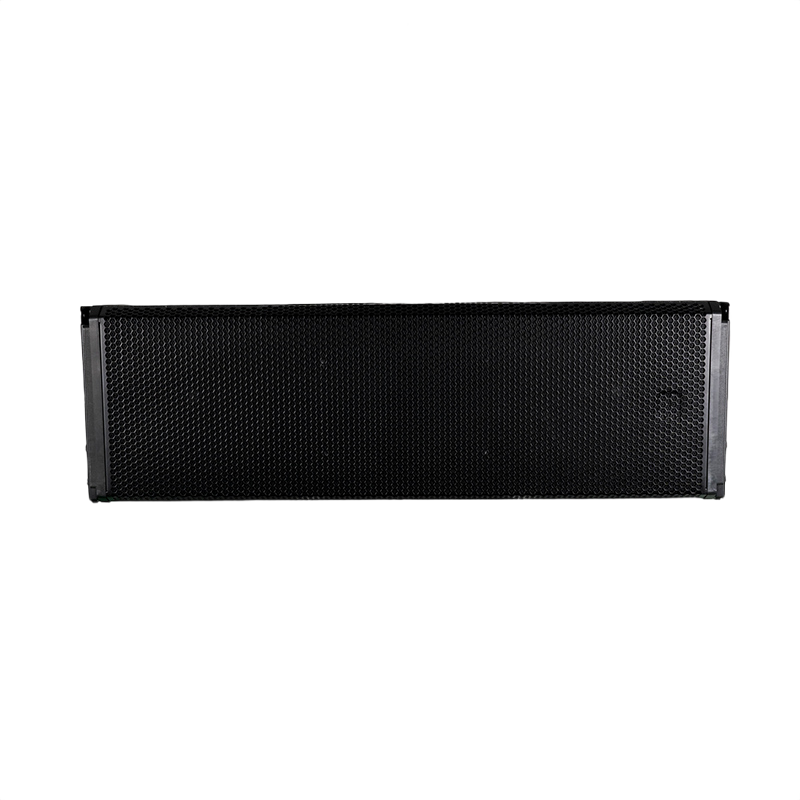
Magnet material is worth a line in the specification, because it affects both cabinet weight and how the driver is engineered. Most cabinets in this range use ferrite magnets: 50 OZ on the HDL210, HDL28 and PL210LA, 40 OZ on the HDL26. The HDL50-A uses neodymium throughout.
Where the subwoofer fits
Every two-way cabinet in this range stops producing useful output somewhere between 45Hz and 95Hz, so the subwoofer is not an accessory: it is half of the system for any programme with bass content. The DS218A dual 18-inch powered subwoofer is published from 35Hz to 180Hz with a 90Hz crossover point, 2000W RMS and 4000W peak, a 131 dB maximum SPL, two female XLR inputs and four male XLR outputs. That output count is what lets one subwoofer feed several array cabinets without a separate distribution box.
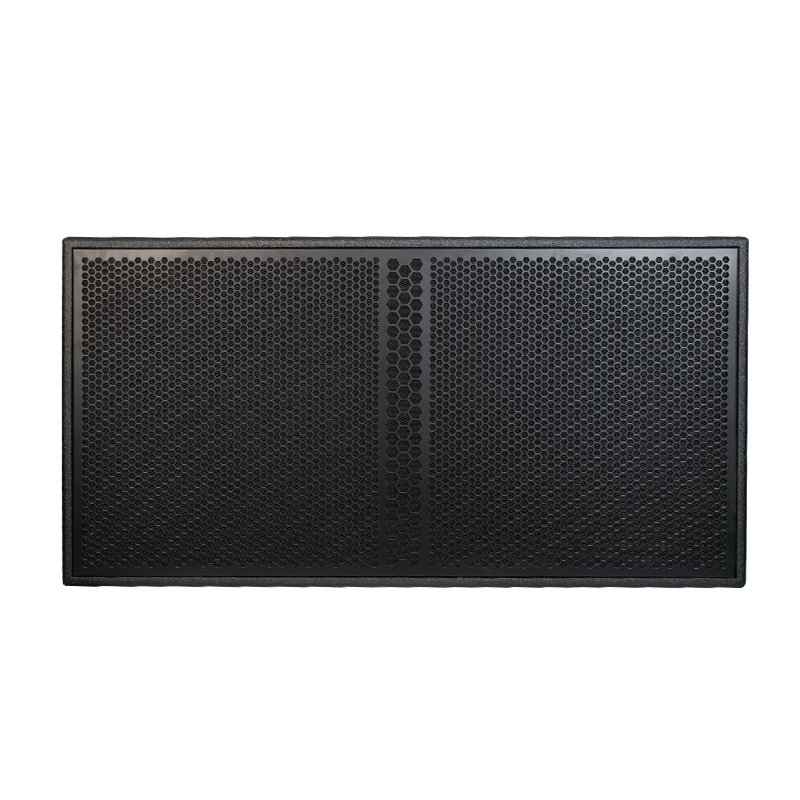
The PL210 takes the guesswork out of the matching by shipping the array and the subwoofer as one package: four 10-inch cabinets and one 18-inch subwoofer with a 4-inch voice coil on a 125 OZ ferrite magnet, in birch plywood with a steel grille.
Specification comparison
| Model | Configuration | Power (RMS / Peak) | Max SPL @ 1 m | Frequency response | Sensitivity | Crossover | Coverage (H x V) | Cabinet |
|---|---|---|---|---|---|---|---|---|
| HDL50-A | Three-way, 2 x 12" + 4 x 6.5" mid, NEO | 2200W / 4400W | 140 dB | 45Hz - 18000Hz | 104 dB | 200Hz, 800Hz | 100 x 10 | PP, steel grille |
| HDL210 | Two-way, 2 x 10", 2.5" v.c., 50 OZ | 700W / 1400W | 131 dB | 75Hz - 20000Hz | 99 dB | 2.0 kHz | 100 x 60 | PP, steel grille |
| HDL28 | Two-way, 2 x 8", 2.5" v.c., 50 OZ | 700W / 1400W | 131 dB | 85Hz - 20000Hz | 98 dB | 2.0 kHz | 100 x 60 | PP, steel grille |
| PL210LA | Two-way, 2 x 10", 2" v.c., 50 OZ | 700W / 1400W | 130 dB | 45Hz - 20000Hz | 98 dB | 2.1 kHz | 100 x 60 | Birch plywood, steel grille |
| HDL26 | Two-way, 2 x 6.5", 2" v.c., 40 OZ | 250W / 500W | 131 dB | 95Hz - 20000Hz | 95 dB | 2.0 kHz | 100 x 60 | PP, steel grille |
| PL210 system | 4 x 10" array + 18" subwoofer | 1000W + 700W x 4 RMS | 130 dB | 45Hz - 20000Hz | 98 dB | Not published for the system | 90 x 90 | Birch plywood, steel grille |
| DS218A | Dual 18" powered subwoofer, 4" v.c., 125 OZ | 2000W / 4000W | 131 dB | 35Hz - 180Hz | 98 dB | 90 Hz | Not applicable | Birch plywood, steel grille |
Sourcing from a China loudspeaker factory: OEM, ODM and sampling
Specification reading and supplier selection are the same exercise. When you approach a China loudspeaker factory for an active line array programme, the questions that separate a usable partner from a catalogue reseller are these:
- Which parts of the design are fixed, and which are configurable? On this range, cabinet colour, logo application, retail packaging including printed colour boxes, and voicing adjustments for a target market or application are all open. Ask for the list in writing before you compare quotations.
- Can the factory work from your reference sample? OEM work can follow a customer's own reference, and the engineering team produces drawings for customer-specific versions where a project needs them. ODM applies where an existing platform does not fit and a purpose-built cabinet is required.
- What are the DSP presets, and can they be changed? The HDL26 publishes four named modes: speech, live music, DJ playback and monitor, selected from the rear panel with LED indication. Other models in the range are listed with four programmable DSP modes. If your market expects a different preset set, say so in the first enquiry, not after the first production run.
- How is the cabinet actually built? Birch plywood and polypropylene behave differently in transport and in service. The PL210LA, the PL210 system and the DS218A use birch plywood with a steel grille; the HDL26, HDL28, HDL210 and HDL50-A use polypropylene with a steel grille. Material choice belongs in the RFQ.
- Can you evaluate before committing? Samples are available, and trial orders are accepted ahead of a full order. Standard trade terms are FOB, CIF, DAP and DDP, settled by TT, LC or credit card.
- What happens when the order grows? Current output for the loudspeaker category runs at approximately 3,000 cabinets each month, and production can be scaled for volume programmes. Ask how a step-up in quantity would be handled before you need it.
Our overview of Audfine active line array models, specifications and OEM options covers the cabinet range in more detail.
Deployment: mounting, transport and cabinet material
Accessories and handling details decide how a system survives its first season in rental. Across this range, two-way cabinets carry two ergonomic side handles and a pole mount line array bracket; the PL210 system carries four. Available accessories include a solid carrying case, a PU carrying bag and a detachable microphone.
On mounting, confirm the method against the specification sheet for the exact model you are ordering. A bracket supplied with one cabinet does not transfer to another, and suspension has requirements that pole mounting does not. Where a venue requires suspension, settle the rigging method and the hardware with the supplier in writing rather than assuming a standard solution applies.
Cabinet material is a transport decision as much as a durability one. Plywood takes impact differently from polypropylene and repairs differently again; for a rental fleet that matters over several years. Weight also drives crew size and vehicle choice, so ask for packed dimensions and net weight alongside the acoustic specification.
Where these systems are deployed
The applications that suit an active line array of this type are professional ones: rental inventories for touring and corporate events, fixed installation in venues and houses of worship, portable systems for event production companies, and distributed systems for regional sound contractors. Sizing a system for a specific capacity is covered separately in our guide to configuring an active line array with subwoofers for a 300 to 500 person venue.
RFQ checklist
Send these with your first enquiry and you will get a usable answer rather than a catalogue:
- Venue or application type: rental, fixed installation, touring or portable production
- Room dimensions, ceiling height and audience format, where relevant
- Programme type: speech, live music, DJ playback or mixed
- Required coverage, and whether the array is pole mounted or suspended
- Whether the low end is covered, and the preferred subwoofer configuration
- Preferred cabinet material, driver size and power class
- Target quantities and destination market
- Branding, packaging and labelling requirements
- Trade terms: FOB, CIF, DAP or DDP
FAQ
What is the difference between an active and a passive line array?
An active cabinet carries its own amplifier, DSP and limiter and accepts a line-level input. A passive cabinet requires external amplification and processing. Active cabinets remove the amplifier rack and the processor from the system, and add a mains requirement at every cabinet position.
Do I need an external processor?
No. Each cabinet in this range carries its own DSP and limiter, with thermal and RMS protection. On the HDL26 the four presets are named: speech, live music, DJ playback and monitor, and selected from the rear panel.
How many cabinets do I need?
Cabinet count follows coverage and distance, not headcount alone. Start from the horizontal coverage figure, the throw distance and the ceiling height, and confirm against the published maximum SPL. Our venue sizing guide walks through the calculation.
Does a three-way cabinet replace a two-way plus a subwoofer?
No. The HDL50-A is published from 45Hz, which still leaves the bottom octaves to a subwoofer for most programme material. A three-way design adds a dedicated midrange band; it does not remove the need for low-frequency support.
Can the same cabinets be pole mounted and flown?
Cabinets in this range are listed with a pole mount line array bracket. Suspension is a separate question: confirm the rigging method and the hardware against the specification sheet for the model you are ordering.
What can be customised on an OEM order?
Cabinet colour, logo application, custom printed packaging and voicing adjustments, with engineering drawings produced for customer-specific versions. OEM work can follow a customer's reference sample, and ODM development is available where an existing platform does not fit.
Can I evaluate before placing a full order?
Yes. Samples are available for evaluation and trial orders are accepted ahead of a full order.
Request a quote or samples
Audfine is the audio brand of Ningbo Lesound Electronics Co., LTD., a professional audio manufacturer and exporter established in 2009 in Ningbo, China, with products exported to over 60 countries. Send your application, target quantities and destination market and we will confirm a configuration, or request a quote and samples to evaluate the HDL50-A, HDL210, HDL28, PL210LA, HDL26, PL210 and DS218A before placing an order. The full range sits under active line arrays.