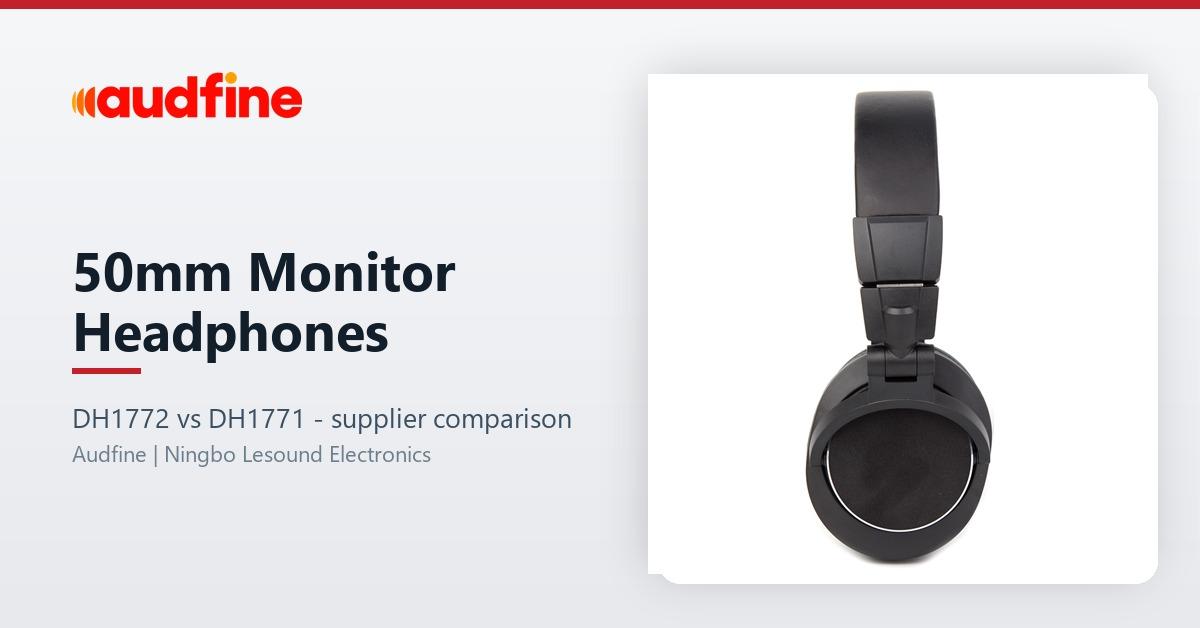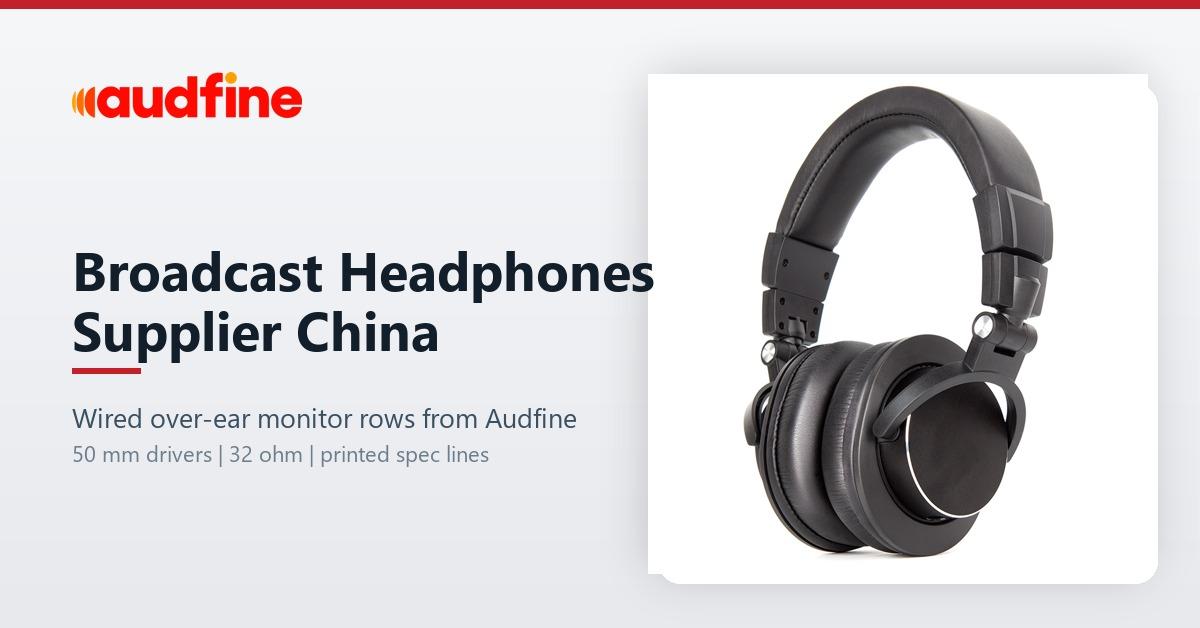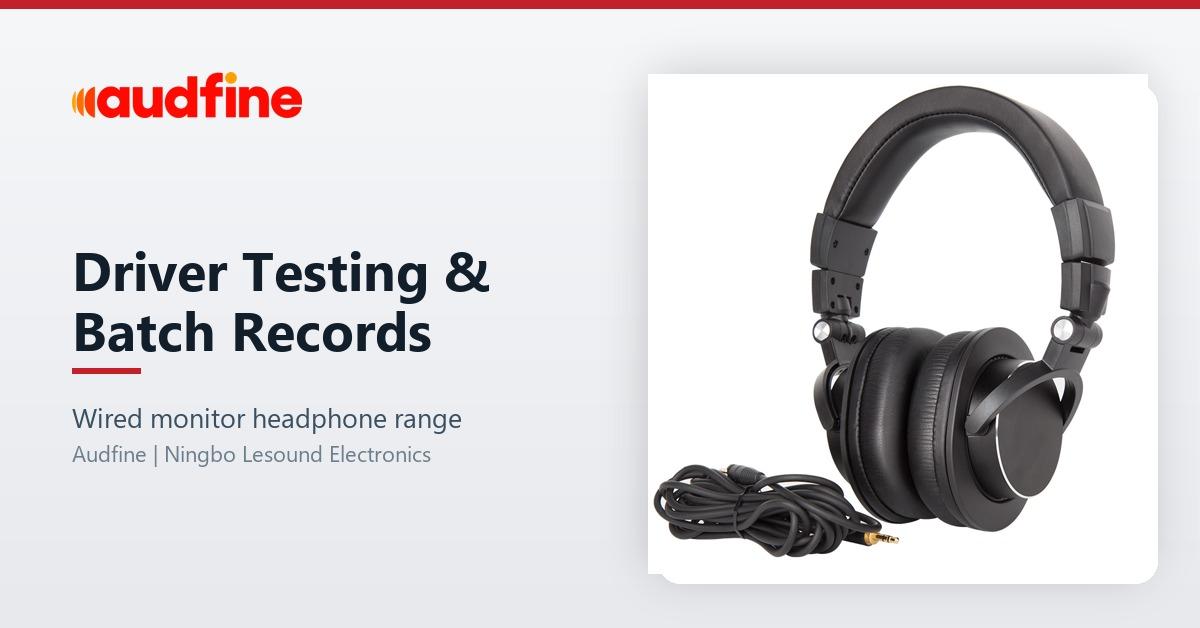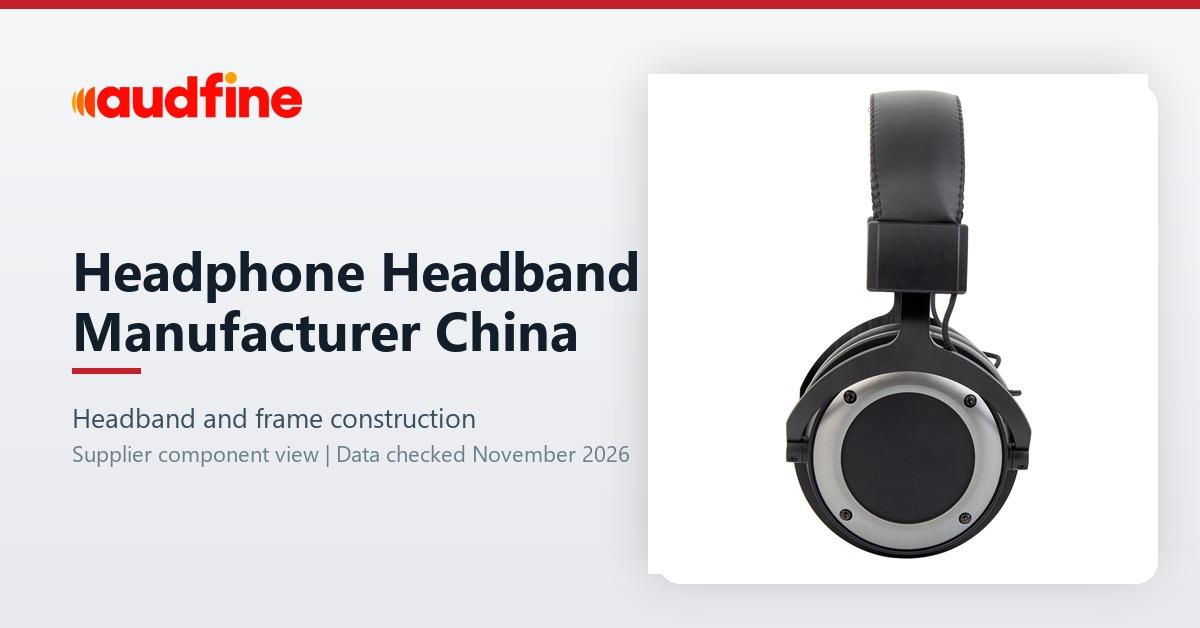
A broadcast headphones supplier China documents wired monitors with a named driver, load and sensitivity on each row. On the Audfine sheet, DH1772 is printed at a 50 mm driver, 32 Ω, 400 mW RMS and 99±3 dB, while DH1771 carries 350 mW at the same 32 Ω load. DH1771K is the open-back version of the DH1771 platform; DH1773 is the open-back row with a fixed cable. Audfine is the headphone brand of Ningbo Lesound Electronics, the manufacturer and brand owner in Ningbo, China. This page reads those rows as a supplier would publish them.

Data checked: November 2026. Source: Audfine headphone product sheet, core-metric and application columns. Driver diameter, load, rated power, sensitivity and frequency range were copied from the named model rows. Rows whose cable description differs between two columns of the source sheet are not quoted here.
What a broadcast headphones supplier China puts on a wired monitor row
A published row has a model name followed by values with units. For a wired over-ear monitor the fields are the voice-coil diameter in millimetres, the load in ohms, the rated power in milliwatts, the sensitivity in decibels and the frequency range in hertz and kilohertz. DH1772 appears as 50 mm, 32 Ω, 400 mW, 99±3 dB and 10 Hz–35 kHz. DH1771 appears as 50 mm, 32 Ω, 350 mW, 98±3 dB and 10 Hz–35 kHz. Those are two rows, not one range with two marketing names.
The application column of the same sheet lists Broadcast for both, alongside Recording, Monitoring, Mixing and Tracking. An application tag says where a factory positions the model; it does not add a specification and it does not grade the model for a job. Our headphone inspection documentation note separates the process checks from the figures published for a row, and the distinction matters here: a buyer can request the row, then evaluate a sample against the work.
Which wired over-ear models are listed for broadcast monitoring?
The table below is copied from the core-metric column of the Audfine sheet. Each model keeps its own line so a value cannot move to a neighbouring row by assumption. Values below are published sheet entries; unlisted fields require RFQ confirmation.
| Model | Driver | Load | RMS power | Sensitivity | Frequency range | Structure |
|---|---|---|---|---|---|---|
| DH1772 | Ø50 mm | 32 Ω | 400 mW | 99±3 dB | 10 Hz–35 kHz | Closed back |
| DH1771 | Ø50 mm | 32 Ω | 350 mW | 98±3 dB | 10 Hz–35 kHz | Closed back |
| DH1771K | Ø50 mm | 32 Ω | 350 mW | 98±3 dB | 10 Hz–35 kHz | Open back |
| DH1773 | Ø50 mm | 32 Ω | 350 mW | 98±3 dB | 10 Hz–36 kHz | Open back |
| DH7100 | Ø50 mm | 32 Ω | 400 mW | 98±3 dB | 8 Hz–38 kHz | Closed back |
Five rows share a 50 mm driver and a 32 Ω load. They do not share a power figure: 400 mW on DH1772 and DH7100, 350 mW on DH1771, DH1771K and DH1773. Frequency coverage differs at the upper end, from 35 kHz on the DH1772 platform to 36 kHz on DH1773 and 38 kHz on DH7100. Our 50 mm driver range note lists which models carry that diameter; the DH1772 factory note keeps one model on one row.
How do I compare closed-back and open-back rows for a broadcast booth?
Keep the electrical fields in the same order and read the structure field last, since it changes how the headphones sit in a room rather than changing the ohms or the milliwatts. DH1771 and DH1771K print the same driver, load, power, sensitivity and frequency range; the closing difference on the sheet is closed back against open back. DH1773 is a separate open-back row with a 10 Hz–36 kHz range and a fixed cable. A comparison that collapses those into "the 50 mm model" has dropped the information a buyer asked for.
The monitoring headphone specification field guide sets out the field order used across the range, and the cable assembly note describes the detachable and fixed options on their own rows. None of these notes turn a published figure into a recommendation for a room; that judgement stays with a listening sample.
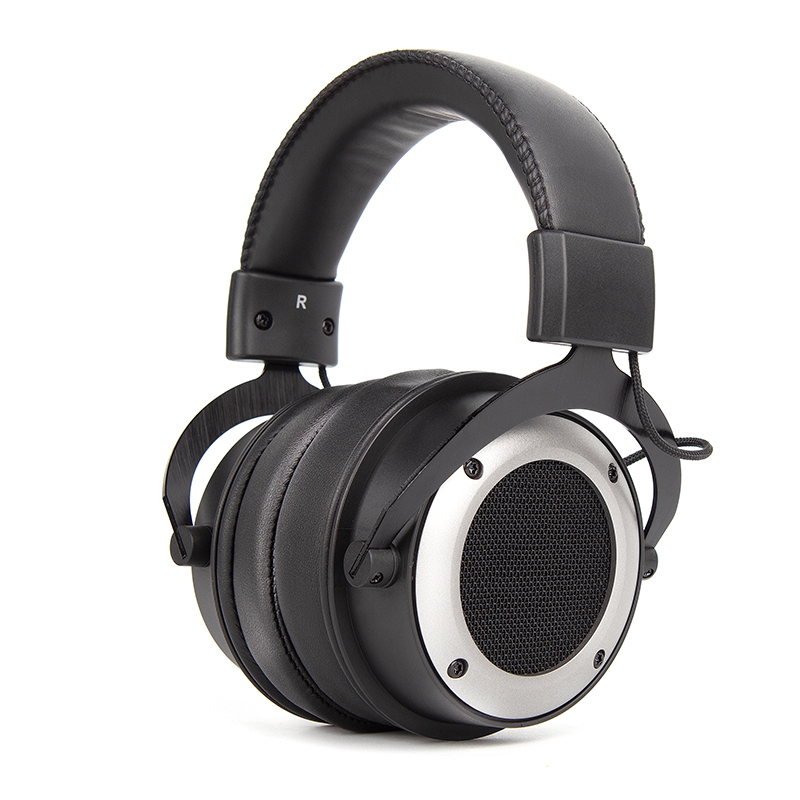
Why does a broadcast supplier name the model before the ohms?
Because a load belongs to a row, not to a platform. The sheet prints DH1772 at 32 Ω and lists higher-impedance versions of the same platform on separate lines; each variant carries its own entry rather than sharing the base figures. Where a model name and a specification column give different ohm figures, we do not state one as settled — confirm in RFQ. A written answer that quotes one load for the whole family is not traceable to any single line, and it cannot be checked against a batch record. Name the model, then the impedance, and ask for the value as printed.
What a published row can and cannot establish
A row states what the factory prints for a model. As defined in the terminology work of the International Electrotechnical Commission, quantities such as frequency range and sensitivity are stated under stated conditions; the Audio Engineering Society maintains measurement vocabulary for audio equipment. These bodies define how a quantity is described. They do not assess this product, and no conformity statement is made here.
That limit is practical. A 10 Hz–35 kHz range on DH1772 and an 8 Hz–38 kHz range on DH7100 are facts from our sheet, not a ranking of the two for a broadcast desk. The Audfine studio monitoring headphone range is the product-side reference for these models. Our driver records note describes how a factory keeps a value attached to its row before shipment.
Which fields should an RFQ name for broadcast monitoring headphones?
Ask for fields, units and a model beside each one. The list below maps a request to a field that exists on the sheet.
- Model first. Write DH1772, DH1771, DH1771K, DH1773 or DH7100. A value from one row does not describe another.
- Driver diameter. Ask for Ø50 mm with the unit attached, as printed against the named model.
- Load and power. Quote 32 Ω with 350 mW or 400 mW as the row prints them; keep the two quantities separate.
- Sensitivity band. Ask for the full band, such as 98±3 dB on DH1771K, rather than a midpoint figure.
- Frequency range. State both ends with units, for example 10 Hz–36 kHz on DH1773, next to the model name.
- Structure and cable. Name closed back or open back, and ask for the cable configuration in writing where the sheet does not state one.
- Unlisted fields. Put them in the enquiry as questions and wait for a written answer.
Can a published row replace a sample evaluation?
No. The row holds the figures the supplier prints and checks against; a sample lets a buyer judge those figures against the actual work. This page does not put one in place of the other. Keep the model name identical across both documents and treat every unlisted field as open until the supplier answers it in writing.
Frequently asked questions
Which models in this list are open back?
DH1771K and DH1773 are printed as open back. DH1772, DH1771 and DH7100 are printed as closed back. All five carry a 50 mm driver and a 32 Ω load; the structure field is the one that separates them in this table.
Do all five rows print the same rated power?
No. DH1772 and DH7100 are printed at 400 mW RMS. DH1771, DH1771K and DH1773 are printed at 350 mW RMS. A shared driver diameter does not make the power figures shared, so the value belongs with its own row.
What is the sensitivity of DH1772?
DH1772 is printed at 99±3 dB. DH1771 and DH1771K are printed at 98±3 dB. The tolerance stays with the model it is printed beside; quoting one band against a different row changes the statement.
Why are two endpoints needed for frequency range?
Because the sheet prints two endpoints for each model. DH7100 runs from 8 Hz to 38 kHz, DH1773 from 10 Hz to 36 kHz and DH1771 from 10 Hz to 35 kHz. One number cannot describe those rows, so an enquiry should carry both ends with units.
Are these headphones wireless or noise cancelling?
No. All 35 headphone variants in our product sheet are wired. Bluetooth, true wireless and active noise cancelling are not listed features of this range. The figures above concern wired monitor models and the printed electrical and dimensional fields for each named row.
When you shortlist a broadcast headphones supplier China line, send the model name, the field order and the units you expect back, and keep every unlisted question open until it is answered in writing. Ningbo Lesound Electronics builds the range under the Audfine brand, and the figures above come from the same sheet used for our product rows. A supplier, distributor or importer comparing two offers gets a usable answer only when both sides quote the same row.