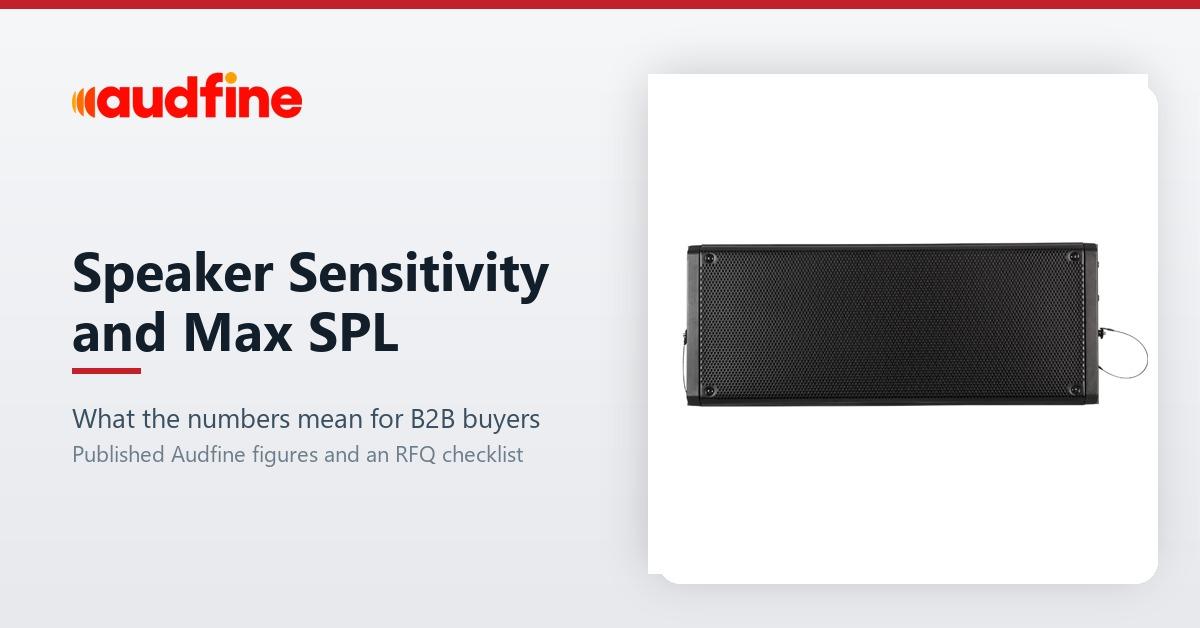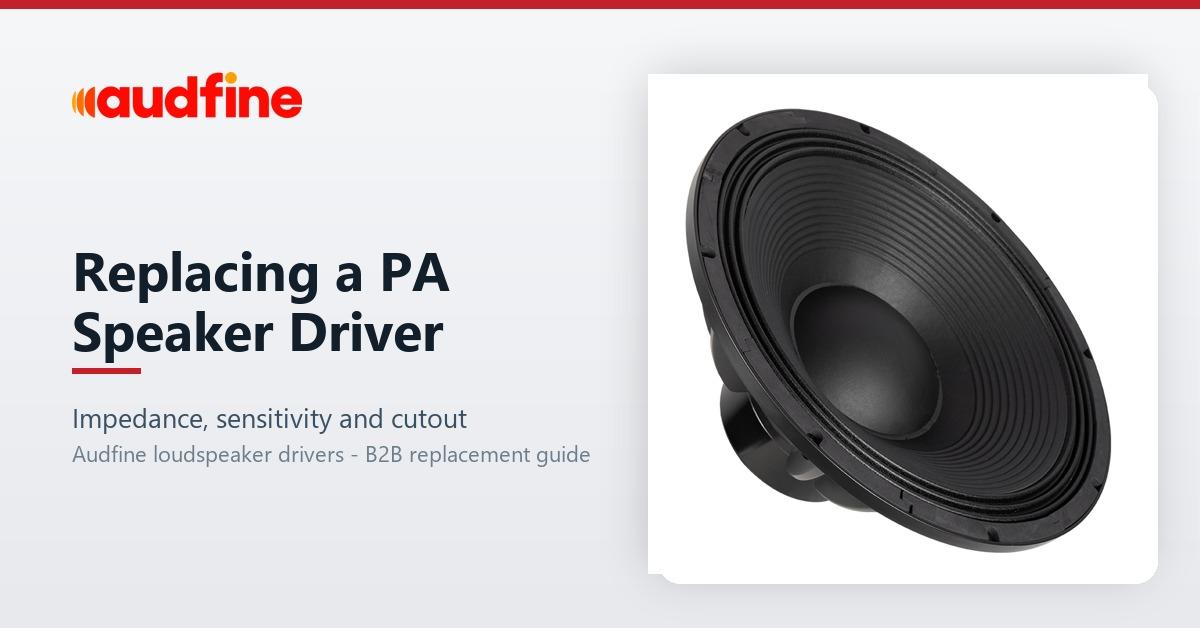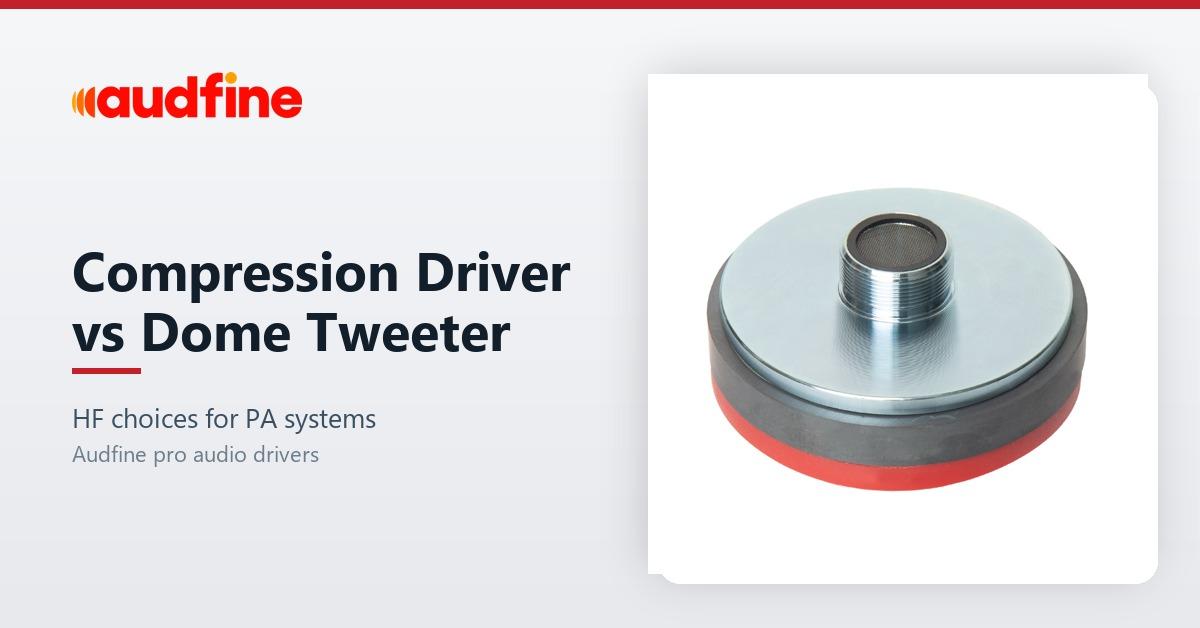
Two figures near the top of every professional loudspeaker data sheet cause more confusion than any others: sensitivity and maximum SPL. Both are printed in decibels, both are normally quoted at one metre, and both get read as "how loud is it". They are not the same measurement, and a buyer who treats them as interchangeable will size a system wrongly — either paying for amplifier power that the room does not need, or specifying cabinets that cannot reach the level the job requires.
This article explains what each figure describes, how the two relate to each other and to amplifier power, and which questions to put to a manufacturer before those numbers are written into a purchase specification. Every cabinet value quoted here is the published figure from the corresponding Audfine product page; the driver values are the published figures from the Audfine transducer pages. Where a reference condition is not printed on the sheet, the article says so rather than assuming one.
What sensitivity actually measures
Sensitivity is an efficiency figure. It states how much sound pressure a cabinet produces at a stated distance for a stated electrical input, so it describes how effectively the cabinet turns amplifier power into acoustic output. Two conventions are in common use across the industry: 1 watt at 1 metre, and 2.83 volts at 1 metre. For an 8-ohm load the two work out to the same number, which is why they appear almost interchangeably on data sheets; for a 4-ohm load they do not. When a sheet prints a bare dB figure without naming the convention, that is the first thing to ask about.
What makes the number useful in buying decisions is the 3 dB rule: doubling the amplifier power delivered to a cabinet raises its output by 3 dB. A cabinet published at 98 dB therefore reaches the same level as one published at 95 dB using roughly half the amplifier power. Across a twelve-box system, or on a site where the available power is limited, that difference decides how many cabinets can be run and how much amplification has to be bought and transported.
It is equally important to be clear about what sensitivity does not tell you. It says nothing about how loud the cabinet can ultimately play, and it says nothing about bandwidth. A figure taken at the peak of the response is not comparable with one averaged across the full operating range, and neither tells you what happens at the low-frequency limit where excursion, not power, becomes the constraint.
What maximum SPL describes
Maximum SPL is the ceiling: the highest level the manufacturer states the cabinet will produce, again normally at one metre. Data sheets differ in two important respects here. The first is which power rating the figure was derived from — the continuous (RMS) rating or the peak rating. The second is whether the number was calculated from sensitivity and power or measured on a finished cabinet. A figure derived from the peak rating will read about 3 dB higher than the same cabinet's figure derived from the continuous rating, which is enough to distort a comparison between two sheets that look otherwise similar.
Peak versus continuous also matters for how the system behaves in use. The peak figure describes short transients. Sustained programme material sits below it, because a voice coil that heats up loses output — the effect generally referred to as power compression — and because the limiter inside an active cabinet exists specifically to hold the transducer inside its thermal and mechanical limits.
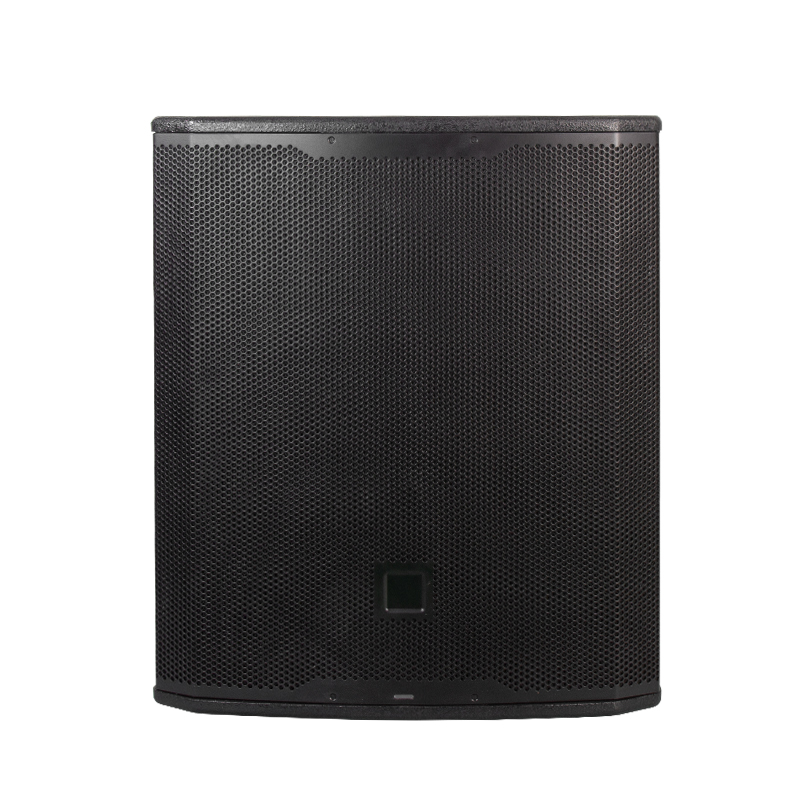
Distance matters more than most spec sheets acknowledge. Under free-field conditions, level falls by roughly 6 dB each time the distance doubles, so a cabinet published at 131 dB at 1 metre works out at about 125 dB at 2 m and 119 dB at 4 m. Real rooms add boundary gain, and a properly coupled array of several cabinets behaves differently again, so treat the arithmetic as a planning estimate rather than a prediction.
How the two figures relate: reading a sheet end to end
The practical check is whether sensitivity, power and maximum SPL are consistent with one another. The relationship is logarithmic: output equals sensitivity plus ten times the logarithm of the power ratio. Applying it to three published examples from the Audfine range:
- NX-915 — 97 dB sensitivity with 400 W RMS: 97 + 10 log10(400) ≈ 123 dB, which is the published maximum SPL figure.
- PRX918 — 98 dB sensitivity with 2000 W peak: 98 + 10 log10(2000) ≈ 131 dB, again the published figure.
- HDL50-A — 104 dB sensitivity with 4400 W peak: 104 + 10 log10(4400) ≈ 140 dB, the published figure.
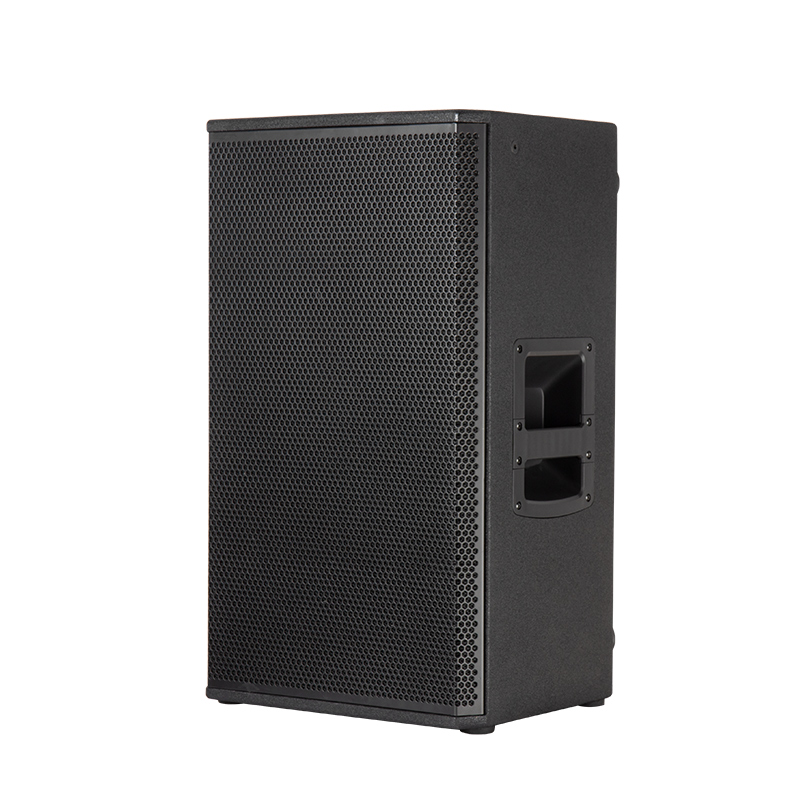
Where the arithmetic and the printed number differ, the printed number is the one to specify: it is the figure the manufacturer publishes for that model. The difference is usually explained by the limiter threshold, by excursion limits at the bottom of the band, or by a sensitivity figure averaged across a wider range than the peak of the response. In every case the question worth asking is which power rating the SPL figure was derived from. The full sheets for the NX-915 15-inch active PA speaker, the PRX918 18-inch active subwoofer and the HDL50-A powered line array speaker each carry all three figures together.
Sensitivity at driver level: why woofers and compression drivers read so differently
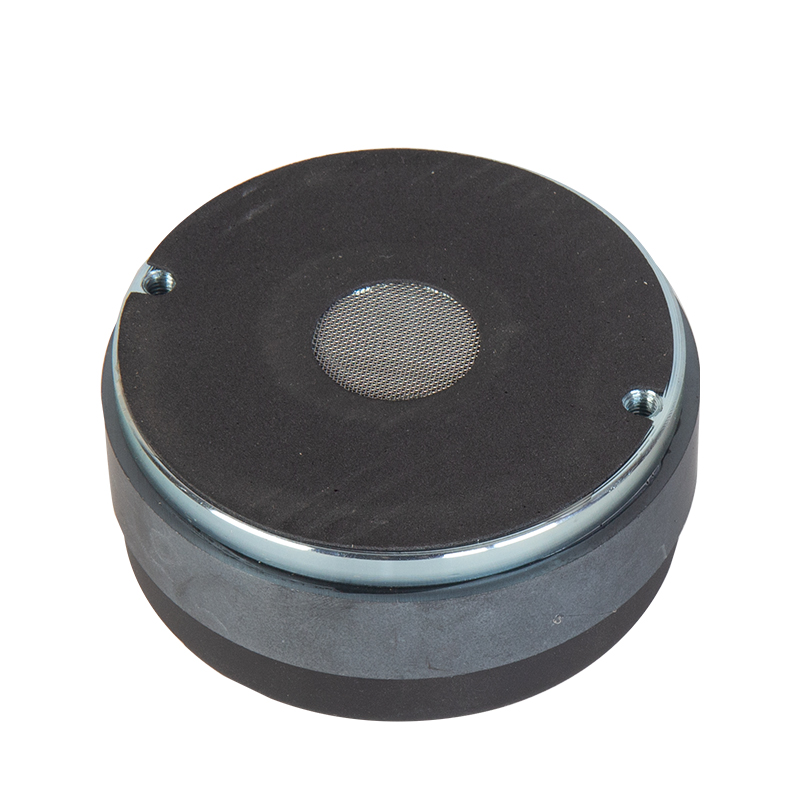
The same two figures appear on transducer sheets, with one important difference in scale. A compression driver working into a horn is a far more efficient device than a direct-radiating cone. Across the published Audfine range the woofers read between 95 dB and 98 dB, while the compression drivers read 106 dB and 110 dB — a gap of roughly 10 dB or more; the CD3601 1.42-inch compression driver is published at 106 dB with a 50 W RMS rating, against 95 dB to 98 dB for the cone drivers.
That gap is why a passive two-way cabinet is never simply a crossover and two drivers wired straight to it. The high-frequency section is attenuated, normally by a resistor network in the crossover, until its level matches the woofer. It is also why sensitivity is one of the four items that must match when a transducer is replaced: fit a replacement with a different sensitivity and the balance of the cabinet shifts, whether or not the impedance and the frame are correct. The fundamentals behind these numbers are covered in more detail in our guide to woofers, tweeters and compression drivers.
Published sensitivity and maximum SPL across the Audfine range
The table below collects the two figures as they appear on each product page, together with the power rating and frequency response printed alongside them. Values are reproduced exactly as published; the sensitivity reference condition is not printed on the sheets and should be confirmed at enquiry stage.
| Model | Type | Sensitivity | Max SPL @ 1 m | Power | Frequency response |
|---|---|---|---|---|---|
| HDL50-A | Three-way powered line array | 104dB | 140 dB | 2200W RMS, 4400W Peak | 45Hz - 18000Hz |
| HDL210 | Active line array (2 x 10") | 99 dB | 131 dB | 700W RMS, 1400W Peak | 75Hz - 20000Hz |
| HDL28 | Active line array (2 x 8") | 98 dB | 131 dB | 700W RMS, 1400W Peak | 85Hz - 20000Hz |
| HDL26 | Active line array (2 x 6.5") | 95 dB | 131 dB | 250W RMS, 500W Peak | 95Hz - 20000Hz |
| PL210 | Active line array system | 98 dB | 130 dB | 1000W+700W*4 RMS | 45Hz - 20000Hz |
| PRX918 | Active subwoofer (18") | 98dB | 131 dB | 1000W RMS, 2000W Peak | 35Hz - 180Hz |
| SUB-8003 | Active subwoofer (18") | 98dB | 131 dB | 1000W RMS, 2000W Peak | 35Hz - 180Hz |
| DS218A | Active subwoofer (dual 18") | 98dB | 131 dB | 2000W RMS, 4000W Peak | 35Hz - 180Hz |
| HD-15A | Powered loudspeaker (15") | 96dB | 123 dB | 400W RMS, 800W Peak | 45Hz - 20000Hz |
| EON-915 | Active PA speaker (15") | 95dB | 123 dB | 700W RMS, 1400W Peak | 45Hz - 20000Hz |
| EON-715 | Active PA speaker (15") | 95dB | 123 dB | 700W RMS, 1400W Peak | 45Hz - 20000Hz |
| NX-915 | Powered loudspeaker (15") | 97dB | 123 dB | 400W RMS, 800W Peak | 45Hz - 20000Hz |
| LSA-15A | Powered loudspeaker (15") | 95dB | 123 dB | 400W RMS, 800W Peak | 45Hz - 20000Hz |
| LSA-12A | Powered loudspeaker (12") | 95dB | 121 dB | 400W RMS, 800W Peak | 50Hz - 20000Hz |
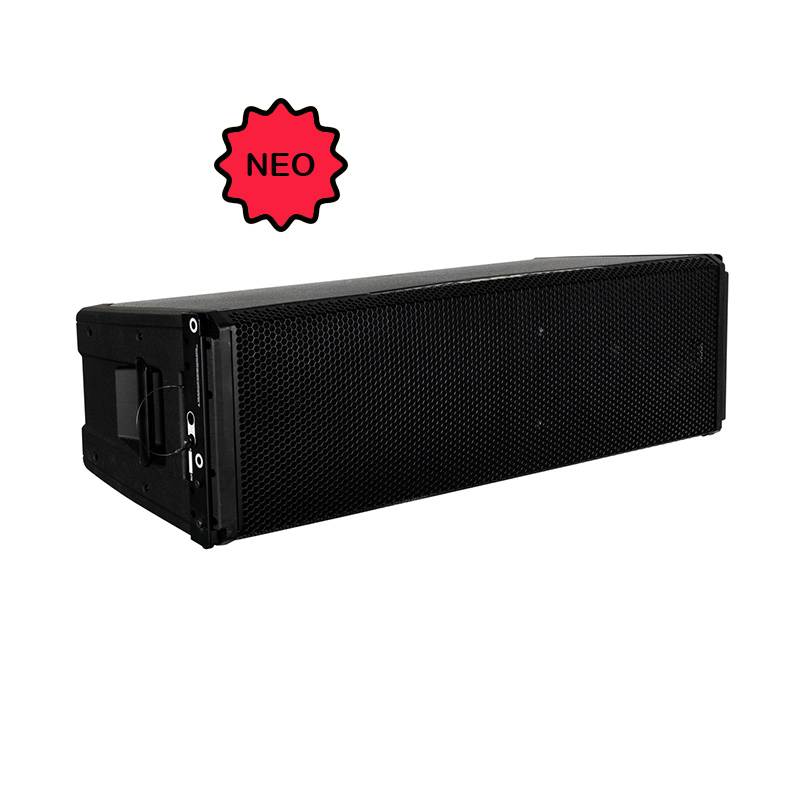
Two things are worth reading across the rows. First, the five active line array models span 95 dB to 104 dB, so the amplifier budget for a given target level is not the same across the family even where the cabinets are used together. Second, the subwoofers cluster at 98 dB and 131 dB, but the power needed to reach that figure varies with the enclosure: a single 18-inch cabinet and a dual 18-inch cabinet reach the same published ceiling from different amplifier channels. System-level questions of that kind are dealt with in the active PA speaker system buyer guide and the active line array technical guide.
Published driver sensitivity: woofers and compression drivers
For buyers specifying transducers rather than finished cabinets, the sensitivity column is the first filter. The published Audfine woofers and compression drivers are listed below with the power and bandwidth printed on the same sheet.
| Model | Size / throat | Sensitivity | Power | Frequency response |
|---|---|---|---|---|
| 10NDL88 | 10" | 96 dB | 500W RMS, 1000W Peak | 60Hz - 2500Hz |
| PW127560A | 12" | 95 dB | 300W RMS, 600W Peak | 55Hz - 2500Hz |
| 12BH300 | 12" | 97.5 dB | 400W RMS, 800W Peak | 55Hz - 5000Hz |
| 12BHP300 | 12" | 97.5 dB | 400W RMS, 800W Peak | 55Hz - 5000Hz |
| 12NLD88 | 12" | 98 dB | 700W RMS, 1400W Peak | 50Hz - 3000Hz |
| 15X600M | 15" | 98 dB | 600W RMS, 1200W Peak | 45Hz - 3000Hz |
| 15NDL100 | 15" | 98 dB | 800W RMS, 1600W Peak | 45Hz - 3000Hz |
| 15DS115 | 15" | 97 dB | 1600W RMS, 3200W Peak | 35Hz - 1000Hz |
| 18SW115 | 18" | 96 dB | 1600W RMS, 3200W Peak | 30Hz - 1000Hz |
| 18BHP401DM | 18" | 98 dB | 1500W RMS, 3000W Peak | 30Hz - 2000Hz |
| 18BH401DM | 18" | 98 dB | 1500W RMS, 3000W Peak | 30Hz - 2000Hz |
| 18BHP501ND | 18" | 98 dB | 2000W RMS, 4000W Peak | 30Hz - 1250Hz |
| 21SW152 | 21" | 96 dB | 2000W RMS, 4000W Peak | 30Hz - 1000Hz |
| CD3601 | 1"/25 mm Throat throat | 106 dB | 50W RMS, 100W Peak | 1500 Hz - 18 KHz |
| BH450 | 1"/25 mm Throat throat | 110 dB | 60W RMS, 120W Peak | 1200 Hz - 20 KHz |
| BH453 | 1"/25 mm Throat throat | 110 dB | 60W RMS, 120W Peak | 1200 Hz - 20 KHz |
What to specify when you source from a China loudspeaker manufacturer
A decibel figure on a data sheet is only useful to a factory if the enquiry states the conditions behind it. For buyers preparing an RFQ to a professional speaker manufacturer in China, the following items turn the two numbers into something a supplier can quote and build against:
- Name the reference. State whether sensitivity is required at 1 W/1 m or 2.83 V/1 m, and the nominal impedance the figure applies to.
- Name the bandwidth. Ask whether the figure is a single peak value or an average across a stated range, and ask for that range in hertz.
- Ask how the SPL figure was obtained. Calculated from sensitivity and power, or measured on a cabinet — and if calculated, whether the RMS or the peak rating was used.
- Set a tolerance. A stated tolerance (±1 dB or ±2 dB) is what makes the figure verifiable on incoming samples.
- Give the target at the listening distance, not at 1 m. State the level required at the back row and the throw distance, so the manufacturer can work back to a cabinet count.
- Give the amplifier power available per channel. Sensitivity and available power together determine whether a shortlist model reaches the target.
- For active cabinets, ask what the internal DSP limiter does. The threshold setting largely determines how much of the published peak figure is usable on programme material.
- For OEM and private-label programmes, state whether published figures must be reproduced. Ask for sample units and measurement data before a production run is scheduled.
Frequently asked questions
Is a higher sensitivity figure always the right choice?
Not by itself. A higher figure means less amplifier power for the same level, which matters where power is limited or where many cabinets share one amplifier. It says nothing about bandwidth, about how low the cabinet plays, or about how much output is available before the limiter intervenes. Read it together with the frequency response and the power rating.
Can maximum SPL figures be compared between two suppliers?
Only if both were obtained the same way. A figure calculated from the peak power rating will read about 3 dB above one calculated from the continuous rating for the same cabinet. Ask each supplier which rating was used and whether the number was measured or calculated before comparing.
How much amplifier power does a cabinet need?
Work from the target level rather than from the cabinet. Every doubling of power adds 3 dB, so moving from a 95 dB cabinet to a 98 dB one is equivalent to halving the amplifier power for the same output. Where the target is fixed, sensitivity decides the amplifier specification.
Do these figures change when several cabinets are used together?
Yes. Closely coupled cabinets radiating the same low-frequency content add level, while adjacent cabinets covering different parts of the band do not add in the same way. Published single-cabinet figures are the starting point, not the array result — which is why array configurations should be specified with the manufacturer rather than extrapolated.
Where can I get the reference conditions for the Audfine figures?
Published values are reproduced on each product page. Where a sheet does not print the measurement convention or the derivation of the SPL figure, send the model number with your enquiry and the engineering team will confirm it, together with dimensional data and sample availability.
Conclusion
Sensitivity tells you how efficiently a cabinet turns amplifier power into output; maximum SPL tells you how far that output goes before the manufacturer's stated limit is reached. Read the first against your amplifier budget, read the second against the level you need at the listening distance, and confirm the reference behind both before they go into a specification. The published Audfine figures above give buyers a consistent set of numbers to compare within the range and to quote back at enquiry stage.
For model-specific measurements, sample units or an OEM enquiry, contact the Audfine engineering team with your target level and throw distance.