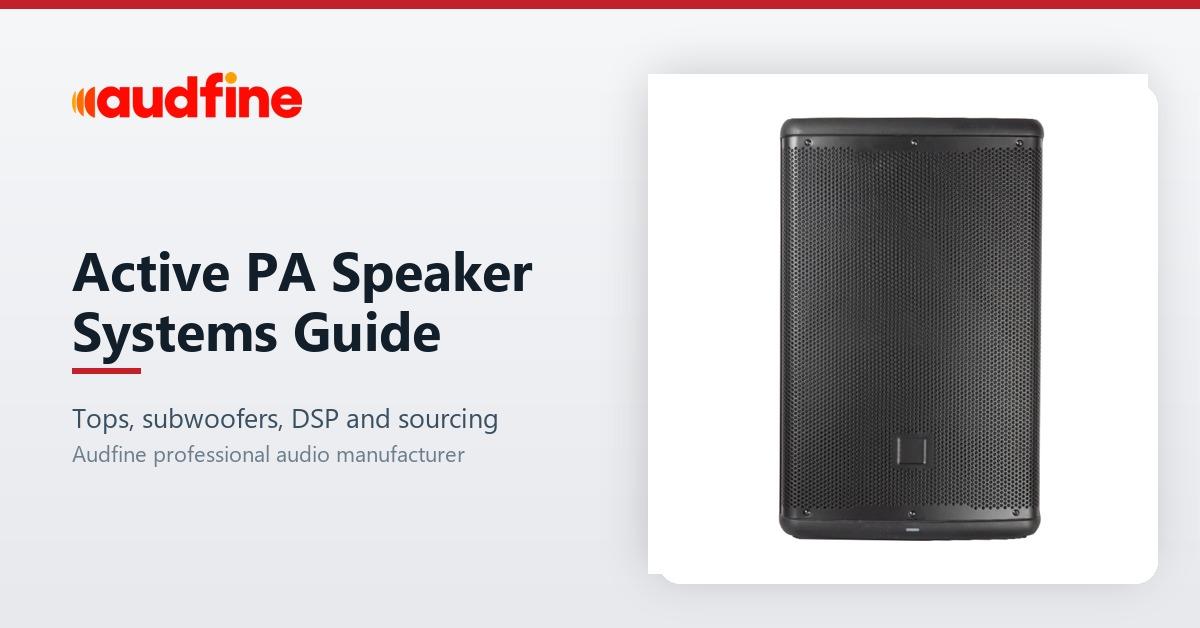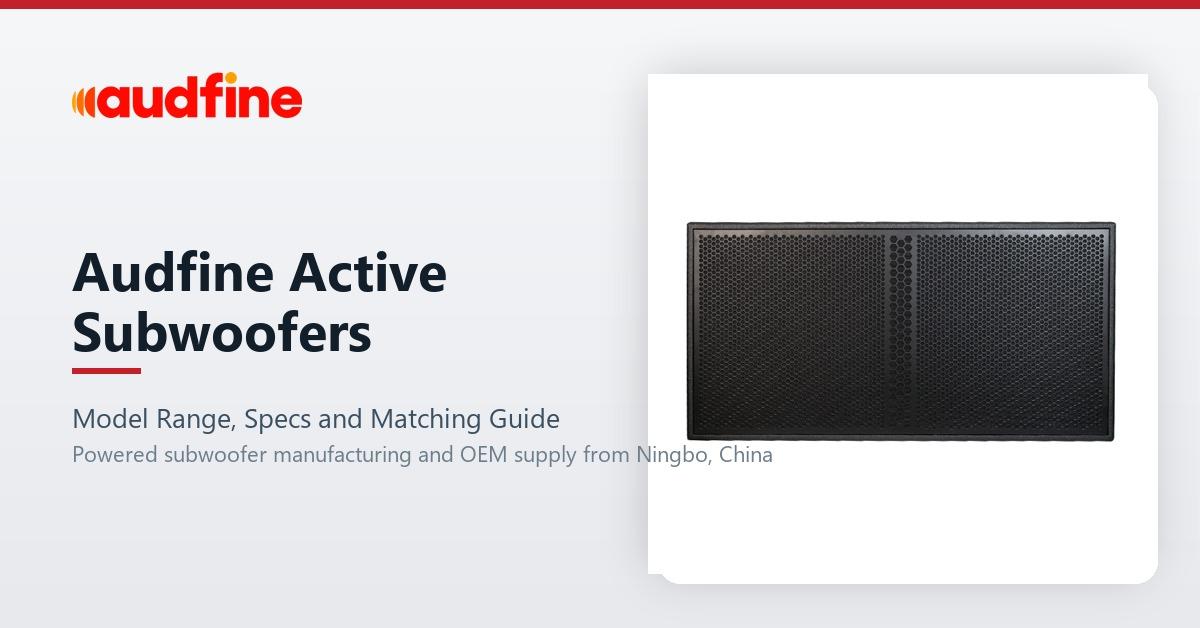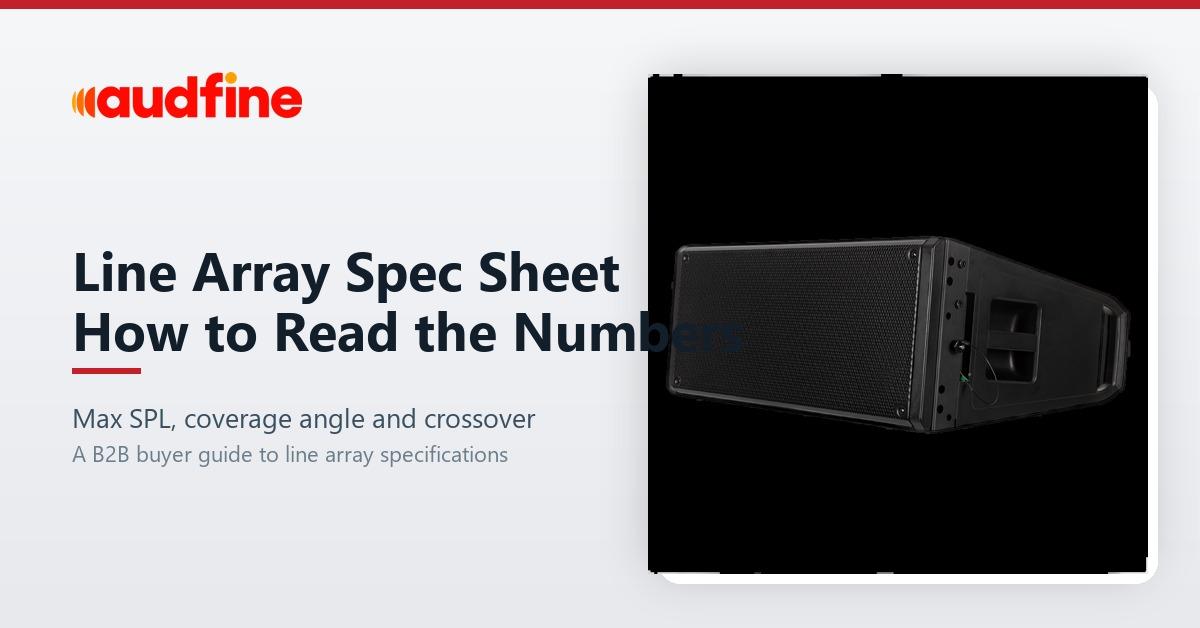
Active PA Speaker Systems: A Complete Guide for B2B Buyers
An active PA speaker system is specified where acoustics, amplifier topology, cabinet mechanics and daily logistics meet. For a distributor building a catalogue, a rental company refreshing an inventory, or a contractor writing an installed system, the decision is rarely about one cabinet. It is about whether the full-range tops and the subwoofers work together as a single system, whether the published figures can be compared across a range, and whether a factory can hold a specification steady across repeat orders.
This guide sets out how an active PA system is assembled, which published figures answer which question, and how the current Audfine range is specified. Audfine is the brand of Ningbo Lesound Electronics Co., LTD., a professional audio manufacturer and exporter established in 2009 in Ningbo, China. The product range covers speakers, speaker transducers, headphones, studio equipment and professional audio accessories, and the factory works with overseas brands on an OEM and ODM basis.
What counts as an active PA speaker system
In an active system each cabinet carries its own amplifier and, in most current designs, its own signal processing. Three consequences follow from that, and they shape the rest of the buying conversation.
The amplifier is matched to the driver by the manufacturer. The power figure printed on a specification sheet describes the amplifier module and the driver working together, not the driver in isolation. That is why two cabinets built around a 15-inch woofer with a 3-inch voice coil can publish very different power figures, and why the figure cannot be read as a proxy for how the cabinet will behave in a room.
The signal chain gets shorter. There is no separate amplifier rack, no speaker cable run to calculate, and no cross-brand matching of amplifier to passive load. For rental fleets and mobile operators this reduces the number of items that have to be packed, checked and re-connected on every job.
The cabinet list becomes the inventory list. Once the amplifier lives inside the box, spare capacity is a spare cabinet rather than a spare amplifier channel. Buyers who plan a fleet over several seasons tend to standardise on one or two cabinet families so that any box can substitute for any other.
Amplifier class and power rating: what the numbers describe
Every active cabinet in the range publishes both an RMS figure and a peak figure. RMS describes continuous capability, which is the number that matters when a system runs a full programme for hours. Peak describes short-term capability on transients. Reading one without the other is the most common way a specification gets misread.
Two amplifier topologies appear across the current range, and both are documented on the relevant product pages:
Class-D digital amplifier. This is the topology used in the EON-915, EON-715, NX-915, LSA-15A and LSA-12A full-range cabinets and in all three powered subwoofers. The product documentation for the DS218A describes a Class-D digital amplifier as known for its high efficiency and its ability to deliver powerful output while keeping the design compact.
Class-H amplifier. The HD-15A is specified with a Class-H amplifier at 400 W RMS and 800 W peak. Its published output ceiling, 123 dB max SPL at 1 m, is the same figure published by the 15-inch Class-D cabinets in the range.
What this means for a buyer is straightforward: amplifier class tells you how the power module is implemented, while the RMS and peak figures tell you what the cabinet can sustain. The choice between them is normally driven by which cabinet the rest of the system is built around, and by what the destination market's service network is equipped to support.
Full-range tops: driver size, crossover and coverage
The top cabinet carries everything above the subwoofer crossover. Four published fields describe it: the woofer, the high-frequency driver, the crossover frequency and the coverage angle.
Woofer. Five of the six full-range cabinets in the range are built around a 15-inch woofer; the LSA-12A is built around a 12-inch woofer. Voice coil diameter and magnet weight vary within the 15-inch group: the HD-15A and NX-915 use a 3-inch voice coil with an 80 OZ ferrite magnet, the EON-915 and EON-715 use a 3-inch voice coil with a 60 OZ ferrite magnet, and the LSA-15A uses a 2-inch voice coil with a 60 OZ magnet.
High-frequency driver. All six use a titanium diaphragm compression driver, specified as 44 mm. This is the professional convention for a horn-loaded compression driver and is distinct from the dome tweeter used in consumer cabinets.
Crossover frequency. Five of the six publish a 2.0 kHz crossover. The NX-915 publishes 1.8 kHz. The crossover is the point at which the woofer hands over to the compression driver, and it is a fixed design parameter rather than a tunable setting on these cabinets.
Coverage angle. All six full-range cabinets publish 100° horizontal by 60° vertical. A consistent coverage pattern across a range is what allows a buyer to mix a 12-inch cabinet and a 15-inch cabinet in one system without re-aiming the whole array, and it is a practical argument for standardising on a single family.
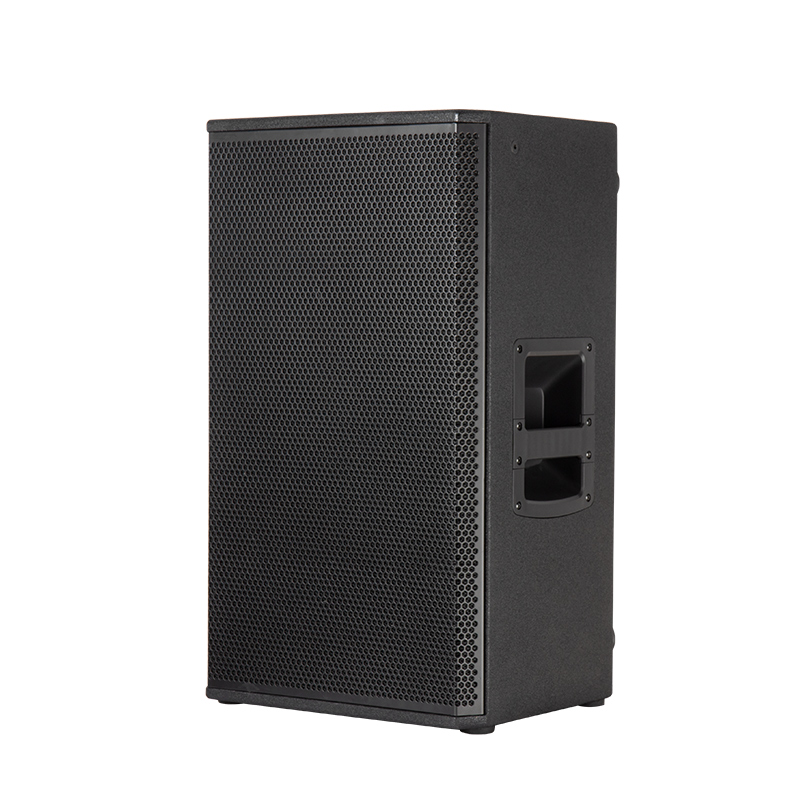
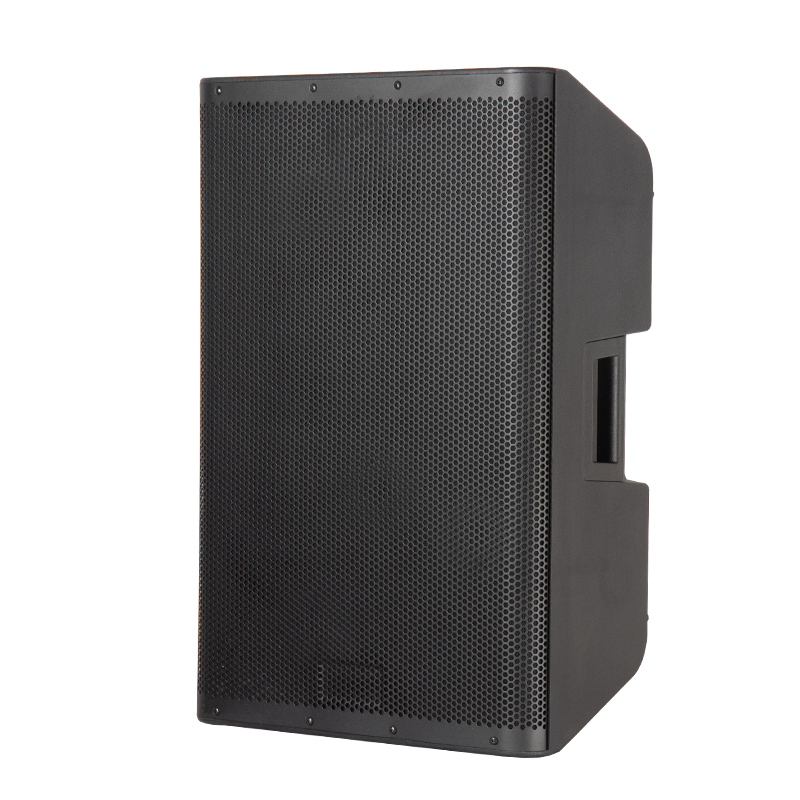
The current full-range selection is listed on the active speakers category page; individual model pages such as the NX-915 15-inch powered loudspeaker carry the full specification block, connector layout and cabinet details.
Where the low end comes from: subwoofers and crossover frequency
A 15-inch top cabinet publishes a frequency response from 45 Hz, and the 12-inch LSA-12A from 50 Hz. Dance music, playback-heavy programmes and most live reinforcement ask for more energy below that point than a full-range box is designed to deliver on its own. That is what the subwoofer is for.
All three powered subwoofers in the range publish 35 Hz to 180 Hz, 131 dB max SPL at 1 m and 98 dB sensitivity. They differ in driver count, power and output topology:
- PRX918 — single 18-inch driver with a 4-inch voice coil and 125 OZ magnet, 1000 W RMS and 2000 W peak, MDF wood cabinet with steel grille, Combo×2 in and male XLR×2 out, a 35 mm pole mount, and a programmable DSP with an LCD screen.
- SUB-8003 — the same single 18-inch electrical specification as the PRX918, in a birch plywood cabinet with steel grille, also with a 35 mm pole mount.
- DS218A — a dual 18-inch cabinet, 2000 W RMS and 4000 W peak, with a 90 Hz crossover, female XLR×2 in and male XLR×4 out, four side handles and no pole mount. The product page states that this model is designed for use in line-array systems.

The 35 Hz to 180 Hz published band is the practical anchor for the whole low-frequency conversation: it tells a buyer where the subwoofer stops, and therefore where the top cabinet has to take over. The active subwoofers category page lists the current models, and the DS218A product page documents the full specification and the line-array application note.
Onboard DSP, limiting and protection
Processing is part of an active cabinet rather than an accessory to it. Three fields on the specification sheet describe what is built in.
Mixer and DSP function. The Class-D cabinets in the range publish DSP and limiter functions; the DS218A documentation describes a built-in DSP with four modes for different applications, covering live music, DJ use and speech reinforcement. On the HD-15A the control set is published as EQ and volume rather than as a DSP mode list, which is the main practical difference in how the two groups are operated on site.
Limiting. A limiter is what keeps a driver inside its working range when the input runs hotter than expected. It is a protection function rather than a tonal one, and its presence is a standard field on these specification sheets.
Protection. All models in the range publish thermal and RMS protection. Thermal protection responds to heat build-up in the amplifier module; RMS protection responds to sustained signal level. Both are specified by the manufacturer as part of the power module, not as user-adjustable settings.
Cabinet material, handles and pole mount: the rental and install reality
Two cabinet materials appear in the range, and the difference is mostly about how the box is used rather than how it is specified acoustically.
PP cabinet with steel grille. Used on the HD-15A, EON-915 and EON-715. Polypropylene cabinets are moulded rather than assembled from sheet material, which suits mobile use where cabinets are loaded and unloaded repeatedly.
Birch plywood with steel grille. Used on the NX-915, LSA-15A, LSA-12A, the SUB-8003 and the DS218A. The PRX918 is specified with an MDF wood cabinet and steel grille. Plywood construction is the convention for cabinets that are flown, stacked or built into a permanent installation.
Handles. Handle count and position are published for every model and they matter more than they look on paper. The HD-15A, EON-915 and EON-715 publish a top handle, which suits single-person carry over a short distance; the NX-915, LSA-15A and LSA-12A publish two side handles only. The DS218A publishes four side handles for a dual 18-inch cabinet.
Pole mount. Most models publish a 35 mm insert. The HD-15A publishes no pole mount, and the EON-915 specification refers to the mounting as shown in the product figure. This is a field worth confirming early, because it decides whether a cabinet can be used on a stand or only stacked or flown.
Connectors, signal chain and mains
Connector layout is where a system design either stays simple or becomes a cabling exercise. The range uses a consistent pattern: a balanced input, a mixed or consumer-format auxiliary input where fitted, and a male XLR output for linking to the next cabinet.
The HD-15A publishes a female XLR and a 6.35 mm jack input. The EON-915, EON-715, NX-915, LSA-15A and LSA-12A publish a Combo input with a 3.5 mm jack; the NX-915, LSA-15A and LSA-12A add an RCA L/R pair. All full-range models publish a single male XLR output. The PRX918 and SUB-8003 publish Combo×2 in and male XLR×2 out; the DS218A publishes female XLR×2 in and male XLR×4 out.
On mains, every model in the range publishes AC 110V to 220V. For a distributor shipping into more than one region, a universal mains input removes a stock-keeping unit from the catalogue and removes a failure mode from the installation.
Four deployment patterns and the figures behind them
System design is a decision about coverage and headroom, and those two questions can be answered from published figures without any listening test.
Single-box speech and playback. Where one cabinet per side covers a small audience on a stand, the questions are pole mount availability, coverage angle and whether the programme needs low-frequency support. A cabinet with no pole mount, such as the HD-15A, has to be stacked or flown instead.
Tops over subwoofers for playback-led work. The 35 Hz to 180 Hz subwoofer band and the 45 Hz floor of the 15-inch tops define the handover. The number of subwoofers is set by the audience area and the programme, not by the number of tops.
Distributed fill in a wide room. A consistent 100° by 60° coverage pattern across the range is what makes a distributed design predictable. Where the 12-inch LSA-12A is used as fill, its 121 dB published ceiling and 50 Hz floor are the figures to plan against.
Larger audience areas. Where a single point source per side will not reach, the specification conversation moves to line-array cabinets, which are covered separately in the active line array range. The DS218A is documented by the manufacturer for use in line-array systems, which is reflected in its output count and its absence of a pole mount.
What to specify when sourcing an active PA speaker system from a China manufacturer
Once the technical shape of the system is settled, the commercial specification decides whether the first shipment matches the sample. Buyers sourcing an active PA speaker system from China usually get a usable answer faster if the following points are settled before the enquiry is sent:
- Target market and mains. Confirm the destination region. The range publishes AC 110V to 220V, and plug type and documentation language still have to be stated per market.
- Cabinet family and size. State whether the programme is 15-inch or 12-inch, and whether PP or birch plywood construction is required.
- Amplifier topology. Confirm whether Class-D is required throughout, or whether a Class-H cabinet such as the HD-15A fits the intended application.
- Low-frequency plan. State whether subwoofers are part of the order, and whether the dual 18-inch DS218A or a single 18-inch model is intended.
- Pole mount and rigging requirement. Confirm whether cabinets must stand on a pole, be stacked, or be flown. Not every model in the range publishes a pole mount.
- Connector layout. Confirm the input and output format the install or rental operation already uses, including whether the RCA pair is needed.
- Branding and documentation scope. Confirm which parts of the programme are OEM and which are ODM, and what artwork, manual and packaging material is supplied by the buyer.
- Repeat-order consistency. Ask how the specification is held across production runs, and which components are subject to substitution. This is the question most often left until after the first shipment.
Audfine works on both OEM and ODM programmes for overseas brands. The scope of what can be customised, and the artwork required, is normally confirmed at sample stage. Two reference points from the current range are the EON-915 15-inch active PA speaker and the PRX918 18-inch powered subwoofer; both product pages carry the full published specification.
Audfine active PA speaker system models at a glance
| Model | Type | Amplifier | Power | Max SPL @ 1 m | Frequency response | Coverage | Cabinet | Pole mount |
|---|---|---|---|---|---|---|---|---|
| HD-15A | 15 inches powered loudspeaker | Class-H | 400 W RMS / 800 W peak | 123 dB | 45Hz - 20000Hz | 100°x 60° (H x V) | PP cabinet with steel grille | N/A |
| EON-915 | 15" active PA speaker | Class-D digital | 700 W RMS / 1400 W peak | 123 dB | 45Hz - 20000Hz | 100°x 60° (H x V) | PP cabinet with steel grille | As shown in figure |
| EON-715 | 15" active PA speaker | Class-D digital | 700 W RMS / 1400 W peak | 123 dB | 45Hz - 20000Hz | 100°x 60° (H x V) | PP cabinet with steel grille | 35 mm insert |
| NX-915 | 15 inches powered loudspeaker | Class-D digital | 400 W RMS / 800 W peak | 123 dB | 45Hz - 20000Hz | 100°x 60° (H x V) | Birch plywood with steel grille | 35 mm insert |
| LSA-15A | 15 inches powered loudspeaker | Class-D digital | 400 W RMS / 800 W peak | 123 dB | 45Hz - 20000Hz | 100°x 60° (H x V) | Birch plywood with steel grille | 35 mm insert |
| LSA-12A | 12 inches powered loudspeaker | Class-D digital | 400 W RMS / 800 W peak | 121 dB | 50Hz - 20000Hz | 100°x 60° (H x V) | Birch plywood with steel grille | 35 mm insert |
| PRX918 | 18" subwoofer speaker | Class-D digital | 1000 W RMS / 2000 W peak | 131 dB | 35Hz - 180Hz | 90°x 90° (H x V) | MDF wood cabinet with steel grille | 35 mm insert |
| SUB-8003 | 18" subwoofer speaker | Class-D digital | 1000 W RMS / 2000 W peak | 131 dB | 35Hz - 180Hz | 90°x 90° (H x V) | Birch plywood with steel grille | 35 mm insert |
| DS218A | Dual 18 inches powered subwoofer | Class-D digital | 2000 W RMS / 4000 W peak | 131 dB | 35Hz - 180Hz | N/A | Birch plywood with steel grille | NON |
Frequently asked questions
Should the tops and the subwoofers come from the same range?
Where the published bands are documented, the handover point is known in advance: the subwoofers in this range publish 35 Hz to 180 Hz and the 15-inch tops publish a frequency response from 45 Hz. Sourcing both from one range also means one point of contact for service documentation and spare parts.
What does the difference between 800 W and 1400 W cabinets actually change?
The 1400 W models, EON-715 and EON-915, publish 700 W RMS and 1400 W peak against 400 W RMS and 800 W peak on the 800 W models. All four publish 123 dB max SPL at 1 m in the 15-inch size, so the difference appears as amplifier headroom rather than as a different published output ceiling.
Which cabinet material should be specified?
It depends on how the cabinet is handled. PP cabinets are used on the HD-15A, EON-915 and EON-715; birch plywood with a steel grille is used on the NX-915, LSA-15A, LSA-12A, SUB-8003 and DS218A, and the PRX918 uses an MDF wood cabinet. Rental operations that load and unload daily and installation contractors building permanent systems tend to answer this differently.
Can every cabinet be used on a speaker stand?
No. Most models publish a 35 mm insert, but the HD-15A publishes no pole mount and the DS218A is specified without one. Where a cabinet has to stand on a pole, that field should be confirmed before the model is specified.
Can the cabinets be supplied with custom branding?
Yes — the factory works on both OEM and ODM programmes for overseas brands. The scope of what can be customised, and the artwork required, is normally confirmed at sample stage.
Next step for your active PA speaker programme
If you are specifying an active PA speaker system, the fastest route to a usable answer is to send the venue type, the audience area, the programme material, the deployment plan and the destination market. That is enough to identify which cabinet families fit and how much low-frequency support the system needs. Audfine is a professional audio manufacturer in Ningbo exporting to more than 60 countries, and enquiries from distributors, rental companies and installation contractors are handled directly by the factory.
Contact the factory with your active PA speaker system requirement.