A professional loudspeaker is not a single component. It is a system of purpose-built drivers, each responsible for a band of the audio spectrum, mounted in a tuned enclosure and divided by a crossover at precise frequencies. For buyers who specify or source this equipment, understanding what each driver does — and what its published specification actually describes — is the difference between a cabinet that performs to plan and one that does not.
This guide walks through the drivers used in Audfine professional cabinets: woofers for low and mid frequencies, and compression drivers for the high end. We explain the role of each part, the meaning of every figure in a specification sheet, and how to read those figures when comparing options from a loudspeaker driver manufacturer. A companion article covers woofer voice coils, magnets and power handling in more depth; links to individual product pages are provided throughout.
What a driver does
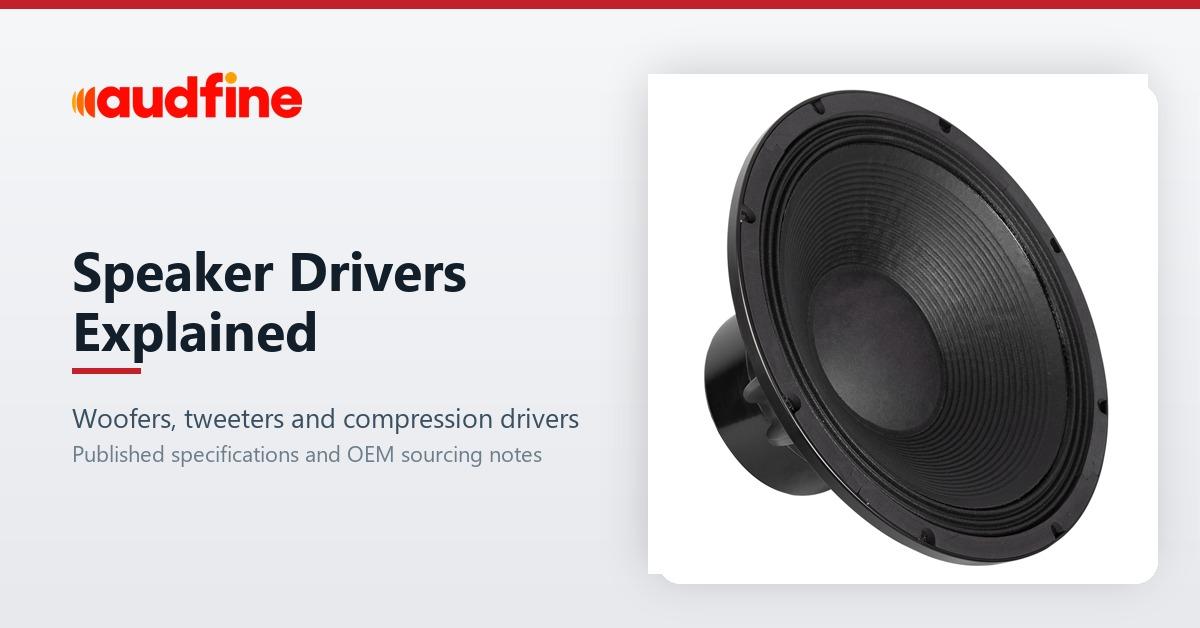
A driver is the electromechanical transducer at the heart of every loudspeaker. An electrical signal passes through a voice coil suspended in a magnetic field; the interaction produces a force that moves a diaphragm, and that movement pushes air to create sound. The size of the diaphragm, the mass of the moving assembly, and the strength and type of the motor determine which frequencies the driver reproduces cleanly. No single driver covers the full audible range with equal efficiency, which is why cabinets use several, split by a crossover.
Three jobs in a professional cabinet
Low frequency (LF). Woofers move the large volumes of air needed for bass and sub-bass. Larger cones reach lower; smaller cones play faster and extend higher in frequency.
Mid frequency (MF). In many full-range tops, the same woofer that handles LF also covers the midrange up to a few kilohertz before the high-frequency driver takes over.
High frequency (HF). The HF section reproduces detail, attack and intelligibility. In PA cabinets this is normally done by a compression driver mounted on a horn; in smaller or nearfield designs a direct-radiator tweeter may be used instead. The dividing points — the crossover frequencies — are chosen so each driver works where it is most efficient.
Woofers: size, cone and suspension
Woofer size is the clearest indicator of role. A 10" or 12" unit is common in compact full-range tops and stage monitors, where it must reach reasonably high in frequency. A 15" unit is a flexible mid of a two-way top or a dedicated low section. An 18" or 21" unit is built for sub-bass in a subwoofer cabinet.
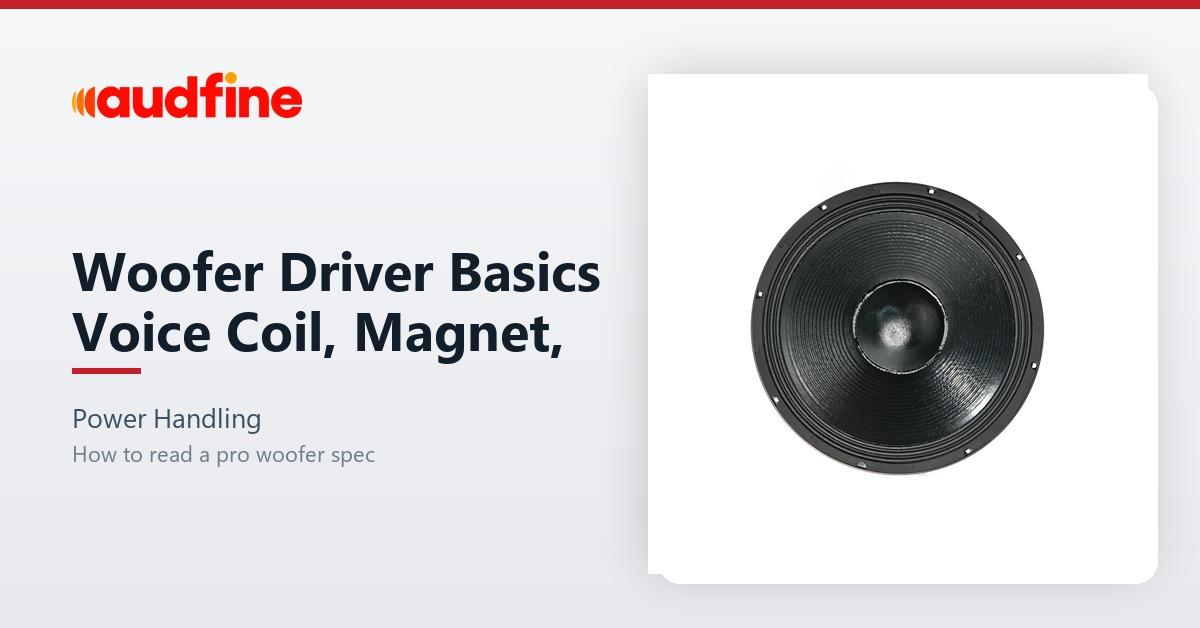
The cone is paper across the entire Audfine woofer range. Paper strikes a balance of stiffness, low mass and controlled breakup that suits professional audio, and it is straightforward to manufacture consistently at volume. The 12NLD88 neodymium woofer shown below illustrates a typical paper-cone, die-cast basket build.
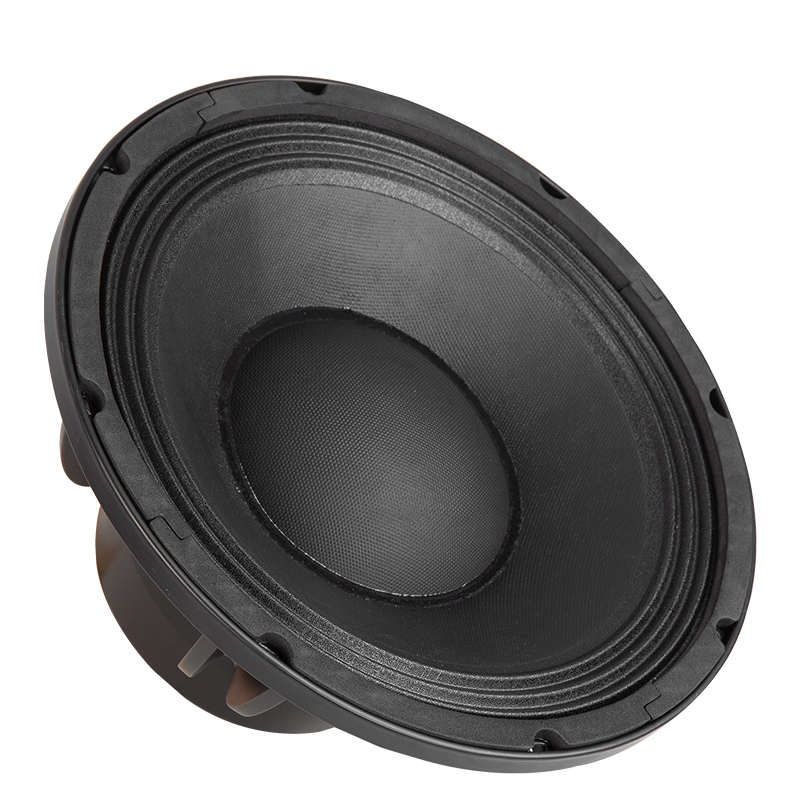
The suspension — surround and spider — centres the voice coil and sets the mechanical limits. Across the range you will see a PC (polyester) spider, a double spider, or a silicone spider, each chosen for the excursion and power the model is designed for. The 18" ferrite units use a silicone spider for high excursion; the neodymium and standard ferrite woofers use double or PC spiders.
Voice coil and former materials
The voice coil is the engine of the driver. A larger diameter coil dissipates heat better and handles more power, which is why high-output 15", 18" and 21" models use 4", 4.5" and 6" coils. The former (the tube the coil is wound on) and its coating matter for thermal behaviour:
- Kapton former, used on the 12" PW127560A, tolerates high temperature.
- TGL former on the 12BH300 / 12BHP300 pair.
- GBF (glass-fibre) former on the neodymium models, from 3.5" on the 10" and 12" units up to 6" on the 21" 21SW152.
The coil winding may be inside/outside (IN/OUT) to improve heat transfer and linear travel. These details are listed for every model in the table below.
Ferrite or neodymium motor
The magnet assembly sets the motor strength. Two types appear in the range:
- Ferrite. Used on value and high-excursion models such as the 12" pair, the 15X600M, and the 18" ferrite units (18BHP401DM / 18BH401DM). Ferrite is robust and economical.
- Neodymium (NEO). Used on the higher-output models — 10NDL88, 12NLD88, the 15" neodymium units (15NDL100, 15DS115), 18SW115, 18BHP501ND and 21SW152. Neodymium gives a stronger field for the same or lower weight, which helps when cabinet weight matters.
Neither type is the obvious choice in the abstract; the decision is a balance of output, weight and budget for the target cabinet.
Reading woofer specifications
The table below lists published figures for thirteen Audfine woofers. Read it column by column:
- Power is RMS (continuous) and Peak (programme / transient). Peak is typically twice RMS.
- Sensitivity (dB, 1 W / 1 m) tells you how loud the driver is for a given input; higher means more output for less amplifier power.
- Frequency response is the band the driver covers; note that a woofer used as a sub crosses out well below its upper limit.
- Magnet and basket describe the motor and frame.
| Model | Size | Voice coil | Power | Sensitivity | Frequency response | Magnet | Basket |
|---|---|---|---|---|---|---|---|
| 10NDL88 | 10" | GBF3.5" IN/OUT voice coil | 500W RMS, 1000W Peak | 96 dB | 60Hz - 2500Hz | NEO magnet | Die-cast ALU. basket |
| PW127560A | 12" | Kapton 3" IN/OUT voice coil | 300W RMS, 600W Peak | 95 dB | 55Hz - 2500Hz | Ferrite magnet | Steel basket |
| 12BH300 | 12" | TGL3" IN/OUT voice coil | 400W RMS, 800W Peak | 97.5 dB | 55Hz - 5000Hz | Ferrite magnet | Die-cast ALU. basket |
| 12BHP300 | 12" | TGL3" IN/OUT voice coil | 400W RMS, 800W Peak | 97.5 dB | 55Hz - 5000Hz | Ferrite magnet | Die-cast ALU. basket |
| 12NLD88 | 12" | GBF3.5" IN/OUT voice coil | 700W RMS, 1400W Peak | 98 dB | 50Hz - 3000Hz | NEO magnet | Die-cast ALU. basket |
| 15X600M | 15" | GBF 4" IN/OUT voice coil | 600W RMS, 1200W Peak | 98 dB | 45Hz - 3000Hz | Ferrite magnet | Die-cast ALU. basket |
| 15NDL100 | 15" | GBF 4" IN/OUT voice coil | 800W RMS, 1600W Peak | 98 dB | 45Hz - 3000Hz | NEO magnet | Die-cast ALU. basket |
| 15DS115 | 15" | GBF4.5" IN/OUT voice coil | 1600W RMS, 3200W Peak | 97 dB | 35Hz - 1000Hz | NEO magnet | Die-cast ALU. basket |
| 18SW115 | 18" | GBF4.5" IN/OUT voice coil | 1600W RMS, 3200W Peak | 96 dB | 30Hz - 1000Hz | NEO magnet | Die-cast ALU. basket |
| 18BHP401DM | 18" | GBF 4" IN/OUT voice coil | 1500W RMS, 3000W Peak | 98 dB | 30Hz - 2000Hz | Ferrite magnet | Die-cast ALU. basket |
| 18BH401DM | 18" | GBF 4" IN/OUT voice coil | 1500W RMS, 3000W Peak | 98 dB | 30Hz - 2000Hz | Ferrite magnet | Die-cast ALU. basket |
| 18BHP501ND | 18" | GBF 5" IN/OUT voice coil | 2000W RMS, 4000W Peak | 98 dB | 30Hz - 1250Hz | NEO magnet | Die-cast ALU. basket |
| 21SW152 | 21" | GBF6" IN/OUT voice coil | 2000W RMS, 4000W Peak | 96 dB | 30Hz - 1000Hz | NEO magnet | Die-cast ALU. basket |
Tweeters and high-frequency drivers: two approaches
There are two common ways to produce HF in a professional cabinet.
Direct-radiator tweeters use a small dome or cone that radiates straight into the air. They are simple and common in compact, nearfield or studio-style boxes, but their output and pattern control are limited at high power.
Compression drivers sit behind a horn. The small diaphragm compresses air into the horn throat, which increases efficiency and lets the horn control the coverage pattern. This is the standard HF choice for touring, installed and line-array PA because it delivers high output with controllable directivity. Audfine's published HF range is compression drivers; the next section details them.
Compression driver specifications that matter
A compression driver is specified differently from a woofer because its job is HF:
- Throat (1" / 25 mm) is the horn coupling; the diaphragm is larger than the throat, which is what "compresses" the air.
- Voice coil (CCAW — copper-clad aluminium wire) and diaphragm material (titanium) set the HF behaviour and power.
- Power here is modest in watts but the sensitivity is very high (106–110 dB), so a little input produces strong output.
- Frequency response begins around 1.2–1.5 kHz and runs past the top of the audible band.
- Mounting is bolt-on (CD3601) or screw-on (BH450 / BH453).
The BH450 1.75" compression driver below shows the titanium-diaphragm, screw-on build used across the HF range.
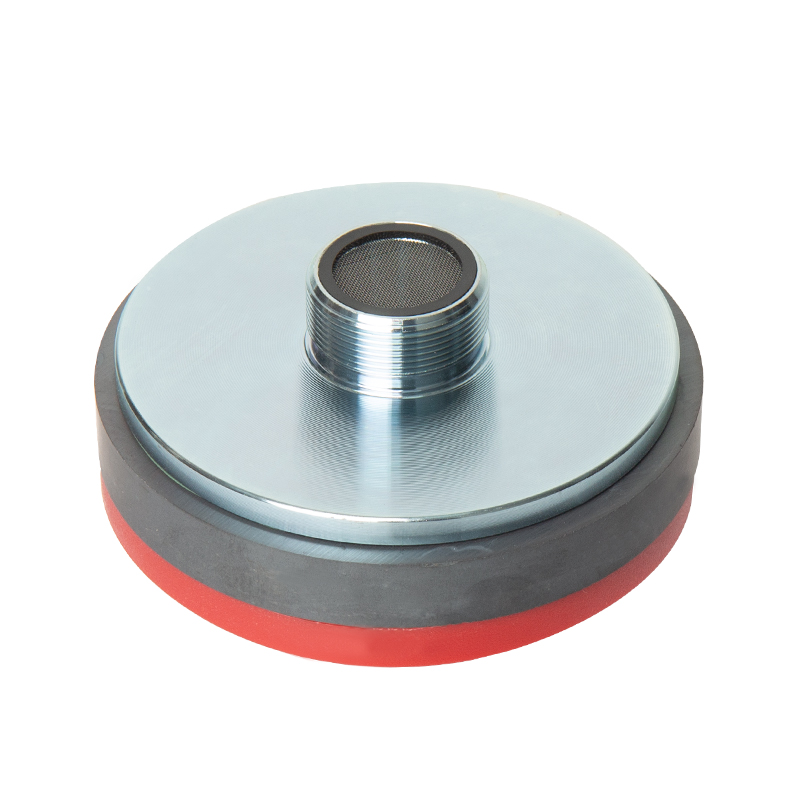
Published figures for all three compression drivers:
| Model | Throat | Voice coil | Diaphragm | Power | Sensitivity | Frequency response | Magnet | Mounting |
|---|---|---|---|---|---|---|---|---|
| CD3601 | 1"/25 mm Throat | 1.42" / 36mm CCAW voice coil | Titanium diaphragm | 50W RMS, 100W Peak | 106 dB | 1500 Hz - 18 KHz | 134*17 ferrite magnet | bolt-on |
| BH450 | 1"/25 mm Throat | 1.75" / 44mm CCAW voice coil | Titanium diaphragm | 60W RMS, 120W Peak | 110 dB | 1200 Hz - 20 KHz | 115*15 ferrite magnet | screw-on |
| BH453 | 1"/25 mm Throat | 1.75" / 44mm CCAW voice coil | Titanium diaphragm | 60W RMS, 120W Peak | 110 dB | 1200 Hz - 20 KHz | 115*15 ferrite magnet | screw-on |
Matching drivers to the cabinet and application
The right driver depends on the cabinet and where it is used.
Subwoofer cabinets
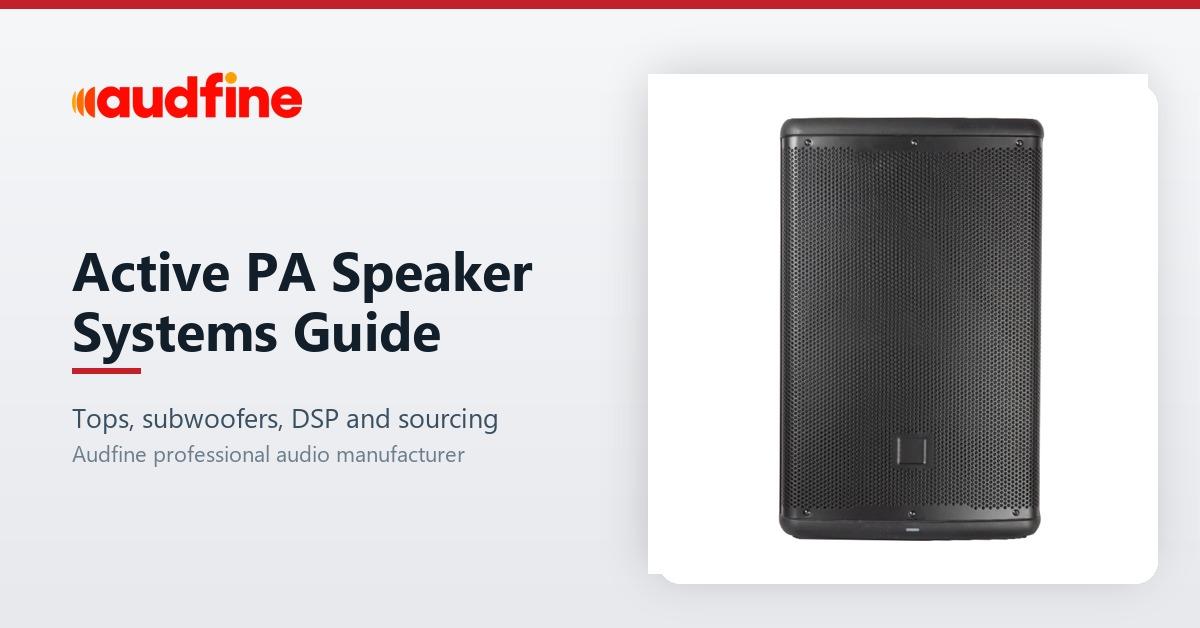
For sub-bass you want the largest cones: 18" (18SW115, 18BHP401DM, 18BH401DM, 18BHP501ND) and 21" (21SW152) reach down to 30 Hz. PRX918 and SUB-8003 active subwoofers pair these drivers with their own amplification and DSP. The 18BHP501ND shown below uses a 5" GBF coil and a chrome-plated yoke for high-output sub duty.
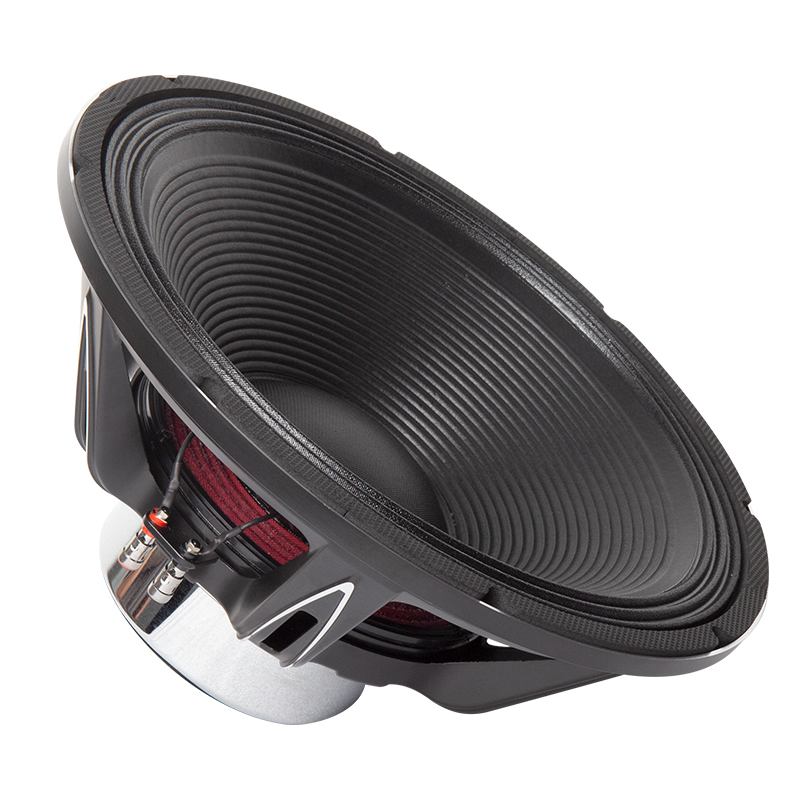
Two-way full-range tops
A 12" or 15" woofer covers LF and mid, crossed to a compression driver for HF. The 15DS115 (15", 35 Hz–1 kHz) is built as a sub / mid-bass unit, while 15X600M and 15NDL100 extend to 3 kHz for full-range duty.
Line array and installed systems
High-output neodymium woofers (15NDL100, 15DS115) and the 21" unit suit large-format systems where weight and output both count. Active line array systems pair these with dedicated HF sections.
What to specify when sourcing speaker drivers from a China manufacturer
When you request quotes from a speaker driver factory, the specification sheet is the shared language between buyer and supplier. A clear request reduces sampling rounds and mismatch. Specify these eight points:
- Driver type and cone size — woofer, mid or compression driver, and the exact diameter.
- Impedance — the full Audfine range is 8 ohm; confirm yours matches the cabinet wiring.
- Power rating — state RMS and Peak separately; do not quote only one.
- Frequency response target — the band the driver must cover in your design.
- Magnet type — ferrite or neodymium, and any weight constraint.
- Sensitivity target — so amplifier and cabinet size can be planned.
- Mounting and cutout — bolt-on versus screw-on for drivers; basket and cutout for woofers.
- Quantity and program — share the expected volume so tooling and planning can be discussed.
Audfine supplies these drivers as a manufacturer and supports OEM and ODM projects; sample and graphic services are listed on the product pages.
Service and replacement considerations
Drivers are the field-replaceable heart of a cabinet. When a woofer is damaged, matching impedance, sensitivity and cutout to the original keeps the system balanced. Because every model here is published with its full specification, replacements can be sourced and verified against the original data rather than guessed. Keep the specification sheet with the cabinet documentation.
Frequently asked questions
Are all Audfine woofers 8 ohm?
Yes — the published woofer and compression driver range is 8 ohm throughout.
Ferrite or neodymium — which should I choose?
Neodymium where weight and output matter most; ferrite where budget and robustness lead. Both are valid for professional use.
What is a compression driver used for?
HF reproduction in PA cabinets, paired with a horn for efficiency and pattern control.
Can I get a custom diaphragm or basket?
Customized speaker boxes and sample graphics are offered; discuss driver-level customization with the factory against your program.
How do I match a woofer to a subwoofer cabinet?
Choose the largest cone that fits, confirm the cabinet tunes to the driver's lower limit, and cross over below the woofer's upper limit.
Where do I find full specifications?
Each product page linked in this article carries the complete published figures, and the companion woofer driver basics guide explains voice coil, magnet and power handling in detail.
Request a quote
If you are building or servicing professional cabinets and need woofers or compression drivers sourced to specification, contact our team with your driver type, size, impedance, power and quantity. We supply the published range as a manufacturer and support OEM and ODM programs.