Woofer Driver Basics: Voice Coil, Magnet and Power Handling
A woofer driver looks like a simple assembly of cone, surround, spider, magnet and coil. The four numbers that decide how it behaves in a cabinet — voice coil diameter, power handling, sensitivity and frequency response — are all set by those parts, and they move together. Specifying one without the others is a frequent reason a finished enclosure either underperforms on site or does not survive its first season.
This guide explains what each published specification actually describes, using figures taken from the Audfine professional transducer range so the relationships can be read across a real product line. It is written for cabinet manufacturers, rental companies, installers and service workshops that buy drivers and build or maintain their own enclosures. Audfine is the brand of Ningbo Lesound Electronics Co., LTD., a professional audio manufacturer and exporter established in 2009 in Ningbo, China, working with overseas brands on an OEM and ODM basis.
What a woofer driver does in a professional cabinet
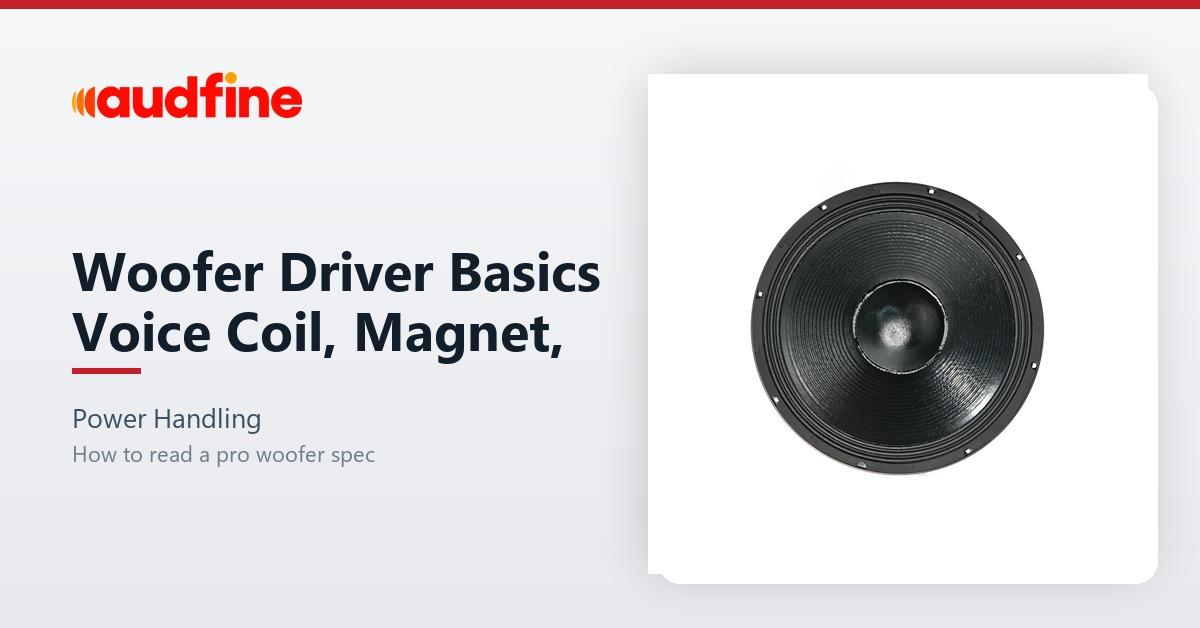
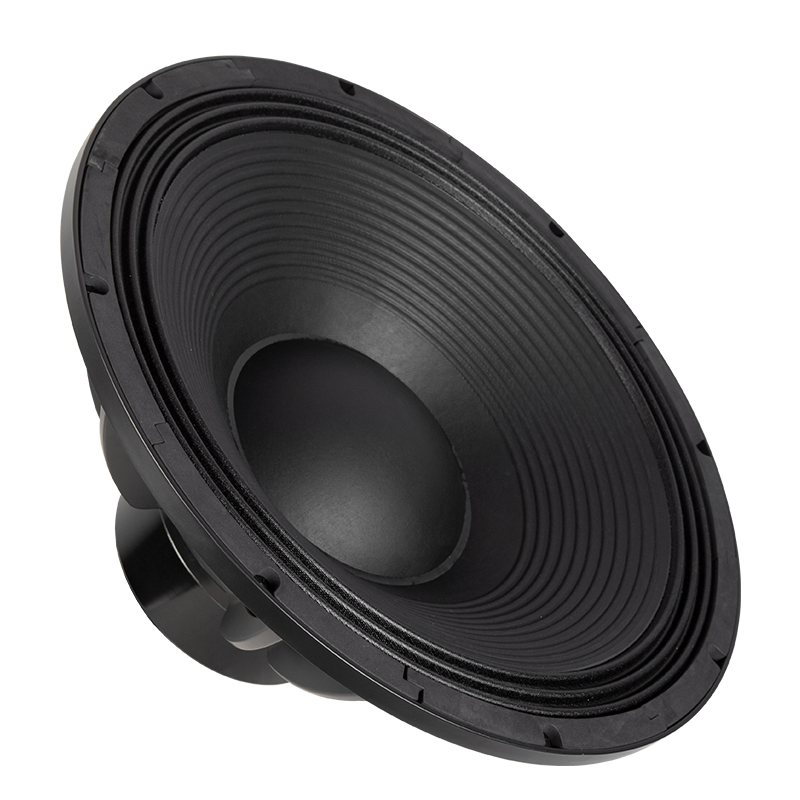
In a professional sound system the woofer is the transducer that moves the largest volume of air. It converts amplifier current into cone movement through a voice coil suspended in a magnetic gap, and the cone then couples that movement to the room. A 12-inch driver in a two-way cabinet, a 15-inch driver in a stage monitor and an 18-inch driver in a subwoofer all work on the same principle; what changes between them is how far the cone can travel in a controlled way, how much heat the motor can absorb before output falls away, and how low the assembly can play before the response rolls off.
That is why a driver and its enclosure have to be considered as one item. The same 18-inch woofer will behave very differently in a sealed cabinet, a vented cabinet and a band-pass design, and the frequency range published for the driver describes the transducer, not the finished box. Buyers who compare driver specifications across suppliers are usually comparing transducers; buyers who compare finished cabinets are comparing the result of a tuning decision as well.
Voice coil: the specification that sets the thermal limit
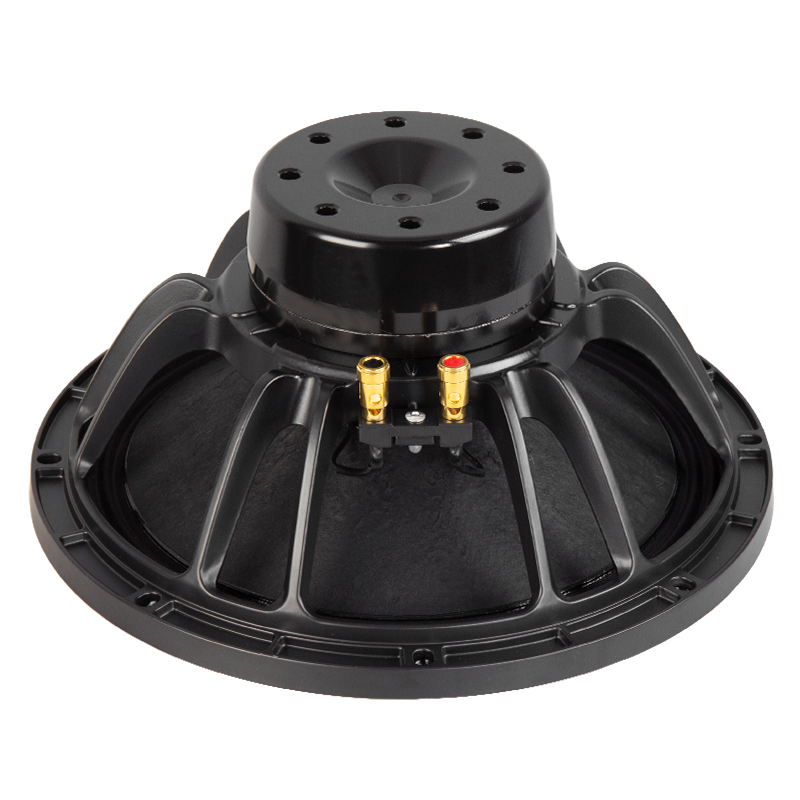
The voice coil is a winding attached to the rear of the cone and held in the magnetic gap. Amplifier current passing through it creates a force that drives the cone forward and back. Two things about that coil decide what the driver can withstand: its diameter, and the materials the winding and former are made from.
Coil diameter tracks power handling across the range. The published figures make the relationship easy to see. The 12NLD88 12-inch woofer uses a 3.5-inch GBF coil and publishes 700 W RMS with 1400 W peak. The 15NDL100 15-inch woofer steps up to a 4-inch GBF coil and 800 W RMS with 1600 W peak. The 18BHP501ND 18-inch woofer uses a 5-inch GBF coil and publishes 2000 W RMS with 4000 W peak. At the bottom of the ladder, the PW127560A 12-inch woofer runs a 3-inch Kapton coil at 300 W RMS and 600 W peak. A larger coil presents more surface area to dissipate heat, and the power figures published across the range follow the coil sizes consistently.
Former and winding materials differ by model. Three constructions appear in the published specifications: Kapton in a 3-inch size, TGL in a 3-inch size, and GBF in 3.5-inch, 4-inch, 4.5-inch, 5-inch and 6-inch sizes. Each is listed with an "IN/OUT" descriptor, which refers to how the winding is arranged on the former. Because thermal behaviour depends on that construction as much as on the diameter, it is a fair question to put to a supplier at specification stage rather than inferring it from the power number alone.
Heat is the dominant failure mode. When a coil overheats, the first symptom is usually compression — the driver stops getting louder as more power arrives — and the second is an open or shorted winding. Both are avoided by matching the amplifier to the continuous rating and by using processing that limits long-term energy rather than only reacting to peaks.
Magnet: ferrite and neodymium in the same range
The magnet establishes the field the coil works against. Two materials are used across the Audfine woofer range, and the choice is visible in the specifications.
Ferrite. The PW127560A, 12BH300, 12BHP300 and 15X600M are all published with ferrite magnets, as are the 18BHP401DM and 18BH401DM 18-inch woofers. Ferrite is a mature, widely serviced material and the magnet assemblies are physically larger for a given field strength.
Neodymium (NEO). The 10NDL88, 12NLD88, 15NDL100 15-inch woofer, 15DS115, 18SW115, 18BHP501ND and 21SW152 are all published with NEO magnets. Neodymium delivers the required field from a much smaller and lighter assembly, which is why it appears on the highest-power models in the range and on large-format drivers where shipping and handling weight matter.
The published specifications also record the magnet dimensions where they are stated: the CD3601 compression driver lists a 134 by 17 mm ferrite magnet, and the BH450 and BH453 compression drivers list a 115 by 15 mm ferrite magnet. The yoke or magnet shell is specified separately as black T-yoke, black yoke, chrome T-yoke or chrome-plated yoke, which is worth noting when a replacement has to match an existing assembly visually as well as electrically.
Basket, spider and cone: the mechanical limits
Three mechanical parts decide how well the moving assembly stays aligned under load, and all three are published.
Basket. The PW127560A is specified with a steel basket. Every other woofer in the range — 10NDL88 through 21SW152 — is specified with a die-cast aluminium basket. A cast basket gives a stiffer frame for the motor and a more direct path for heat to leave the assembly.
Spider. The suspension uses three different constructions. A single PC spider is published on the PW127560A, 12BH300, 12BHP300 and 15X600M. A double spider is published on the 10NDL88, 12NLD88, 15NDL100, 15DS115, 18SW115, 18BHP501ND and 21SW152. A silicone spider is published on the 18BHP401DM and 18BH401DM. The double-spider construction appears on the models that publish the largest excursion demands, which makes it a useful indicator when comparing two drivers of the same nominal size.
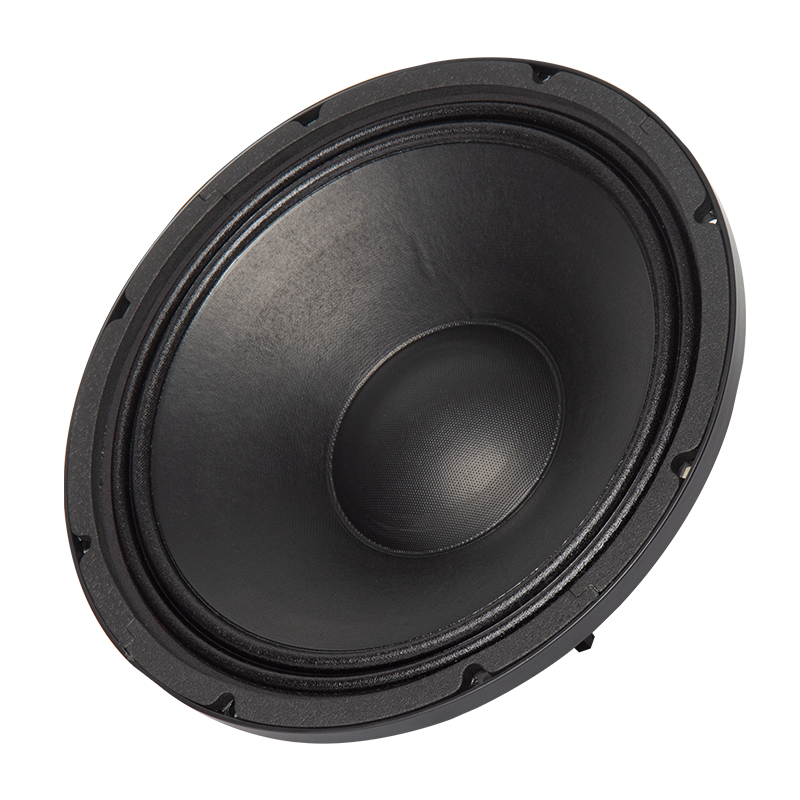
Cone. Paper cone is published across the entire woofer range. On the compression driver side the diaphragm material is titanium, which is the normal pairing with a high-frequency motor.
Reading power handling: RMS and peak
Every driver publishes two power figures, and they answer different questions. RMS describes continuous capability — what the driver can absorb over a long programme. Peak describes short-term capability on transients. Read together they describe the operating envelope; read separately, either one can be misleading.
Across this range the ladder runs from 300 W RMS and 600 W peak on the PW127560A, through 400 W and 800 W on the 12BH300 and 12BHP300, 500 W and 1000 W on the 10NDL88, 600 W and 1200 W on the 15X600M, 700 W and 1400 W on the 12NLD88, 800 W and 1600 W on the 15NDL100, 1500 W and 3000 W on the 18BHP401DM and 18BH401DM, 1600 W and 3200 W on the 15DS115 and 18SW115, to 2000 W and 4000 W on the 18BHP501ND and 21SW152. In every case the peak figure is twice the RMS figure, which makes the two easy to compare at a glance.
For amplifier sizing, the continuous figure is the one to plan against, with headroom above it for programme dynamics. Where a system runs at high level for hours, the limiting factor is thermal rather than mechanical, and it is set by the coil described above.
Sensitivity and frequency response: the two numbers that get compared
Sensitivity is published as a single dB figure on each product page. In this range the woofers run from 95 dB on the PW127560A to 98 dB on the 12NLD88, 15X600M, 15NDL100, 18BHP401DM, 18BH401DM and 18BHP501ND, with 97.5 dB on the 12BH300 and 12BHP300, 97 dB on the 15DS115, and 96 dB on the 10NDL88, 18SW115 and 21SW152. The figure describes how much acoustic output the driver produces for a given electrical input, so a higher number means more output from the same amplifier channel. Compression drivers publish far higher figures — 106 dB on the CD3601 and 110 dB on the BH450 and BH453 — because they work into a horn rather than into open air.
Frequency response is published as a band. Sorting the range by cone size shows how consistently the lower limit moves: 60 Hz for the 10-inch 10NDL88, 55 Hz for the 12-inch PW127560A, 50 Hz for the 12-inch 12NLD88, 45 Hz for the 15-inch 15X600M and 15NDL100, 35 Hz for the 15-inch 15DS115, and 30 Hz for the 18-inch 18SW115, 18BHP401DM, 18BH401DM and 18BHP501ND and for the 21-inch 21SW152. The upper limit varies with the intended role: 5000 Hz on the 12BH300 and 12BHP300, 3000 Hz on the 12NLD88, 15X600M and 15NDL100, 2500 Hz on the 10NDL88 and PW127560A, 2000 Hz on the 18BHP401DM and 18BH401DM, 1250 Hz on the 18BHP501ND, and 1000 Hz on the 15DS115, 18SW115 and 21SW152. Drivers intended to be crossed over to a compression driver publish a lower upper limit by design.
Published woofer specifications
| Model | Size | Voice coil | Power (RMS / Peak) | Sensitivity | Frequency response | Magnet | Basket |
|---|---|---|---|---|---|---|---|
| 10NDL88 | 10" | GBF 3.5" IN/OUT | 500 W / 1000 W | 96 dB | 60 Hz - 2500 Hz | NEO | Die-cast ALU. |
| PW127560A | 12" | Kapton 3" IN/OUT | 300 W / 600 W | 95 dB | 55 Hz - 2500 Hz | Ferrite | Steel |
| 12BH300 | 12" | TGL 3" IN/OUT | 400 W / 800 W | 97.5 dB | 55 Hz - 5000 Hz | Ferrite | Die-cast ALU. |
| 12BHP300 | 12" | TGL 3" IN/OUT | 400 W / 800 W | 97.5 dB | 55 Hz - 5000 Hz | Ferrite | Die-cast ALU. |
| 12NLD88 | 12" | GBF 3.5" IN/OUT | 700 W / 1400 W | 98 dB | 50 Hz - 3000 Hz | NEO | Die-cast ALU. |
| 15X600M | 15" | GBF 4" IN/OUT | 600 W / 1200 W | 98 dB | 45 Hz - 3000 Hz | Ferrite | Die-cast ALU. |
| 15NDL100 | 15" | GBF 4" IN/OUT | 800 W / 1600 W | 98 dB | 45 Hz - 3000 Hz | NEO | Die-cast ALU. |
| 15DS115 | 15" | GBF 4.5" IN/OUT | 1600 W / 3200 W | 97 dB | 35 Hz - 1000 Hz | NEO | Die-cast ALU. |
| 18SW115 | 18" | GBF 4.5" IN/OUT | 1600 W / 3200 W | 96 dB | 30 Hz - 1000 Hz | NEO | Die-cast ALU. |
| 18BHP401DM | 18" | GBF 4" IN/OUT | 1500 W / 3000 W | 98 dB | 30 Hz - 2000 Hz | Ferrite | Die-cast ALU. |
| 18BH401DM | 18" | GBF 4" IN/OUT | 1500 W / 3000 W | 98 dB | 30 Hz - 2000 Hz | Ferrite | Die-cast ALU. |
| 18BHP501ND | 18" | GBF 5" IN/OUT | 2000 W / 4000 W | 98 dB | 30 Hz - 1250 Hz | NEO | Die-cast ALU. |
| 21SW152 | 21" | GBF 6" IN/OUT | 2000 W / 4000 W | 96 dB | 30 Hz - 1000 Hz | NEO | Die-cast ALU. |
Impedance is published as 8 ohms on every woofer in the range, and the cone material is paper throughout. Spider construction is single PC on the PW127560A, 12BH300, 12BHP300 and 15X600M; double on the 10NDL88, 12NLD88, 15NDL100, 15DS115, 18SW115, 18BHP501ND and 21SW152; and silicone on the 18BHP401DM and 18BH401DM.
Compression drivers in the same system
A woofer is normally specified together with a high-frequency device, and the same discipline applies to reading its figures. Three compression drivers are published in the range. The CD3601 uses a 1.42-inch (36 mm) CCAW voice coil with a titanium diaphragm and a 1-inch throat, publishes 50 W RMS with 100 W peak, 106 dB sensitivity and a 1500 Hz to 18 kHz response, and is bolt-on mounted. The BH450 and BH453 use a 1.75-inch (44 mm) CCAW coil with a titanium diaphragm and a 1-inch throat, publish 60 W RMS with 120 W peak, 110 dB sensitivity and a 1200 Hz to 20 kHz response, and are screw-on mounted. All three are 8 ohm with ferrite motors.
The pairing logic is visible in the numbers: where a woofer publishes a 1000 Hz upper limit, the crossover point and the compression driver's lower limit have to be considered together. That is a design decision for the cabinet builder, and it is the reason both sets of published figures belong in the same document.
What to specify when sourcing woofer drivers from a China manufacturer
For buyers working with a woofer driver manufacturer in China, the value of a clear enquiry is that it removes the assumptions that cause re-orders to drift. A usable first enquiry normally covers eight points:
1. Cabinet type and internal volume. Sealed, vented or band-pass, and the target tuning. The same driver publishes the same figures regardless of box, so the box has to be stated separately.
2. Continuous and peak power at the intended crossover. Not just the driver rating, but how the system will actually be powered.
3. Impedance and the number of drivers per channel. Every woofer in this range publishes 8 ohms, which determines the load a single amplifier channel sees when drivers are combined.
4. Voice coil construction. Diameter plus former and winding material, since thermal behaviour follows the construction and not the power number alone.
5. Magnet material. Ferrite or neodymium, decided together with the weight and service considerations for the destination market.
6. Mechanical build. Basket material, spider construction and cone material, particularly where the driver replaces an existing unit.
7. Programme material and duty cycle. Speech, live music or playback at high continuous level leads to different thermal demands.
8. Branding and packaging scope. Whether the programme is OEM, ODM or private label, and what artwork and packaging are required.
An OEM speaker driver supplier can usually respond to that list with a shortlist rather than a full catalogue, which shortens the sampling stage considerably. Working from a single supplier for both the woofer and the compression driver also keeps the published figures in one consistent format.
Matching the driver to the cabinet and the system
Drivers are usually bought for one of three jobs: building a new cabinet, replacing a failed unit in an existing cabinet, or stocking spares for a fleet. Each reads the same specification differently.
New cabinet programmes start from the target response and work back to cone size and coil. Where the design calls for sub-bass from a single large driver, the 30 Hz lower limit published on the 18-inch and 21-inch models is the starting point — the 18BHP501ND 18-inch woofer and the 21SW152 21-inch woofer both publish 2000 W RMS with a 30 Hz floor, and differ in coil size, upper limit and motor material. Replacement and service work starts from the failed unit's published figures, where impedance, sensitivity and cutout diameter all have to be matched before anything else is considered. Fleet spares are normally standardised on the fewest possible models, which favours a range where impedance and cone material are consistent across sizes.
Where the finished system is bought rather than built, the same range is available in complete cabinets. The powered subwoofer range is specified as finished systems, and the subwoofer model matching guide sets out how those cabinets are compared. Buyers who build their own enclosures and buyers who buy finished cabinets tend to need the same figures, but they use them at different points in the project.
Frequently asked questions
Which specification matters most when comparing two woofers of the same size?
Voice coil diameter and construction, because the power figures and the thermal behaviour follow from it. Two 15-inch woofers in this range publish 600 W RMS with a 4-inch coil and 1600 W RMS with a 4.5-inch coil, and the difference is decided by the motor rather than by the cone size.
Does a higher sensitivity figure mean a louder cabinet?
It means more acoustic output for the same electrical input. The 98 dB published on the 12NLD88, 15NDL100, 15X600M and 18BHP501ND is 3 dB above the 95 dB published on the PW127560A, which is a real difference in what the same amplifier channel delivers. It does not describe the cabinet's maximum output, which depends on power handling and excursion as well.
Ferrite or neodymium — which should be specified?
Ferrite is published on the PW127560A, 12BH300, 12BHP300, 15X600M, 18BHP401DM and 18BH401DM; neodymium on the 10NDL88, 12NLD88, 15NDL100, 15DS115, 18SW115, 18BHP501ND and 21SW152. Neodymium reduces assembly weight for the same field, which matters for transport and handling. The decision is best made together with the shipping plan and the service arrangements for the destination market.
Can a woofer and a compression driver be sourced as a matched pair?
Yes. The published ranges are specified in a consistent format, so the woofer's upper limit and the compression driver's lower limit can be compared directly. Send the intended crossover point and the cabinet type with the enquiry.
Is the driver range available for OEM and private-label programmes?
Yes. The factory works on OEM and ODM programmes for overseas brands, and samples are available. The scope of customisation, artwork and packaging is normally confirmed at sample stage.
Next step for your driver programme
If you are specifying a woofer driver, the fastest route to a usable answer is to send the cabinet type and internal volume, the target response, the intended power and crossover point, the duty cycle and the destination market. That is enough to identify which coil size, motor material and mechanical build fit the application. Audfine is a professional audio manufacturer and exporter in Ningbo, and enquiries from cabinet builders, distributors, rental companies and service workshops are handled directly by the factory.