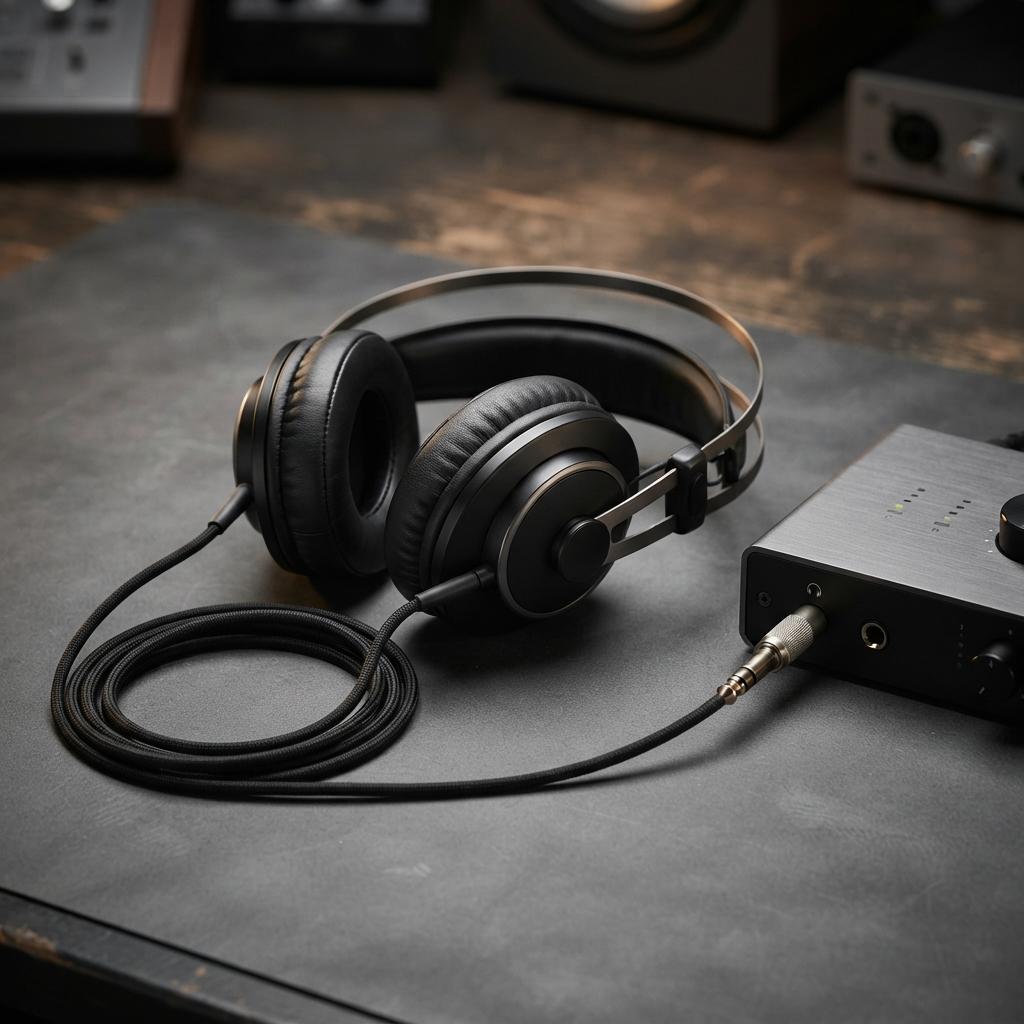
Headphone impedance is the electrical load a headphone presents to whatever drives it, measured in ohms: 32 Ω is the low-impedance class that runs from laptops, phones and DJ mixers, 80 Ω sits between the easy and the demanding, and 250 Ω is a high-impedance load that needs a source with real voltage swing, such as an audio interface or a dedicated headphone amplifier. Higher impedance is not better sound by itself — headphone impedance matching is a decision between the headphone and the source, and for a brand or distributor it should be settled before the sample order rather than after the first shipment.
Key takeaways
- Impedance (Ω) is an electrical property, not a sound quality rating. It describes how much voltage a source must supply to push a given current through the driver.
- Loudness depends on impedance and sensitivity together. A 250 Ω headphone at high sensitivity can still be driven from a modest interface; a 32 Ω headphone at low sensitivity can still be quiet.
- 32 Ω is the safest single choice for a product line that has to work on phones, laptops, DJ gear and consumer interfaces.
- 80 Ω and 250 Ω are for professional sources with headroom, and they reward a quieter noise floor and more consistent level control rather than extra loudness.
- One acoustic platform can carry several impedances. That is how a brand covers three price tiers from one driver design and one set of tooling.
What headphone impedance actually measures
Impedance is the AC resistance of the headphone's voice coil and its associated electrical network, expressed in ohms (Ω). A dynamic driver is a coil sitting in a magnetic gap, so it behaves as a resistor with inductance: its impedance is not a single flat number across the audio band, and the figure printed on a specification sheet is a nominal value, usually measured at 1 kHz.
If you only need one sentence on headphone impedance meaning, this is it: it is the electrical load the headphone puts on the source, not a ranking of quality.
That nominal figure tells you how the headphone loads the amplifier. Audio power follows P = V² / R, so for the same output voltage a lower impedance draws more current and produces more power — which is why 32 ohm headphones play louder from a weak source than a 250 Ω pair does. The trade is current: low impedance headphones ask more of the amplifier's output stage, while high-impedance loads ask more of its voltage swing.
The measurement vocabulary is standardised. IEC 60268-7:2025 defines the characteristics and measurement methods for headphones, earphones, headsets and earsets, covering impedance, sensitivity, frequency response and distortion, which is why a well-written specification sheet can be compared line by line across suppliers. If a quotation lists a headphone impedance figure with no reference point or test condition, that is worth a question before it becomes a purchase order.
Why the number changes what you hear
Two electrical figures decide how a headphone behaves in the real world: impedance and sensitivity. Sensitivity is usually printed in dB SPL per milliwatt (dB/mW) or per volt, and it says how much acoustic output the driver produces for a given electrical input.
Headphone impedance vs sensitivity is the comparison that actually predicts loudness, and it is the one most quotations leave out. A high-impedance driver with high sensitivity can reach a usable level from an interface's headphone output; a low-impedance driver with low sensitivity may need more current than a laptop is willing to supply before it distorts. Read alone, headphone impedance cannot tell you whether a model will play loudly enough.
There is also a system-level effect. A headphone output has its own output impedance, and when that impedance is a significant fraction of the headphone's impedance, the voltage division between the two can shift the frequency response — most audibly in the bass, where a driver's impedance curve typically rises. The widely used engineering rule of thumb is to keep the source's output impedance at roughly one-eighth of the headphone's nominal impedance. It is a design guideline for clean, predictable behaviour, not a law of sound quality.
32 Ω, 80 Ω and 250 Ω: what each class is for
The three figures that appear most often in professional headphone catalogues are not three grades of quality. They are three positions on a matching scale, and each has a natural job.
| Nominal impedance | Load the source sees | Typical sources | What it is chosen for |
|---|---|---|---|
| 16–32 Ω (low impedance) | High current, low voltage | Phones, laptops, tablets, DJ mixers, camera and field recorders | Plug-and-play level from almost any device; one SKU that serves consumer and semi-pro buyers |
| 60–80 Ω | Balanced current and voltage | Audio interfaces, small consoles, dedicated headphone amps with modest gain | A compromise SKU where a line has to serve studio and live sources without a separate amplifier |
| 250 Ω and above (high impedance) | High voltage, low current | Studio consoles, rack headphone amplifiers, high-gain interface outputs | Level control with headroom, low noise floor, consistent performance on long, multi-headphone cue systems |
The practical consequence for a brand is that impedance decides which customer can use the product out of the box. A 250 ohm headphone sold to buyers who work from a laptop will generate support tickets that have nothing to do with the acoustic design. A 32 Ω-only line sold into a studio that runs eight cue positions from a rack amplifier works, but gives up the noise-floor advantage the amplifier could have provided.
Why high impedance is used at all
Higher impedance reduces the current the amplifier must deliver, which lowers resistive losses in long cable runs and in multi-position headphone distribution, and it makes the load less sensitive to the source's output impedance. In a studio where several headphones hang off one amplifier and cables run across a live room, those two properties matter more than raw efficiency. That is a system decision, not a marketing claim.
Matching impedance to the source you actually ship with
The specification question to settle first is not "which impedance is best", but "what will the buyer plug this into". Headphone impedance matching is the process of pairing that load with the source, and four source types cover most of the market:
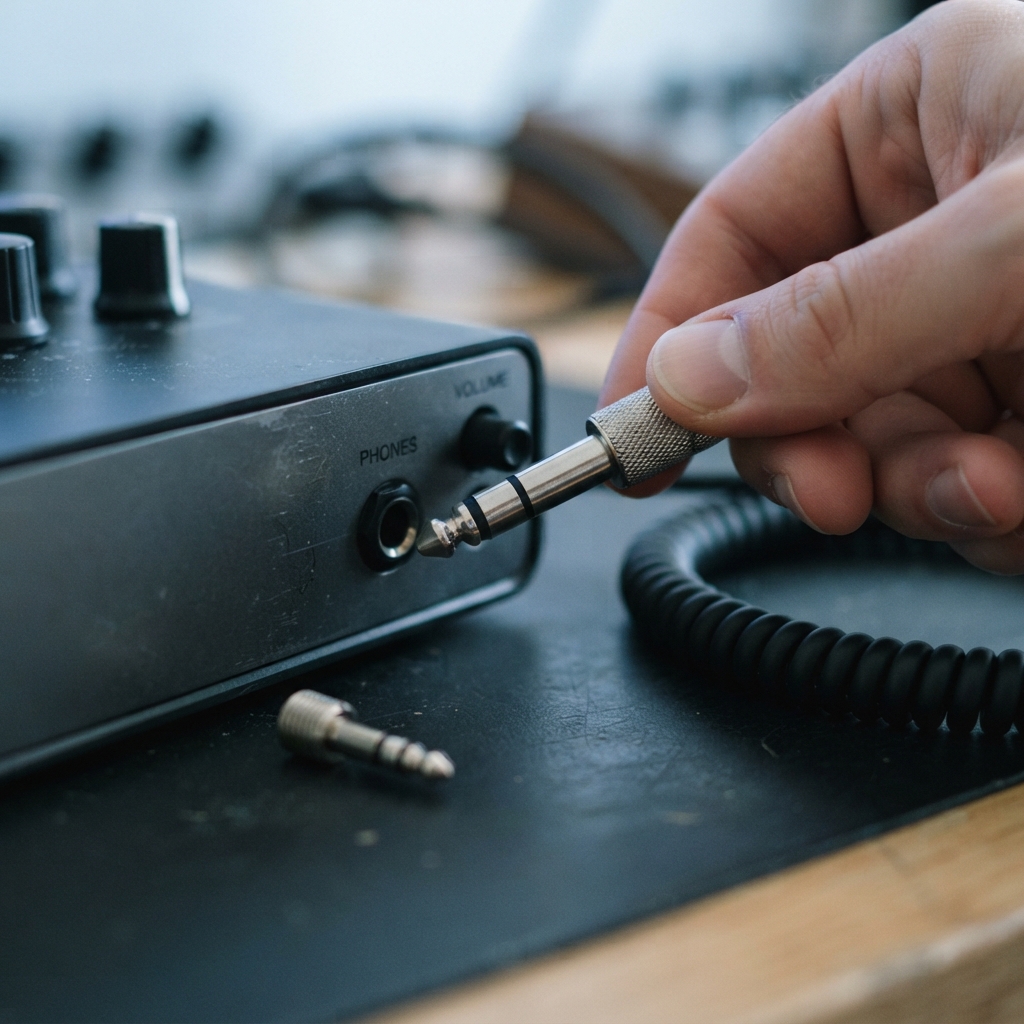
- Phones, tablets and laptops. Output voltage is limited and current delivery is modest. A 32 Ω load at normal sensitivity is the reliable choice; 250 Ω will usually play, but quietly, and often without the dynamics the driver is capable of.
- DJ mixers and controllers. Headphone outputs on DJ gear are designed to drive low-impedance loads at high level for cueing over a loud PA. 32 Ω is the native match, and it is why DJ models cluster at that figure.
- Audio interfaces and small consoles. These usually specify a maximum output level and an output impedance; both numbers tell you what the source can do. A 32 Ω or 80 Ω headphone both work, and 250 Ω often gives finer use of the level control because small knob movements produce smaller level changes.
- Rack headphone amplifiers and cue systems. Built for voltage swing and multiple outputs. This is the environment where a 250 Ω load behaves at its best, with more headroom before the amplifier runs out of clean output.
If a product line has to cover more than one of these, there are two clean strategies: standardise on 32 Ω and sell the same load everywhere, or offer one acoustic platform in several impedances and let the distributor stock the version their market asks for.
How the impedance options look in our own range
The Audfine monitoring range is built so that both strategies are available. Four published examples show how the same 50 mm neodymium driver platform is specified for different jobs; every figure below is taken from the model's published specification line.
| Model | Type | Driver | Impedance | Frequency response | Sensitivity | Power handling | Cable |
|---|---|---|---|---|---|---|---|
| AH2300 | Closed-back monitor | Ø50 mm neodymium | 32 Ω | 10 Hz–32 kHz | 98 ±3 dB | 350 mW rated / 1500 mW max | Detachable 3 m OFC, 3.5 mm + 6.35 mm adapter |
| AH1775 | Closed-back tracking monitor | Ø50 mm neodymium | 32 Ω | 18 Hz–35 kHz | 97 ±3 dB | 350 mW rated / 1500 mW max | Detachable 3 m OFC, 3.5 mm + 6.35 mm adapter |
| DH7600 | Closed-back DJ | Ø50 mm neodymium | 32 Ω | 10 Hz–40 kHz | 98 ±3 dB | 400 mW rated / 2000 mW max | Detachable 3 m OFC, 3.5 mm + 6.35 mm adapter |
| DH1771K | Open-back studio | Ø50 mm neodymium | 32 Ω, 80 Ω or 250 Ω | 10 Hz–35 kHz | 98 ±3 dB | 350 mW rated / 1500 mW max | Detachable 3 m OFC, 3.5 mm + 6.35 mm adapter |
The DH1771K is the clearest illustration of the platform argument: one open-back acoustic design, published at 10 Hz–35 kHz, 98 ±3 dB and under 0.15 % total harmonic distortion at 500 Hz, offered in three load impedances. A brand that wants a single model to serve a mobile-first market, an interface-based studio market and a console-based installation market can do it without a second tooling programme, a second set of test data or a second packaging design.
The other three models sit at 32 Ω and differ by job rather than by load: the product range covers closed studio monitoring, tracking with a foldable frame and 90° swivelling cups, and DJ work with the higher 2000 mW maximum input. If you are still mapping the range, the Audfine monitoring headphone model map groups every platform by application.
A note for distributors and brand owners
Impedance is one of the few specification decisions that changes the customer's day-to-day experience without changing the bill of materials much. That makes it a good commercial lever: one platform in three impedances is easier to stock and to explain than three separate models, and a distributor can hold 32 Ω as the volume line while keeping 250 Ω for studio accounts that ask for it. If you are planning a monitoring headphone line for your own market, tell us the source devices your buyers use most and we will confirm which published version matches them; availability and distributor terms are confirmed per order.
Common mistakes buyers make when specifying impedance
- Treating a higher number as an upgrade. 250 Ω is not a premium tier. It is a load that expects a specific class of amplifier, and on a laptop it is a downgrade in usable output.
- Reading headphone impedance without sensitivity. Loudness comes from the pair. A specification sheet that lists one without the other cannot be used to predict whether a headphone will play loudly enough.
- Ignoring the source's output impedance. An output impedance that is high relative to the headphone can tilt the response. Ask for the figure; if a supplier cannot provide it, the test conditions on the headphone data are worth questioning too.
- Assuming a phone and an interface behave the same. They do not. Test the actual source your customer will use, at the level they will use it, before approving a sample.
- Forgetting the cable and connector. Impedance matching is undone by a fixed 3 m cable with no adapter if the buyer's desk is 1 m from the source. Detachable cables with a 6.35 mm adapter cost little and remove a whole class of returns.
- Skipping the load test on the sample. A frequency sweep at one level, run at the intended source impedance, catches most of the mismatch problems before a purchase order exists.
What to put in the RFQ
An enquiry that gets a usable answer states the headphone impedance and the conditions around it:
- Nominal impedance required, and whether the line must also be available in other impedances from the same platform
- Sensitivity in dB/mW or dB/V, with the test condition stated
- Rated and maximum input power, as the basis for the warranty discussion
- The source devices the product must serve, including output level and output impedance if known
- Cable type, length, connector and whether the cable is detachable
- Connector adapter supplied in the box
- Sample quantity, and the level and duration of the load test you will run on the sample
- Packaging, branding and destination market for the first shipment
Our guide to reading a monitoring headphone spec sheet covers the remaining lines — frequency response tolerance, distortion and power handling — in the same way.
Frequently asked questions
What does headphone impedance mean in simple terms?
It is the electrical resistance the headphone presents to the amplifier, in ohms. A low figure (16–32 Ω) lets a small device such as a phone deliver enough current to play loudly; a high figure (250 Ω and above) needs a source that can supply more voltage.
Are high impedance headphones better?
Not inherently. High impedance loads suit studio consoles, rack amplifiers and multi-headphone cue systems because they draw less current and are less affected by the source's output impedance. On a phone or laptop, a high-impedance model usually plays quieter and offers no acoustic advantage.
Is 32 Ω or 250 Ω better for studio monitoring?
32 Ω is the safer choice when the monitoring position might be driven from a laptop, a camera or a small interface. 250 Ω is the better match when the cue system is a rack amplifier or console with enough voltage swing, where the headroom and lower noise floor are useful.
Can a 250 Ω headphone be used with a phone?
It will usually produce sound, but at a reduced maximum level and often with less dynamic range, because the phone's output voltage is limited. If mobile use matters, specify 32 Ω.
Does headphone impedance affect sound quality?
Impedance itself is not a sound quality figure. It affects loudness for a given input and, when the source's output impedance is high relative to the headphone, it can shift the frequency response. The acoustic design — driver, cup volume, damping, pad seal — decides the sound.
What is headphone output impedance and why does it matter?
It is the internal impedance of the headphone amplifier's output. Keeping it to roughly one-eighth of the headphone's nominal impedance is the common engineering guideline for predictable frequency response, especially in the bass region.
Can one headphone model be ordered in several impedances?
Yes. In our range the DH1771K open-back studio model is published at 32 Ω, 80 Ω and 250 Ω on the same acoustic design, so a brand can offer three load options from one platform. Other models in the range are specified at 32 Ω.
How do I test whether headphone impedance matches my source?
Run a frequency response sweep at your intended listening level from the actual source, compare the result with the published curve, and check for audible distortion at the loudest level your users will need. Do this before the purchase order, not after the first container.
Does impedance change the maximum input power?
Power handling is a separate published line: for example, 350 mW rated and 1500 mW maximum on our 50 mm monitoring models, and 400 mW rated and 2000 mW maximum on the DH7600 DJ model. Read the two figures together with impedance rather than inferring one from the other.
Can a headphone be damaged by a mismatched amplifier?
Damage is more often caused by excessive level than by impedance mismatch, which is why the rated and maximum input figures matter. Hearing exposure matters too: noise at or above 85 dBA averaged over a working day carries a recognised risk, as CDC NIOSH guidance on noise-induced hearing loss sets out, so cue levels and session length belong in the specification discussion.
Conclusion
Headphone impedance is one of the few specification lines that decides whether a product works on the customer's desk on day one. Read it together with sensitivity, match it to the source the buyer will actually use, and treat 32 Ω, 80 Ω and 250 Ω as three jobs rather than three grades: 32 Ω for portability and DJ cueing, 80 Ω as a flexible middle, 250 Ω where a proper amplifier is part of the system. When the carton leaves the factory with the right load for its buyer, the acoustic design gets judged on its merits.
If you are planning a monitoring headphone line and need to settle impedance, cable and cup design before sampling, send your source devices and target quantities through our contact form or the inquiry form, and we will confirm which published versions of the range match the specification.