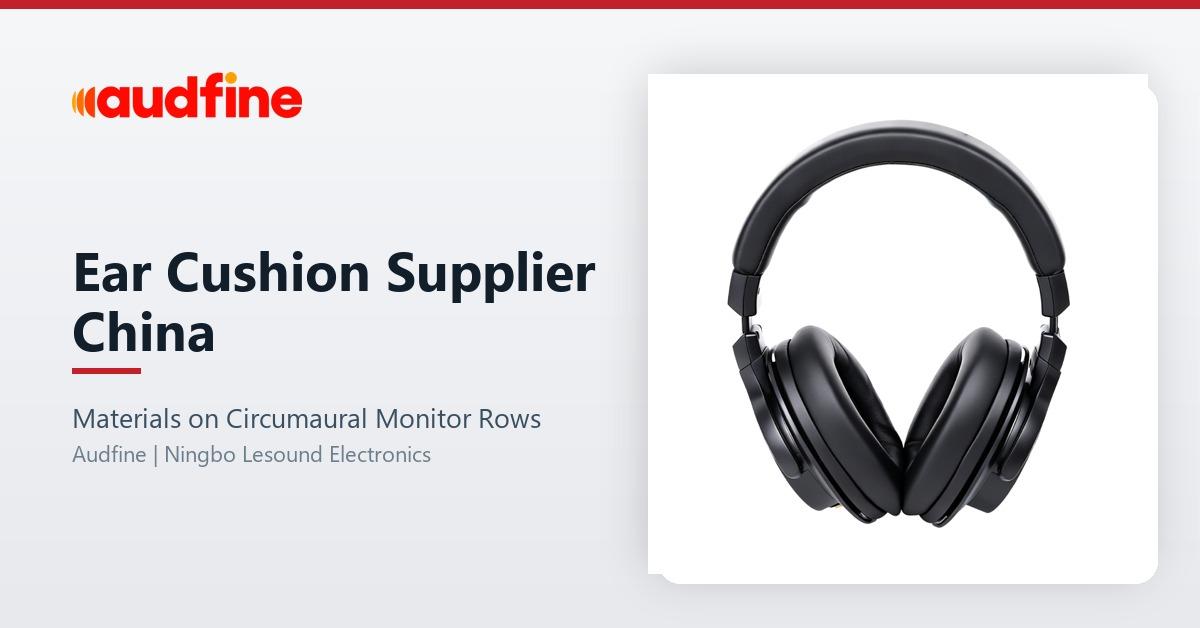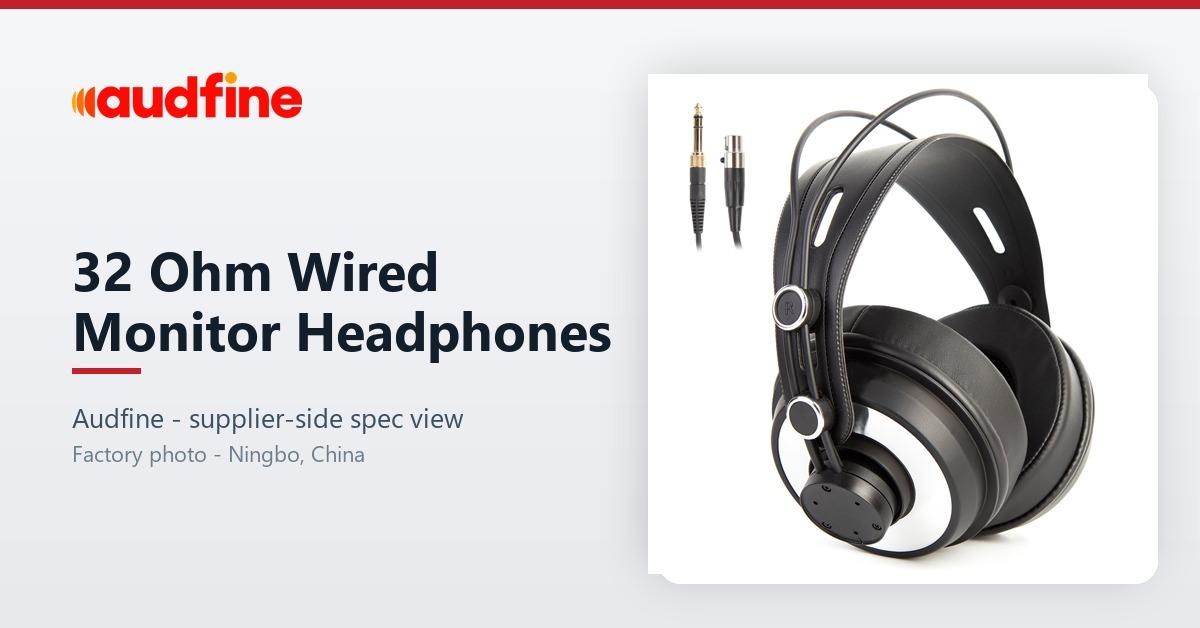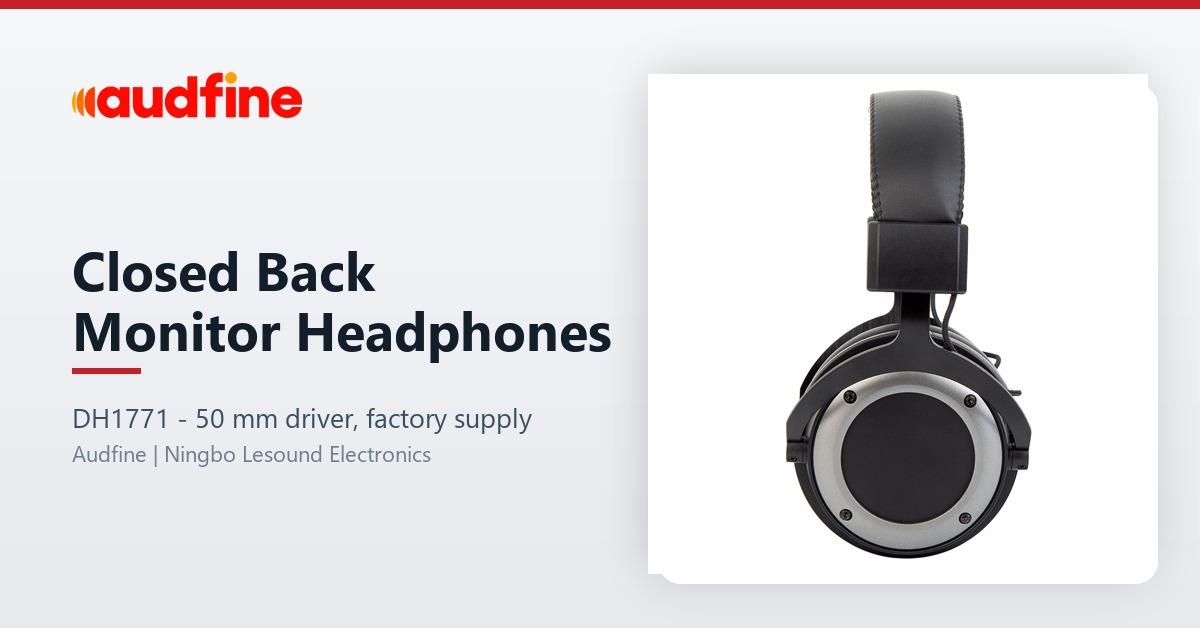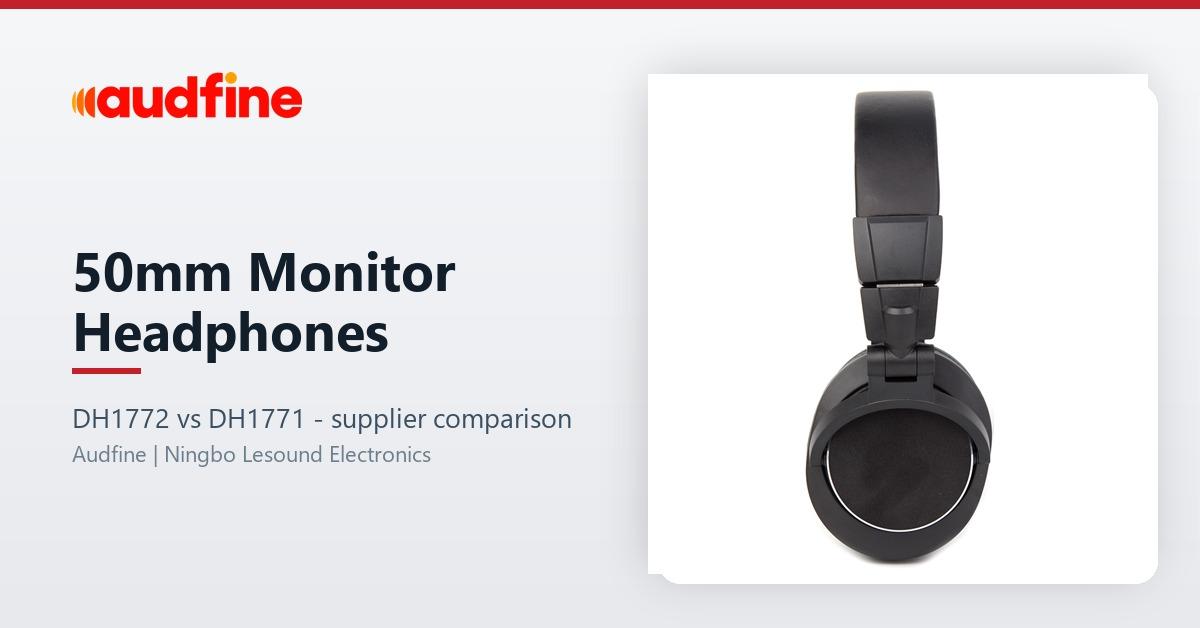
An ear cushion supplier China can specify a cushion by three published fields: the surface wording, the cup form, and the model the wording belongs to. On Audfine's sheet, DH1772 is printed with a soft skin-friendly material on a fully wrapping large earcup, a 50 mm driver, a 32 Ω load and 400 mW RMS. Audfine is the headphone brand of Ningbo Lesound Electronics, the manufacturer and brand owner in Ningbo, China. This page records the cushion wording printed on each named circumaural row and the fields the sheet leaves to an RFQ.
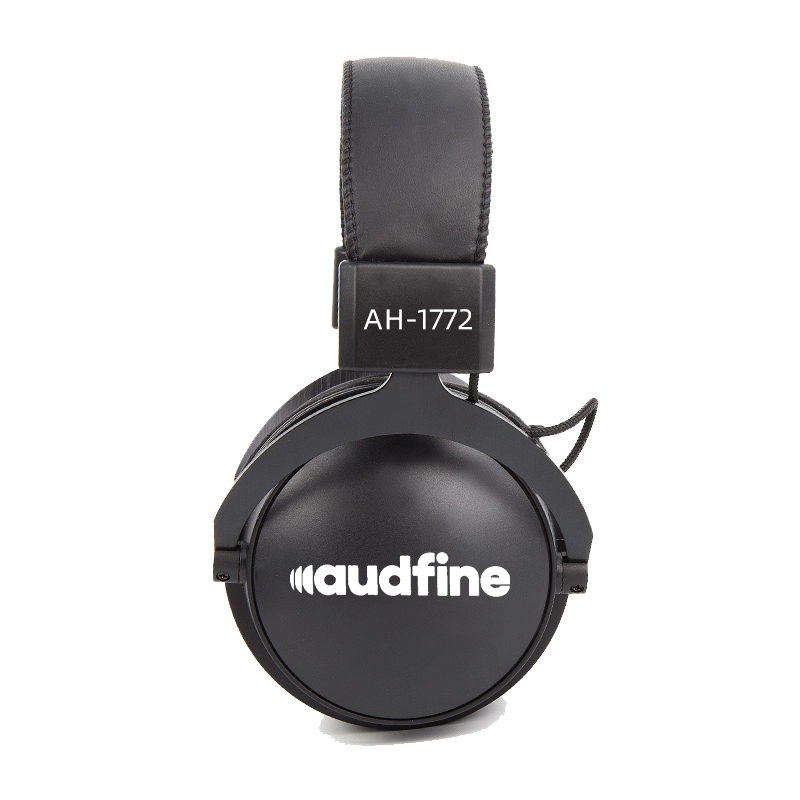
Data checked: November 2026. Source: Audfine headphone product sheet, named model rows and the positioning, core-metric and application columns. Cushion wording is copied from the positioning column; driver diameter, load, rated power and adapter from the core-metric column. Fields not printed on a row are left as confirm in RFQ.
What does an ear cushion supplier China actually publish about cushion material?
The sheet publishes descriptors, not chemical compounds. Three rows read soft skin-friendly material: DH1772 and DH1771 on the earcup, and MR830X on both the earcup and the headband. DH1772B is printed as the velour-earpad version of DH1772, with the word velour written into its core-metric line. DH7300 publishes the cup structure but no cushion material. None of these rows names a foam grade, a density or a leather type, so those fields belong in an RFQ rather than in a specification copied from a headline.
The distinction matters because a cushion is two things at once: a comfort part and a fit part. The sheet separates those descriptions. Soft skin-friendly material describes the surface that touches the listener. Fully wrapping large earcup describes how the cup sits around the ear. A buyer who quotes both fields against a named model gets a description that can be checked on the goods; a buyer who collapses them into one word gets a promise nobody can inspect.
| Model | Cushion wording on the sheet | Cup form | Driver | Load | RMS power | Adapter |
|---|---|---|---|---|---|---|
| DH1772 | Soft skin-friendly material, fully wrapping large earcup | Over ear, closed back | 50 mm | 32 Ω | 400 mW | 6.35 |
| DH1772B | Velour earpads, velour version of DH1772 | Over ear, closed back | 50 mm | 32 Ω | 400 mW | 6.35 |
| DH1771 | Soft skin-friendly material, large earcup fully wrapping the ear | Over ear, closed back | 50 mm | 32 Ω | 350 mW | 6.35 |
| MR830X | Soft skin-friendly material on earcup and headband; cup flips at multiple angles | Over ear, closed back, metal ear-cup | 45 mm | 32 Ω | 450 mW | 6.35 |
| DH7300 | Cup flips at multiple angles; cushion compound not published | Over ear, closed back, metal ear-cup, folds up | 50 mm | 32 Ω | 350 mW | 6.35 |
Values below are published sheet entries; unlisted fields require RFQ confirmation. Each row keeps its own wording, driver, load, power and cup description.
Which models share a cushion material, and which change it on the same platform?
DH1772 and DH1772B are the clearest pair. Both rows print a 50 mm dynamic driver, a 32 Ω load, 400 mW RMS, a detachable cable and a 6.35 adapter. The material line is where they separate: DH1772 reads soft skin-friendly material on a fully wrapping large earcup, while DH1772B is listed with velour earpads. The same acoustic platform therefore carries two published cushion options, and a buyer can specify either by naming the row.
DH1771 keeps the soft skin-friendly wording and the large earcup that wraps the ear, but its rated power reads 350 mW against the 400 mW of DH1772. MR830X extends the same surface wording to the headband and adds a 45 mm driver at 450 mW RMS. Its cup flips at multiple angles for single-ear monitoring. The DH1772 factory note keeps that platform on its own page, and the custom earpad programme note covers the ordering side when a buyer wants a cushion made to a drawing rather than taken from a published row.
For the frequency field, the two DH1772 rows carry a printed range of 10 Hz to 35 kHz on their parameter line. The other rows in this table do not print a frequency range on that line, so that value is not carried across to DH1771, MR830X or DH7300.
How does cup form change what a supplier can specify?
Every row above is printed over ear. Within that fit, two structures are named. MR830X and DH7300 print a metal ear-cup and a cup that flips at multiple angles; DH7300 also folds up. DH1772 and DH1771 print no flip, and the positioning column notes that they are not intended for single-ear monitoring or wearing around the neck. Those are structural facts attached to models, and they constrain which cushion description is meaningful.
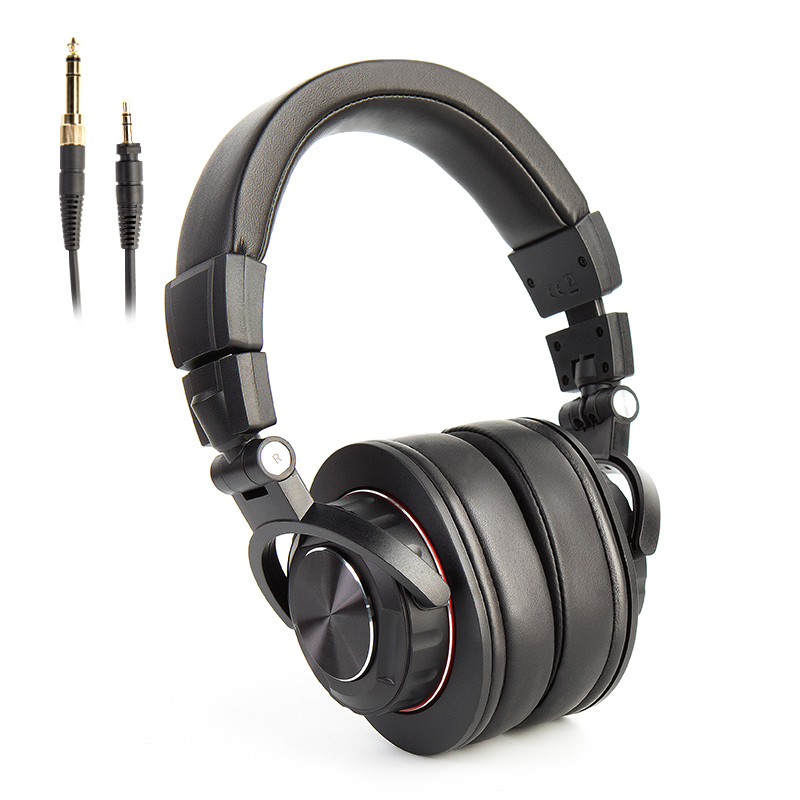
A swivel cup is handled, flipped and folded in ways a fixed cup is not, so the cushion on that model is asked to stay attached through movement. The sheet does not publish a cycle count or a retention figure for either construction. Ask for the attachment method and any test conditions in the enquiry rather than reading a durability result into the word swivel. The headband component note covers the matching crown part, and the closed-back supplier note sets out the cup families side by side.
What should a buyer put in an RFQ to an ear cushion supplier China?
Ask for the model, the field and the wording on the same line. That is the only way to attach a cushion description to a row that can be checked later.
- Model first. Write DH1772, DH1772B, DH1771, MR830X or DH7300. A cushion note printed on one row does not describe another.
- Surface wording. Ask for the exact sheet wording: soft skin-friendly material, or velour earpads.
- Cup form. State over ear and closed back, and whether the sheet says fully wrapping or flips at multiple angles.
- Context figures. Request the 50 mm or 45 mm driver, the 32 Ω load and the rated power as printed on that row.
- Adapter and cable. Confirm the 6.35 adapter and the detachable cable for the named model.
- Unpublished fields. Put the foam grade, density, leather type and any retention figure in the enquiry as questions — confirm in RFQ.
- Headband. On MR830X, ask for the headband surface wording separately; the sheet prints it on the same line as the earcup.
Units and quantities are stated under defined conditions. As defined in the terminology work of the International Electrotechnical Commission, an electrical quantity is described with its conditions attached; the Audio Engineering Society maintains measurement vocabulary for audio equipment. Those bodies define how a quantity is described. They do not assess this product, and no conformity statement is made here. The Audfine studio monitoring headphone range is the product-side reference for the professional rows, and the 32 ohm supplier note reads the same rows from the load side.
Frequently asked questions
Which model prints velour earpads?
DH1772B. Its core-metric line names velour earpads and the positioning line calls it the velour version of DH1772. The two rows share a 50 mm driver, a 32 Ω load, 400 mW RMS, a detachable cable and a 6.35 adapter, so the cushion wording is the published difference between them. DH1772 itself is printed with a soft skin-friendly material on a fully wrapping large earcup.
Does the sheet name a foam grade or a leather type?
No. It prints soft skin-friendly material on DH1772, DH1771 and MR830X, and velour earpads on DH1772B. It does not publish a foam grade, a density, a compound name or a leather type. Those are legitimate questions for an RFQ, but writing one of them into a specification as though it were printed would put a value on the page that the sheet does not contain.
Are the DH1772 and DH1771 cushions described the same way?
Both rows use the soft skin-friendly wording and both describe a large earcup that wraps the ear. DH1772 is printed at 400 mW RMS with a stated 10 Hz to 35 kHz range on its parameter line; DH1771 is printed at 350 mW RMS without that range on its line. The cushion descriptors match; the other fields do not, and each belongs to its own model.
Which rows mention a cup that flips?
MR830X and DH7300. Both print a metal ear-cup and a cup that flips at multiple angles; DH7300 also folds up. MR830X prints soft skin-friendly material on the earcup and headband. DH7300 publishes no cushion material, so that field stays as confirm in RFQ.
Can I order a cushion made to my own drawing?
Yes, through a custom programme rather than a published row. The sheet records what each named model ships with; a cushion made to your own geometry, attachment or surface is a separate enquiry. The custom earpad supplier note sets out the drawing, material reference and attachment fields such a programme needs.
Specify the cushion on the named row
For an ear cushion supplier China, the useful unit of comparison is one printed row, not a material heading. Audfine keeps the cushion wording beside the driver, load and power of DH1772, DH1772B, DH1771, MR830X and DH7300 so a buyer can quote it back and check it line by line, and sends unpublished fields to the RFQ.
Contact the Audfine team to specify a cushion on a named model.