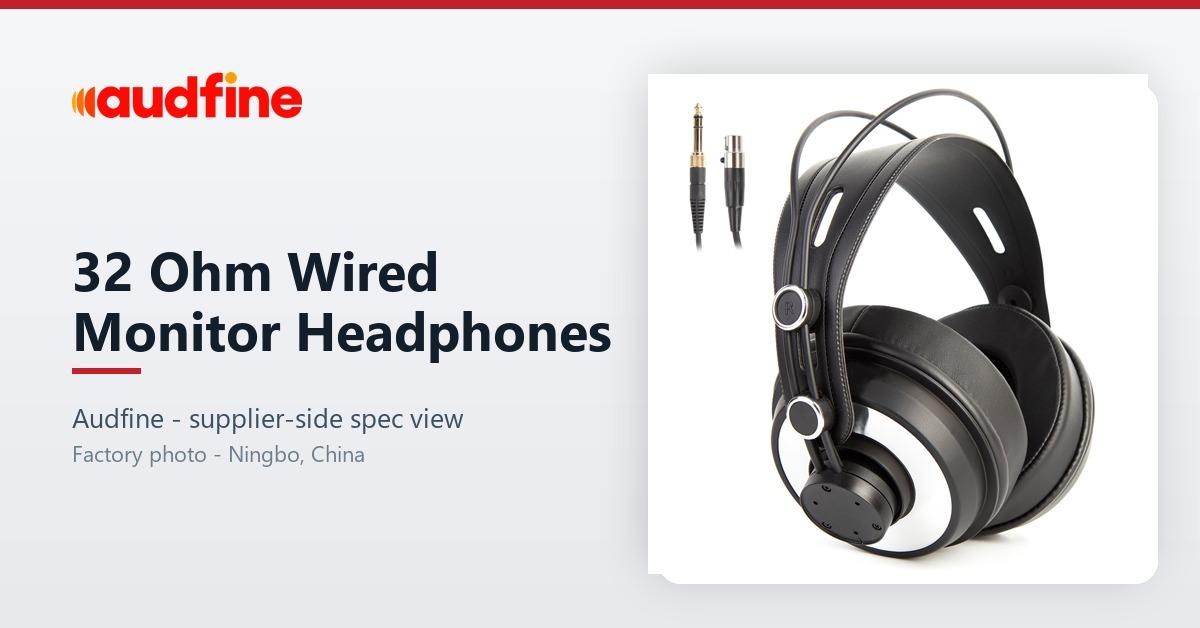
A 32 ohm headphones supplier China can list one impedance value across an entire wired range and still keep each model's other numbers separate. Audfine prints DH1772 at 32 Ω, Ø50 mm, 400 mW RMS, 1800 mW maximum, 99±3 dB and 10 Hz–35 kHz, with a braided 3 m detachable cable. Audfine is the headphone brand of Ningbo Lesound Electronics, the manufacturer and brand owner in Ningbo, China. This page records which named rows carry a 32 Ω load and which fields change from row to row.

Data checked: November 2026. Source: Audfine headphone product sheet, named model rows and the positioning, core-metric and application columns. Driver diameter, impedance, rated and maximum power, sensitivity, frequency range and cable notes were copied from those rows. Fields not printed on a row are left as confirm in RFQ.
What does a 32 ohm headphones supplier China print on a base row?
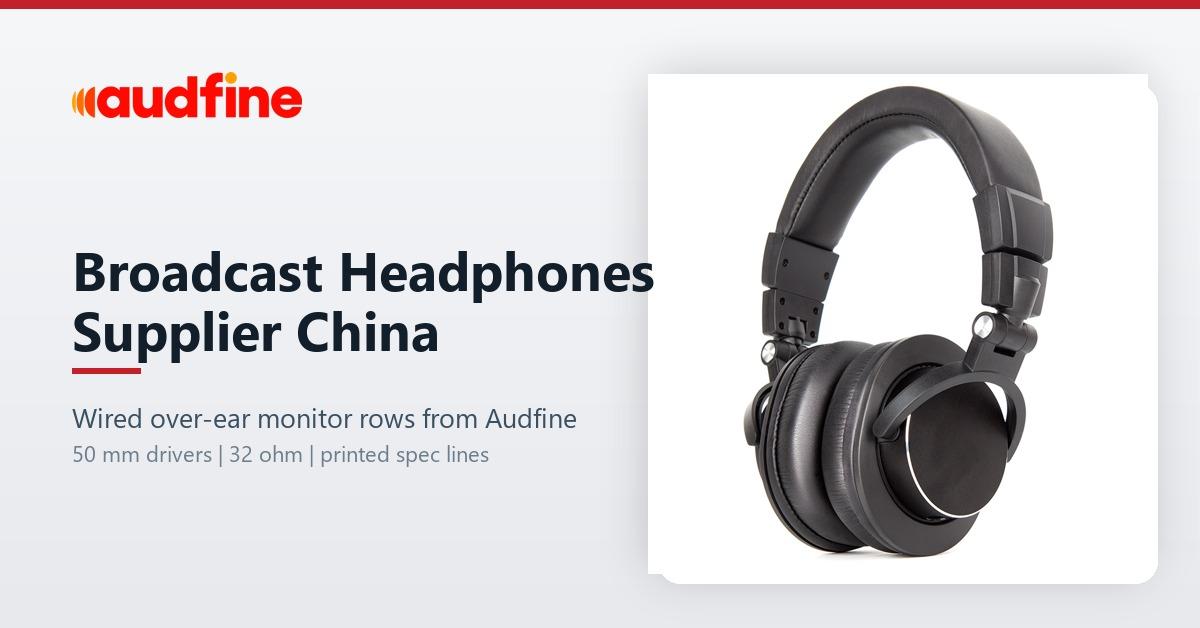
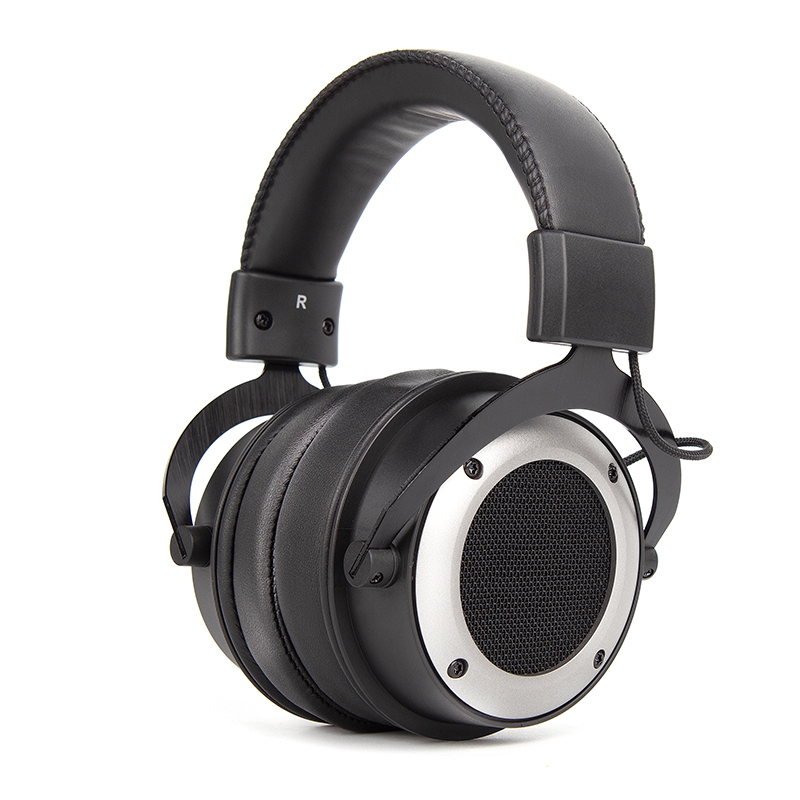
DH1772 is printed as a wired over-ear closed-back monitor with a 50 mm dynamic driver, a NEO magnet and a 32 Ω load. Rated power reads 400 mW RMS and maximum input reads 1800 mW. Sensitivity reads 99±3 dB and the frequency range reads 10 Hz–35 kHz. The cable line reads braided 3 m, detachable, with a 3.5 to 6.35 adapter.
Each figure is attached to the model name. A buyer can ask for that same line back from any supplier and check it field by field. The positioning column places DH1772 in the professional grade, for instrument and professional monitoring, with clean sound and high detail, recommended for studio work. It also records the limits: the earcup does not swivel, so the model is not described for single-ear monitoring or for wearing around the neck. Our DH1772 factory note keeps that single platform on its own page.
Values printed on the 32 Ω rows
The table below is copied from the named model rows of the Audfine sheet. Values below are published sheet entries; unlisted fields require RFQ confirmation. Each row keeps its own driver, power, sensitivity and cable description. One open-back row is included only so its structure is not carried over to the closed-back rows.
| Model | Driver | Load | RMS power | Max power | Sensitivity | Frequency range | Cable / cup |
|---|---|---|---|---|---|---|---|
| DH1772 | Ø50 mm | 32 Ω | 400 mW | 1800 mW | 99±3 dB | 10 Hz–35 kHz | Braided 3 m / closed back |
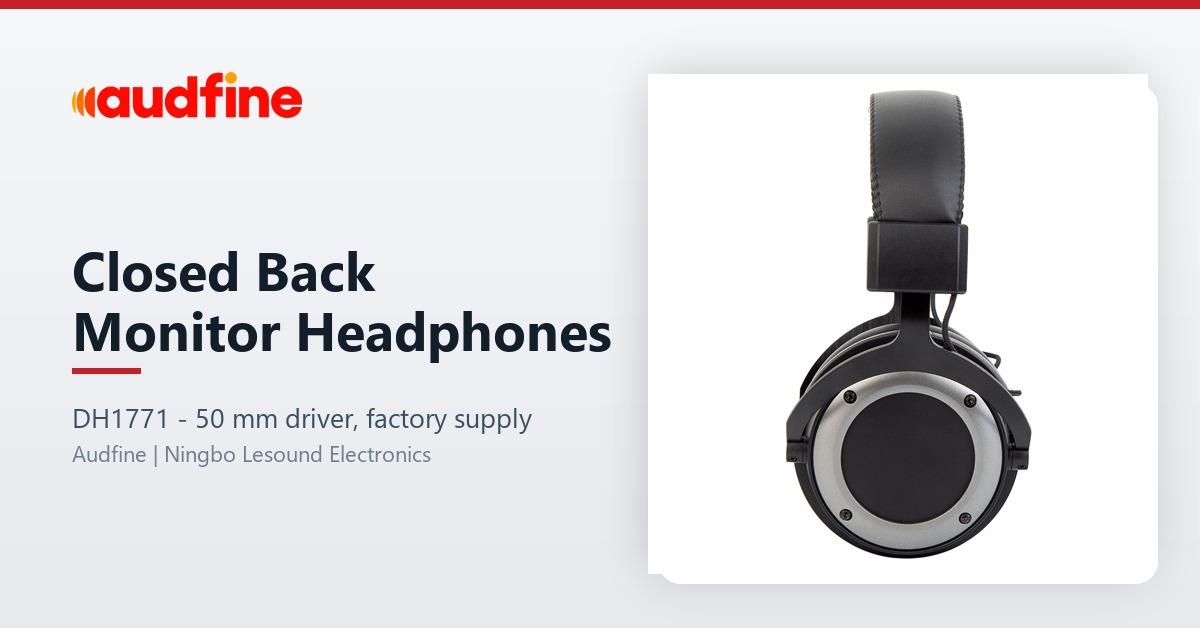
| DH1771 | Ø50 mm | 32 Ω | 350 mW | 1500 mW | 98±3 dB | 10 Hz–35 kHz | Braided 3 m / closed back |
| DH1771K | Ø50 mm | 32 Ω | 350 mW | 1500 mW | 98±3 dB | 10 Hz–35 kHz | Braided 3 m / open back |
| DH7300 | Ø50 mm | 32 Ω | 350 mW | 1800 mW | 97±3 dB | 10 Hz–40 kHz | Coiled 4 m / closed back, metal cup |
| MR830X | Ø45 mm | 32 Ω | 450 mW | 1500 mW | 99±3 dB | 12 Hz–28 kHz | 3 m / closed back, metal cup |
| DH4100 | Ø50 mm | 32 Ω | 400 mW | 1500 mW | 100±3 dB | 18 Hz–28 kHz | 3 m / closed back, folds up |
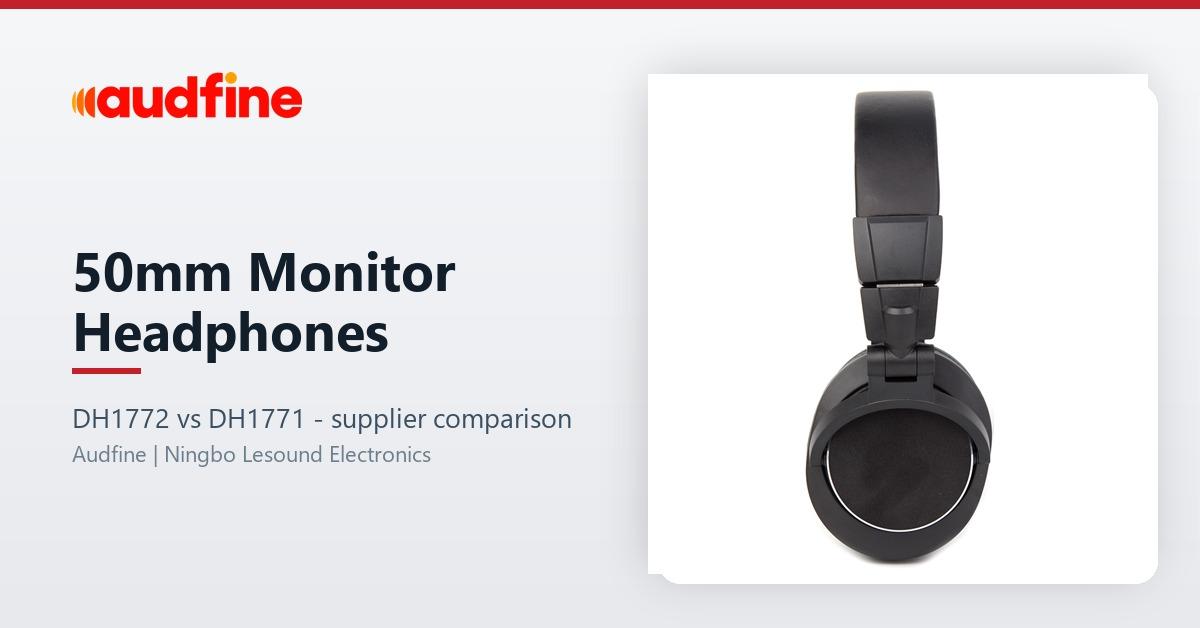
A shared load does not make these rows identical. DH1772 and DH1771 both print Ø50 mm and 32 Ω, but the rated power is 400 mW against 350 mW and the maximum is 1800 mW against 1500 mW. DH7300 keeps 350 mW RMS yet runs to 40 kHz and carries a coiled 4 m lead. MR830X is the only row at Ø45 mm and 450 mW RMS. DH4100 prints 100±3 dB, the highest sensitivity figure in this set, on a folding frame. The 50 mm platform comparison reads two of these rows side by side.
Which rows belong to the professional grade and which do not?
The positioning column places DH1772, DH1771, DH1771K, DH7300 and MR830X in the professional grade. DH4100 is printed as standard grade, for home studio, mid-range and instrument use, and is recommended for carrying out. Its frame folds up; the cable is detachable at 3 m. Grade is a classification written on the row, not a value derived from impedance, so a 32 Ω load cannot be used to promote DH4100 into the professional column.
The closed-back supplier note separates the cup structures of DH1771 and DH1771K. The Audfine studio monitoring headphone range is the product-side reference for the professional rows. A buyer who needs a different cup can read the open-back and closed-back lines separately. The broadcast monitoring note applies the same rule: name the row, then the impedance.
Where does 32 Ω sit relative to the other impedances in the range?
32 Ω is the load printed on the base rows of the sheet, including DH1772, DH1771, DH1771K, DH7300 and MR830X. The same sheet also prints DH1772-80ohms at 80 Ω with 400 mW RMS, 99±3 dB and 10 Hz–35 kHz, and DH1773-80ohms at 80 Ω with 350 mW RMS. DH274 is printed at 60 Ω with a 53 mm driver and a fixed cable. These are separate rows with separate values, not conversions of the 32 Ω figures. Variant rows whose model name and specification column disagree are excluded from this table rather than assigned a number by inference.
Impedance is one field on a row. As defined in the terminology work of the International Electrotechnical Commission, electrical quantities are stated under defined conditions; the Audio Engineering Society maintains measurement vocabulary for audio equipment. Those bodies define how a quantity is described. They do not assess this product, and no conformity statement is made here. Our cable assembly note covers the connector and length options as components.
What should a buyer put in an RFQ to a 32 ohm headphones supplier China?
Ask for the model, the field and the unit on the same line. That is the only way to attach a printed figure to a row that can be checked later.
- Model first. Write DH1772. A value printed on DH1771, DH7300 or MR830X does not describe this row.
- Load and driver. Ask for 32 Ω and Ø50 mm with units attached, as printed beside DH1772.
- Power fields. Request 400 mW RMS and 1800 mW maximum separately. Do not merge rated and maximum into one figure.
- Sensitivity band. Ask for 99±3 dB as printed, with the tolerance, rather than a midpoint value.
- Frequency range. State both endpoints, 10 Hz–35 kHz, next to the model name.
- Cable and adapter. Confirm braided 3 m and the 3.5 to 6.35 adapter for this specific row.
- Unlisted fields. Put them in the enquiry as questions and wait for a written answer — confirm in RFQ.
Frequently asked questions
Is DH1772 a 32 ohm closed-back monitor?
Yes. The Audfine sheet prints DH1772 as a wired over-ear closed-back monitor with a 50 mm dynamic driver, a 32 Ω load, 400 mW RMS, 1800 mW maximum, 99±3 dB and 10 Hz–35 kHz. Its cable line reads braided 3 m and detachable with a 3.5 to 6.35 adapter. DH1771K is the open-back variant of the same platform and is listed on its own row.
Do all 32 ohm rows share the same power rating?
No. Within the six rows above, the rated power runs from 350 mW on DH1771, DH1771K and DH7300 to 400 mW on DH1772 and DH4100 and 450 mW on MR830X. Maximum input is printed separately: 1500 mW on four rows and 1800 mW on DH1772 and DH7300. Rated and maximum are two fields and should be requested as two fields.
Does a 32 Ω load mean the model is studio grade?
No. The grade is written in the positioning column. DH1772, DH1771, DH1771K, DH7300 and MR830X are printed as professional grade; DH4100 is printed as standard grade. Both sets carry a 32 Ω load. The application column, not the impedance figure, is the field that states the intended scenario.
Which cable is printed on DH7300?
DH7300 is printed with a coiled 4 m detachable cable and a 3.5 to 6.35 adapter. DH1772 and DH1771 are printed with braided 3 m leads; DH4100 and MR830X with 3 m detachable leads. Length and form are row-specific and should be confirmed for the named model.
Can I order a mixed set of these rows?
Ask in the enquiry. The sheet prints each model as a separate row with its own driver, load, power, sensitivity and cable values. A written confirmation should name each model and repeat the field values you want attached to it; unlisted fields stay as confirm in RFQ.
For a 32 ohm headphones supplier China, the useful unit of comparison is one printed row, not the impedance heading. Audfine keeps that row visible for DH1772 and its siblings so a buyer can quote it back and check it line by line.