Here is how most compact array enquiries start. A rental company or an installer finds every small line array system supplier it can, copies the same one-line message to each of them, and sits back. What comes back? A pile of quotations nobody can compare. Different driver counts. Different sensitivity figures. Three different opinions on how many boxes the job needs. The sizing work has to happen first — and most of it can be done from published specifications alone, before anyone talks terms.
This guide covers the compact end of the line array market. In our range, that means two-way active modules built around paired 6.5-inch, 8-inch and 10-inch woofers. We will walk through the sizing decisions a buyer should settle before asking for quotations, then list the details that turn an enquiry into something a factory can actually quote. For the full-size formats used in festival and arena work, the active line array speaker systems technical guide covers the larger side of the catalogue.
What "compact" means in line array terms
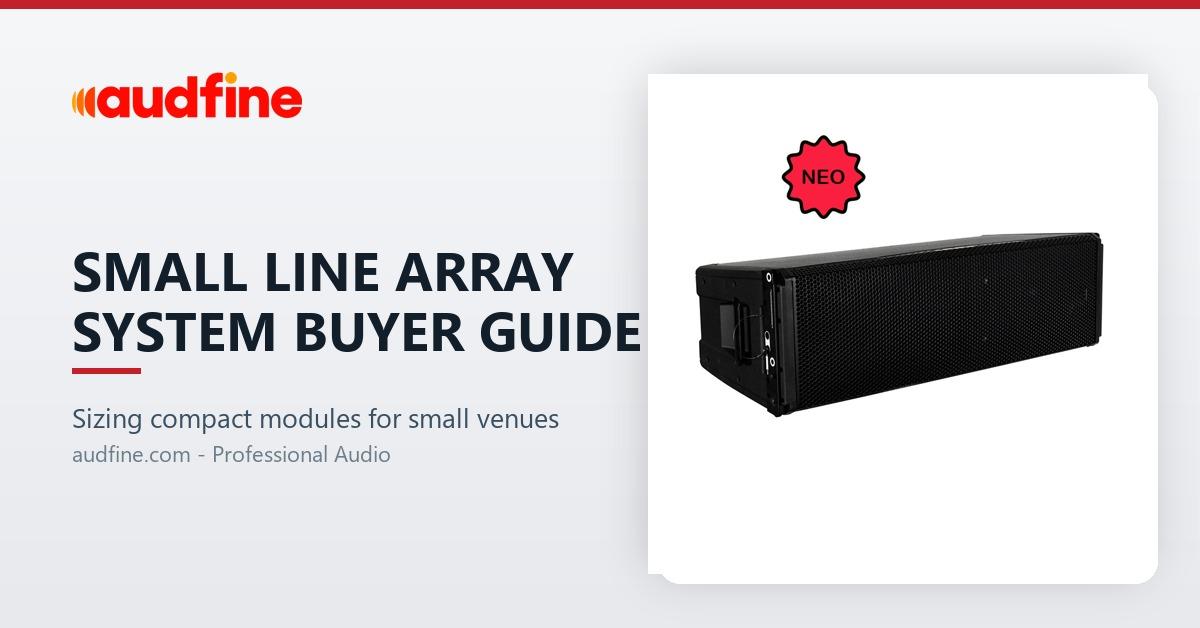
A full-size touring array runs on 12-inch three-way cabinets, engineered flying frames and a truck pack to match. The compact segment keeps the design logic and drops the tonnage. Several elements still couple vertically, so coverage behaves like a line source rather than one point in the air. But each module now pairs two mid-woofers per box, crosses over around 2 kHz, and stays light enough for pole mounting or a short hanging frame.
Who buys this format? Houses of worship. Hotel ballrooms. Meeting and training rooms. Municipal halls, schools, corporate event houses, and rental fleets covering small to medium rooms. The common thread: a room where a full-size array is overkill, yet a pair of point-source boxes on sticks no longer covers evenly from the front row to the back wall.
The compact family at a glance
The table below pulls the published figures from the individual product pages. All values are as printed. If a figure matters to your project, ask for the measurement condition behind it — we do that in quotation replies as a matter of routine.
| Model | Configuration | Sensitivity | Max SPL @ 1m | Power | Frequency response | Crossover |
|---|---|---|---|---|---|---|
| HDL26 | Active 2-way, 2×6.5" woofer, 2" v.c., 40 OZ ferrite | 95 dB | 131 dB | 250W RMS / 500W peak | 95 Hz – 20 kHz | 2.0 kHz |
| HDL28 | Active 2-way, 2×8" woofer, 2.5" v.c., 50 OZ ferrite | 98 dB | 131 dB | 700W RMS / 1400W peak | 85 Hz – 20 kHz | 2.0 kHz |
| HDL210 | Active 2-way, 2×10" woofer, 2.5" v.c., 50 OZ ferrite | 99 dB | 131 dB | 700W RMS / 1400W peak | 75 Hz – 20 kHz | 2.0 kHz |
| PL210 | Active system: 2×10" array modules + 36 mm driver, matched 18" subwoofer, 4" v.c., 125 OZ ferrite | 98 dB | 130 dB | 1000W + 700W×4 RMS | 45 Hz – 20 kHz (system) | — |
| HDL50-A (full-size reference) | Three-way: 2×12" woofer (3" v.c., NEO) + 4×6.5" midrange (2" v.c., NEO) | 104 dB | 140 dB | 2200W RMS / 4400W peak | 45 Hz – 18 kHz | 200 Hz / 800 Hz |

Start with the HDL26 active line array speaker. It is the entry point: 250W RMS, a 95 Hz printed low limit, and a pair of 6.5-inch woofers per box. Speech-first programmes are its home ground — lecture capture, conference reinforcement, ceremony audio, fixed installs where the programme rarely dips low. One thing worth noticing: its printed 131 dB maximum SPL matches the larger siblings exactly. Published numbers follow each model's own measurement conditions, not one uniform test. Keep that in mind whenever two datasheets sit side by side.
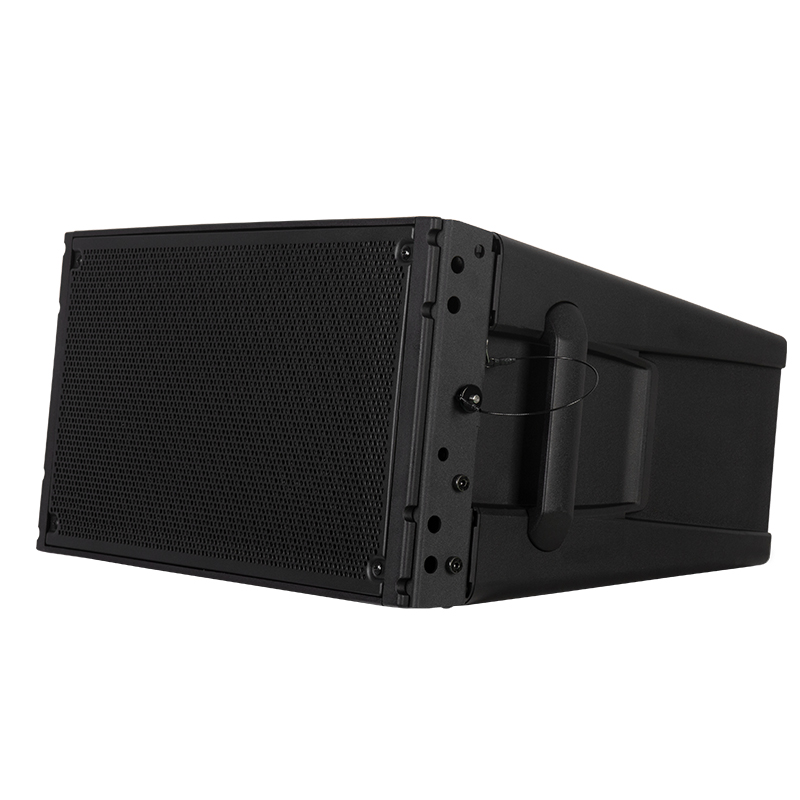
Next, the HDL28 8-inch line array speaker. The voice coil grows to 2.5 inches, power doubles to 700W RMS, and the printed bottom drops to 85 Hz. Most rental houses standardise here. Why? Enough headroom for background-to-moderate music playback, and still light enough that a two-person crew can load in and be done before the client's coffee goes cold.

The HDL210 dual 10-inch line array speaker keeps the 700W RMS rating and moves to bigger cones. 75 Hz. Roughly 4 dB more sensitivity than the HDL26. Buyers who want one compact module that handles spoken programme and music without a subwoofer in the room usually start their shortlist right here.
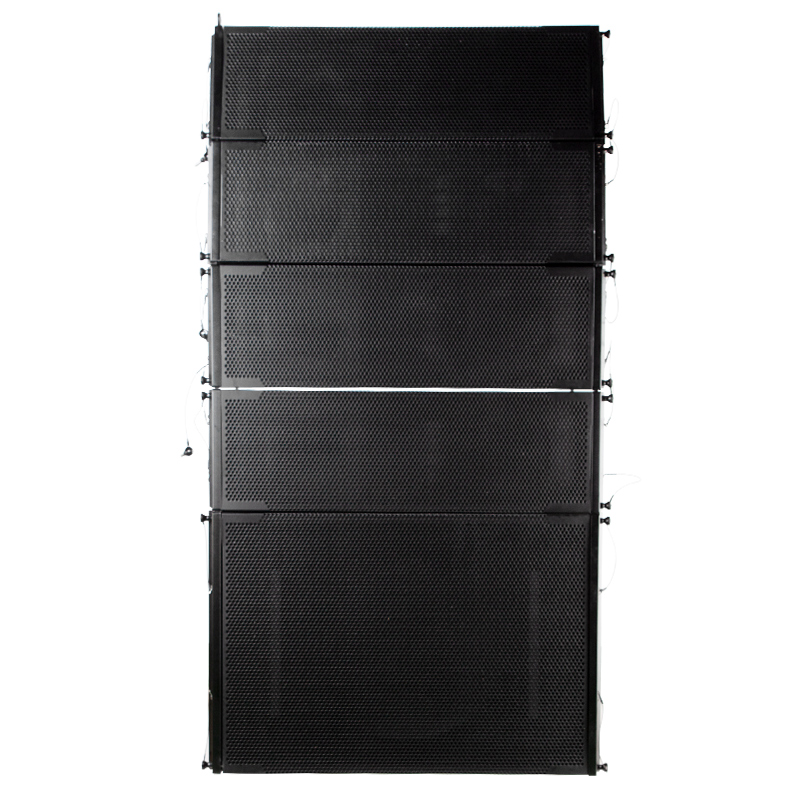
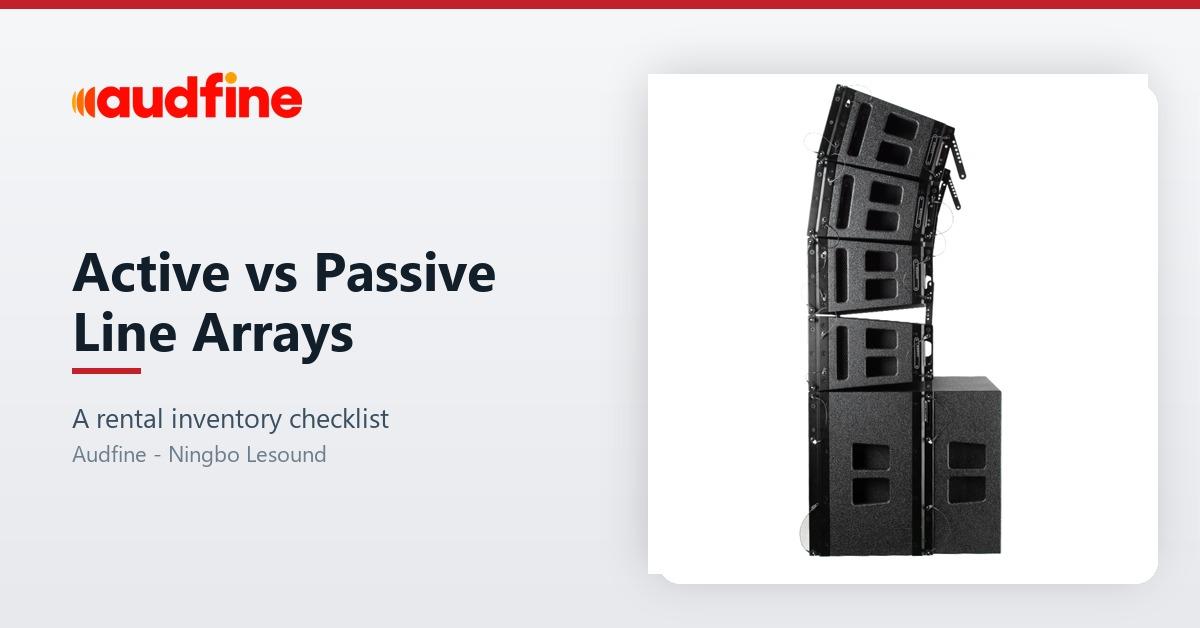
Then there is the PL210 10-inch line array speaker system, which takes a different route altogether. No standalone top box. It ships as a matched package: array modules over an 18-inch subwoofer, with the product page describing Class-D amplification and programmable DSP. Note the 45 Hz figure — that is a system response, not a module response — and the power rating (1000W + 700W×4 RMS) reflects the multi-channel amplifier layout behind it.
Where does the HDL50-A row fit? It is there for scale. A 12-inch three-way cabinet printing 104 dB sensitivity and 140 dB maximum SPL belongs to a different class of hardware, for audiences and distances the compact family is not built to cover. Browse the active line arrays category and the full ladder sits side by side.
What the woofer size actually changes
Three columns in that table do most of the sizing work. Everything else is detail.
Low-frequency limit. The printed response floors move from 95 Hz (2×6.5") to 85 Hz (2×8") to 75 Hz (2×10"). Speech intelligibility sits comfortably above all three. Reproduced music does not. A programme that includes full-range music playback generally wants either the HDL210 or a subwoofer in the signal plan — whichever module ends up in the quotation.
Sensitivity. Each 3 dB of sensitivity halves the amplifier power needed for the same acoustic output. The compact family spreads across 95, 98 and 99 dB, so within the trio the sensitivity difference is small. The real step is towards the HDL50-A class at 104 dB. That is why big rooms graduate to full-size boxes rather than simply buying more compact ones.
Printed maximum SPL. All three compact modules publish 130–131 dB at one metre. Now, here is a habit worth picking up: when a printed maximum cannot be reproduced from the sensitivity and power figures with a simple logarithmic sum, ask which drive signal and measurement window the figure refers to. Published values take precedence over back-of-envelope arithmetic. Reputable factories will state the condition behind the number; the ones that will not are telling you something too.
Estimating throw before committing to a count
Every sizing exercise answers one question in the end: how loud is this system at the back of the room?
As a planning estimate in free-field conditions, sound pressure from a point source falls by about 6 dB per doubling of distance. Take the printed 131 dB maximum of an HDL28 at one metre. At 16 metres, that works out to roughly 107 dB as a peak planning figure (131 − 6×4).
Treat that number for what it is — a planning approximation, nothing more. A real hang couples several elements vertically, which changes how level decays with distance in the coupled band. Room reverberation, audience absorption and wind all push the result further. Most specifiers plan noticeably more headroom for live music than for speech. The honest way to close the gap? State the target level and throw distance in the enquiry, and let the supplier model the array count instead of guessing it.
Rigging and deployment options
Compact modules offer three deployment routes. The choice affects the quotation as much as the driver count does, so settle it early.
Pole mounting on a subwoofer or tripod is the fastest route, and the default for mobile work. Ground stacking suits fixed installs with a stage lip or a riser to work from. Flying — hanging the array from ceiling points or goalposts — gives the cleanest sightlines and the most repeatable geometry. But a flown array is an engineered structure: it must be designed, calculated and installed by qualified rigging personnel, in line with local regulations. Array frames, pins and safety factors are engineered components, not accessories to improvise. Neither this guide nor the product pages publish working load figures, and none should be assumed from cabinet weight alone.
Hang geometry follows the room. Straighter hangs throw further into deep rooms; progressive curvature brings the lower modules inward for coverage near the stage. Our modules fly on dedicated frames, so the practical curvature range is set by the frame design. One more reason to describe the venue when you request a quotation instead of specifying a module count in isolation.
Subwoofer pairing
Speech-only rooms can run the compact trio without low-frequency reinforcement, within the printed response limits above. Music programmes are a different case. The PL210 solves this by design — the 18-inch subwoofer is part of the system, matched and amplified as one package. Buyers who prefer the modular route can pair HDL210 or HDL28 arrays with separate subwoofers from the catalogue, which keeps the fleet flexible between jobs. The same approach we outline for larger rooms in the line array with subwoofer configuration guide.
Requesting a quotation: what to put in the RFQ
A complete enquiry separates a quotable project from a chain of clarifying emails. Honestly, the difference is stark on our side: a full RFQ gets a system proposal within one working cycle, while a one-line message gets questions. Any small line array system supplier moves faster — and quotes more accurately — when the enquiry carries the details below.
- Venue and audience: room dimensions, ceiling height and expected audience capacity, indoors or outdoors.
- Application: speech only, music playback, live performance, or a mix with the expected weighting.
- Coverage targets: the distance the last row sits from the array and the level you want there.
- Array count and geometry: how many hangs or poles per side, and whether flying points already exist.
- Low-frequency plan: whether subwoofers are needed, and whether a matched system like the PL210 or separate subs are preferred.
- Deployment constraints: crew size, transport limits, storage space between events.
- Customisation needs: cabinet colour, grille, logo and packaging, if the programme is for a brand or rental fleet with house standards.
- Logistics: destination port so the quotation can be built on the correct trade terms from the outset.
Send those eight lines and the reply becomes a system proposal, not a generic catalogue dump. Better still, every offer is sized against the same inputs — so comparing quotations finally means something.
How to compare the quotations that come back
So the offers have landed. More than one small line array system supplier, more than one set of numbers. Before looking at anything commercial, compare them on five axes. The woofer configuration and voice coil behind each module. The measurement conditions behind sensitivity and maximum SPL. What the rigging hardware actually includes. Whether the system can grow later by adding identical modules. And how spare drivers and replacement parts are supported over the life of the fleet. Two quotations that look close on a summary sheet can differ on every single one of those axes.
Frequently asked questions
Are compact line arrays suitable for outdoor events?
Within their printed SPL limits, yes — small stages, ceremonies and corporate outdoor functions are standard use cases. That said, the published product pages do not quote an ingress protection rating. For installations that stay exposed to weather, state the environmental conditions in the enquiry and confirm the protection approach with the supplier before the order is finalised.
How many modules per side does a small venue need?
It follows from throw distance and target level, not from a fixed rule. As an order of magnitude, short throws for speech can work with a small number of elements per hang, while music programmes with a 15–20 metre throw usually justify a longer hang or the step up to larger modules. Model the two or three candidate configurations against the printed figures first. Commit after that, not before.
Can compact modules be mixed with full-size cabinets in one hang?
Mixing different module types in a single flown array is not standard practice. Frames, weights and acoustic alignment are designed per family. Where a room needs both, the usual approach is separate zones or separate hangs, each aligned on its own.
What if the room layout changes between events?
That is the rental case for pole-mounted systems. Keep one array geometry as the reference. Note the coverage each room achieved. Adjust module count from event records rather than from memory. Fleets that log this information size their next order with far fewer surprises.
Preparing an enquiry for a compact or mid-sized room? Send the venue details and application through our contact page. The team will come back with a sizing proposal built on the printed specifications above.