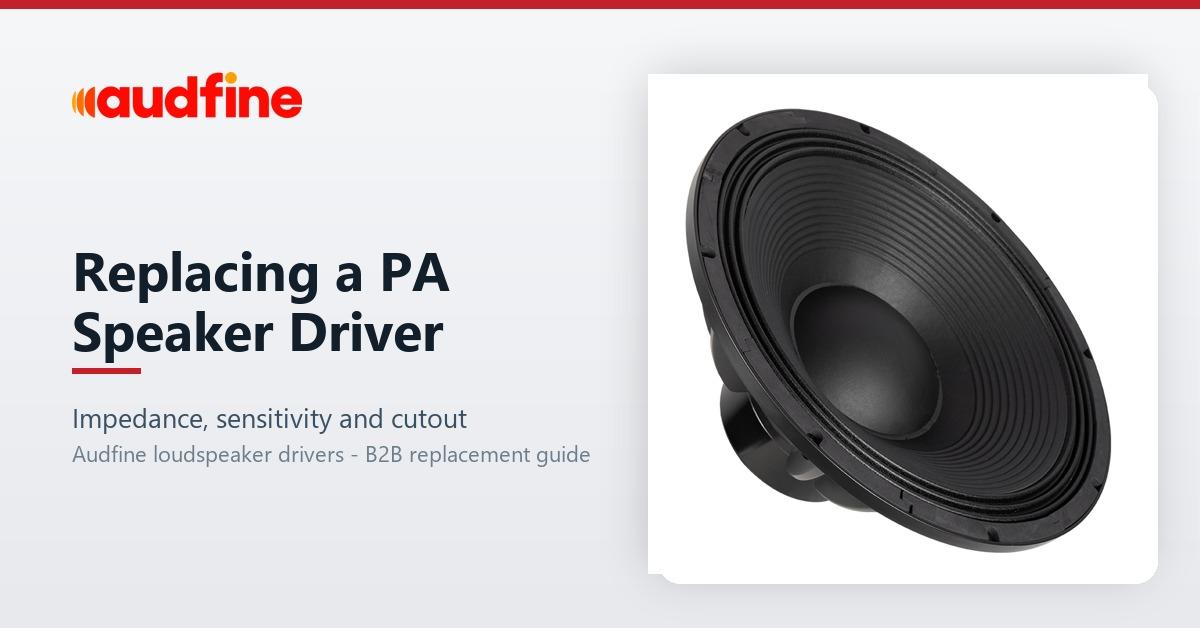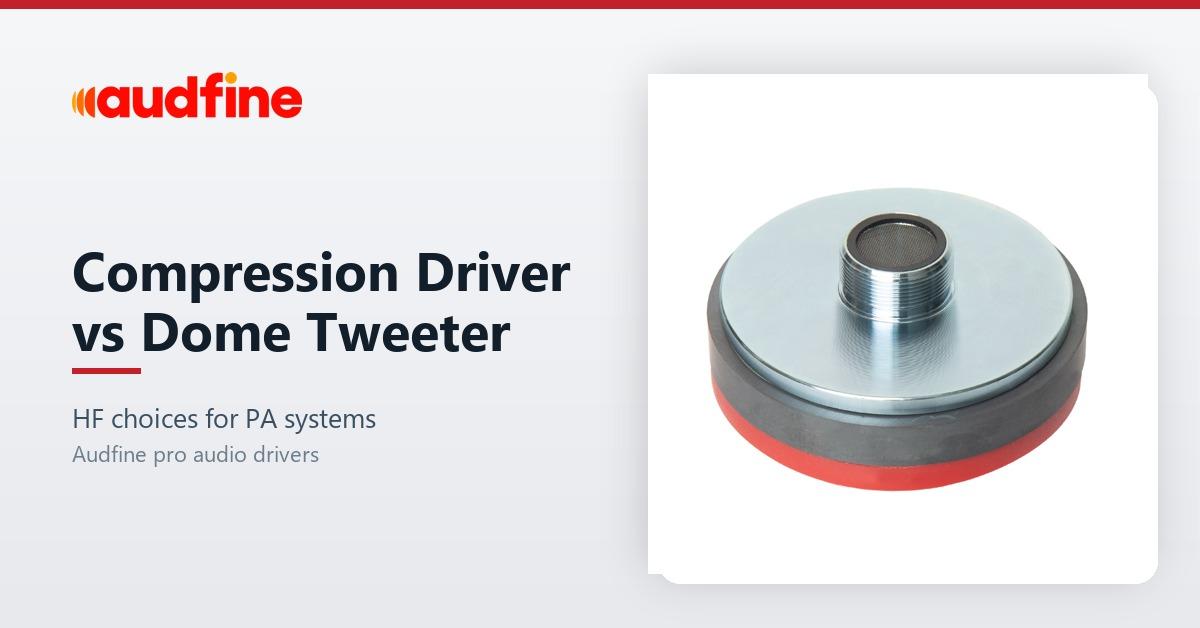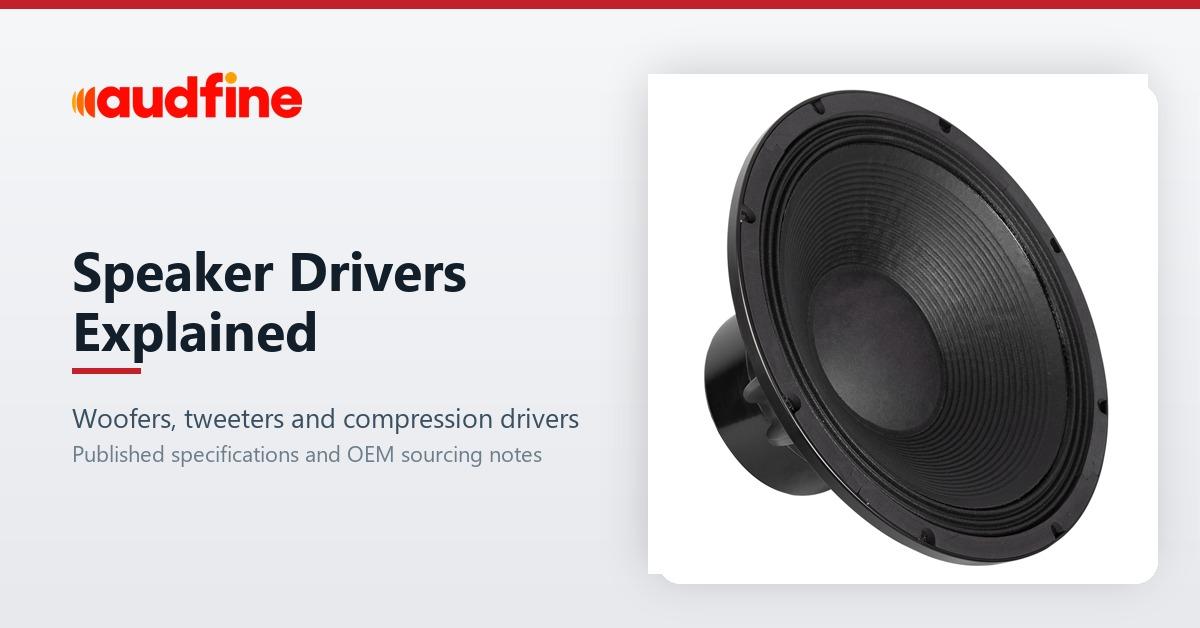
A professional loudspeaker enclosure is built to last for years, but the transducers inside it are the wear items. Heat, over-excursion, transport damage and plain old age all take their toll on a woofer or a high-frequency driver long before the cabinet itself is finished. When a driver fails, the reflex reaction is to order "the same size again" — and that is exactly where replacement orders go wrong. Frame diameter is only one of four things that have to match. The driver also has to match the cabinet electrically (impedance and power handling), acoustically (sensitivity and usable bandwidth) and mechanically (cutout, bolt pattern and mounting depth). Miss any one of them and the repaired box will not sound or behave like the one next to it.
This article sets out a replacement workflow that rental companies, installers and repair shops can follow before re-ordering, and lists the published specifications of the Audfine driver range that buyers commonly match against. It builds on the fundamentals covered in our speaker drivers explained guide, going one step further into the practical question of what to check when a unit has to be swapped.
Confirm the driver has actually failed
Before ordering anything, rule out the rest of the signal chain. A cabinet that is silent is far more often a cable, an amplifier channel, a connector or a blown crossover component than a dead transducer. Work through the simple checks first: substitute a known-good speakON or XLR lead, move the cabinet to another amplifier channel, and listen for the fault moving with the box rather than staying with the channel.
Symptoms that point squarely at the driver itself include a scraping or rubbing sound when the cone is pushed gently and evenly by hand (a displaced voice coil), a distinct burnt smell after a loud event, an open circuit or a wildly off-value reading when the DC resistance is measured at the terminals, and intermittent output that changes when the cone is flexed. A driver that measures open circuit, or one whose coil rubs, is finished. A driver that measures correctly but still produces nothing usually means the fault is upstream, in the crossover or the wiring.
Step 1 — Match the electrical identity: impedance and power handling
Impedance comes first because everything downstream depends on it. Nominal impedance is what the crossover was designed around and what the amplifier expects to see; swapping an 8-ohm unit for a 4-ohm one halves the load the amplifier is driving and, in a passive cabinet, detunes the crossover so that the filter no longer slopes where it should. Professional cabinets in this class are overwhelmingly built around an 8-ohm load, and every driver in the published Audfine range — the thirteen woofers and the three compression drivers — is an 8-ohm unit. That removes one variable from the replacement decision entirely.
Power handling is the second half of the electrical identity, and it has to be read as two numbers. The RMS (continuous) figure describes what the voice coil can dissipate indefinitely; the peak figure describes what it survives in short transients. Across the Audfine range the published peak rating is consistently twice the continuous rating, so a driver published as 800W RMS carries a 1600W peak figure. When you replace a driver, match the continuous rating to the amplifier power the cabinet is actually fed with, and to what the original unit was rated for. Under-rating the replacement makes a repeat failure likely; the root cause of a second failure is almost always a system issue rather than a defective unit.
Step 2 — Match sensitivity so the cabinet stays balanced
Sensitivity, quoted in dB at 1 watt / 1 metre, is the number buyers most often ignore and then regret. It describes how much acoustic output the driver produces for a given electrical input, and it is what keeps the low and high sections of a passive two-way cabinet in balance. The thirteen Audfine woofers span 95 dB to 98 dB, and the three compression drivers span 106 dB to 110 dB. That gap is normal and is absorbed by the attenuation built into the HF leg of the crossover — but if a replacement woofer sits several dB away from the original, the balance of the box changes in a way no passive network can correct, and the cabinet no longer matches its partner on the other side of the stage.
Sensitivity is also where buyers confuse two separate limits. A high sensitivity figure does not mean high power handling; the first describes efficiency, the second describes thermal and mechanical endurance. Our woofer driver basics article walks through how voice coil, magnet and former combine to set both numbers.
Step 3 — Mechanical fit: cutout, bolt pattern and mounting depth
This is the step that turns a confirmed electrical match into a driver that physically cannot be installed. A nominal frame size — 10", 12", 15", 18" or 21" — describes the driver family, not the hole it drops into. Before ordering, measure the original unit on the bench and record:
- Baffle cutout diameter — the diameter of the hole in the baffle, measured across the opening.
- Bolt circle and hole count — the distance between opposite mounting holes, and how many there are. Eight holes on one frame and four on another of the same nominal size is common.
- Mounting depth — from the front of the frame flange to the back of the magnet assembly.
- Magnet and frame clearance — whether the magnet assembly fits past internal bracing, ports or the rear of a horn.
- Terminal position and type — push terminals or binding posts, and where they sit relative to the internal wiring loom.
These are cabinet-specific dimensions rather than driver specifications, so they are not listed on the product pages. The reliable route is to measure the failed unit, then request a dimensional drawing from the supplier and compare it against your measurements before the order is placed. For a fleet operator standardising across several box sizes, keeping a measured record per cabinet model pays for itself the first time a replacement is needed.
Frame construction is worth noting at the same time, because it affects both fit and service life. Most drivers in the range use a die-cast aluminium basket, which holds its shape under load and dissipates heat from the motor; the PW127560A 12" woofer uses a heavy-duty steel basket instead, a construction that suits value-oriented cabinet platforms where the mechanical loads are modest.
Step 4 — High-frequency drivers: throat size and mounting style
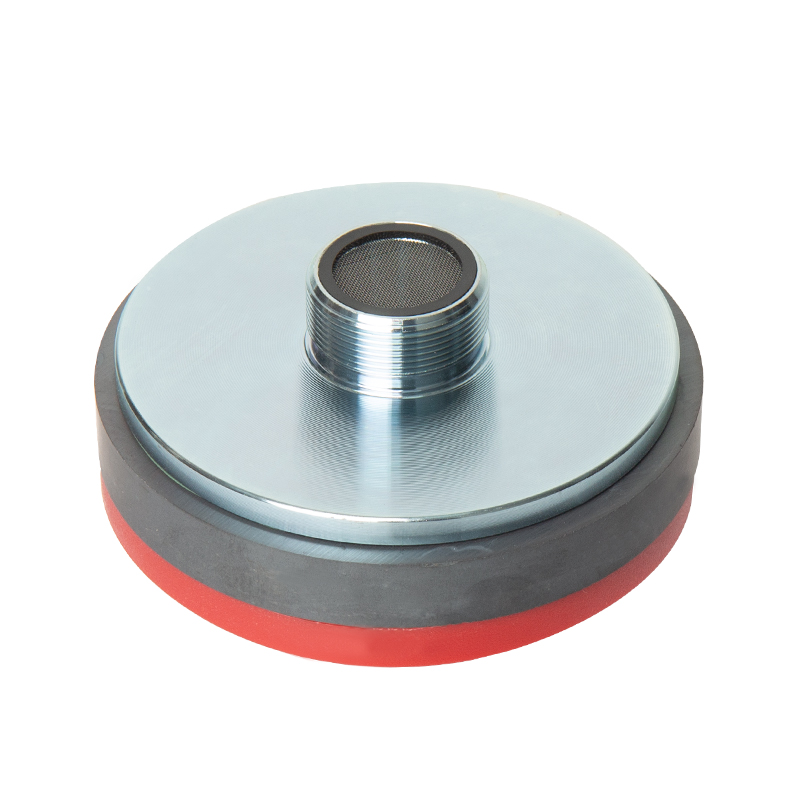
HF replacement adds two checks that have no equivalent on the low end. The first is throat diameter: the compression driver must match the horn it loads into, and 1" / 25 mm is the standard across this class — all three Audfine compression drivers are built to a 1" / 25 mm throat. The second is mounting style. A bolt-on driver is fixed to the horn with bolts through a flange; a screw-on driver threads directly onto the horn's neck. They are not interchangeable without changing the horn, so the failed unit's mounting style has to be identified before ordering. In the Audfine range the CD3601 is bolt-on, while the BH450 and BH453 are screw-on.
Diaphragm material also belongs on the specification. All three use titanium diaphragms with CCAW voice coils, which is the combination that gives this class of driver its high-frequency extension and thermal stability, and it is the same construction discussed in our comparison of compression drivers and direct-radiating HF designs.
Example: matching a 1.75" screw-on HF unit
The BH450 1.75" compression driver below is the screw-on, 44 mm CCAW coil build used across much of the range, rated 110 dB with a 1.2 kHz to 20 kHz published band.
Step 5 — Check the crossover and usable bandwidth
A driver's published frequency response is the band it works in usefully, not a hard limit set by the manufacturer, and the crossover has to hand over inside that band. Fitting a woofer whose response ends at 2.5 kHz into a cabinet crossed at 4 kHz leaves a gap in the midrange; fitting one whose response ends at 1 kHz into a two-way box crossed at 2 kHz does the same. The published frequency responses across the Audfine woofer range run from 30 Hz at the bottom end on the 18" and 21" units up to 5 kHz on the 12BH300 and 12BHP300, which is why those two are frequently specified in compact two-way designs that cross high.
If a replacement keeps failing, the crossover and the system settings deserve the same attention as the driver. Amplifier power far above the driver's continuous rating, limiter thresholds set too high, and a high-pass filter omitted on a subwoofer are the three causes that show up most often in repeat failures.
Audfine published driver specifications for replacement matching
The tables below list the published figures buyers match against when specifying a replacement. All sixteen models are 8 ohm, and in every case the peak rating is twice the continuous rating.
Low-frequency drivers
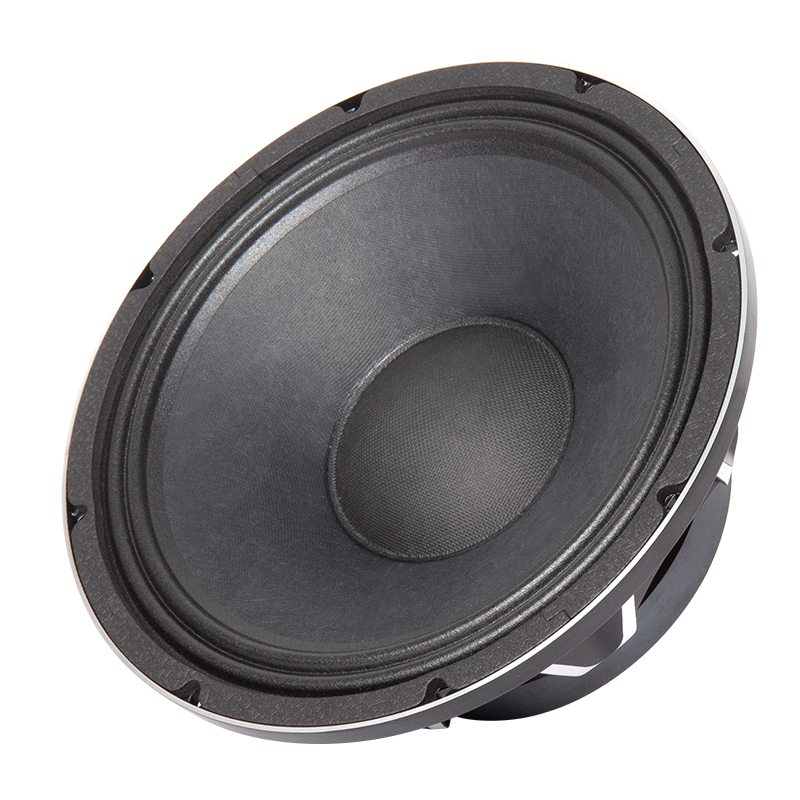
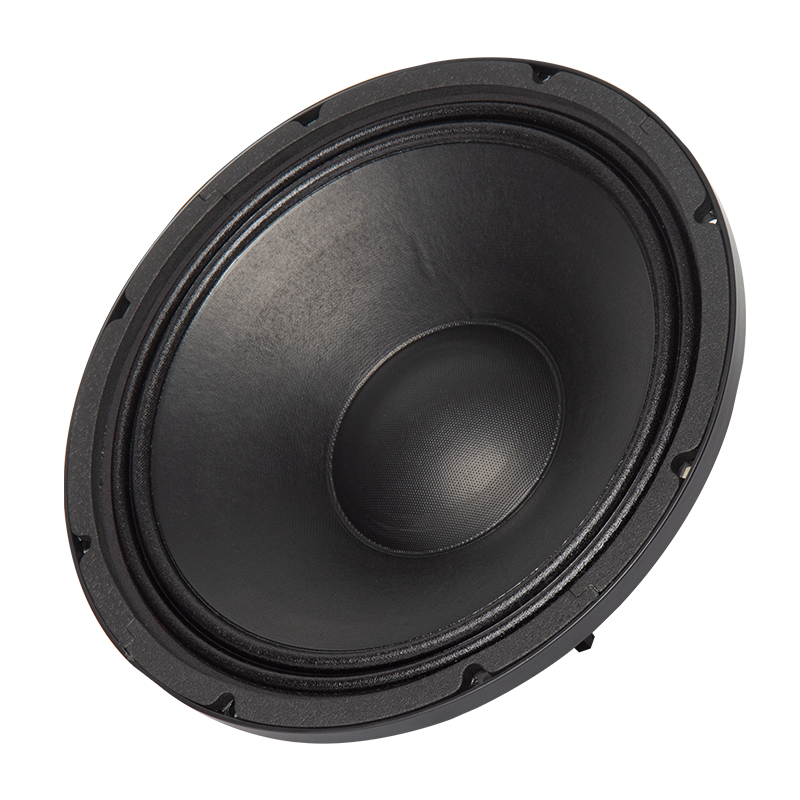
For cabinets where the replacement is a 12" or 15" unit, the two most commonly matched models are shown below. The 12BH300 12" woofer is a 400W RMS ferrite design with a die-cast basket; the 15NDL100 15" woofer is an 800W RMS neodymium design with a double spider.
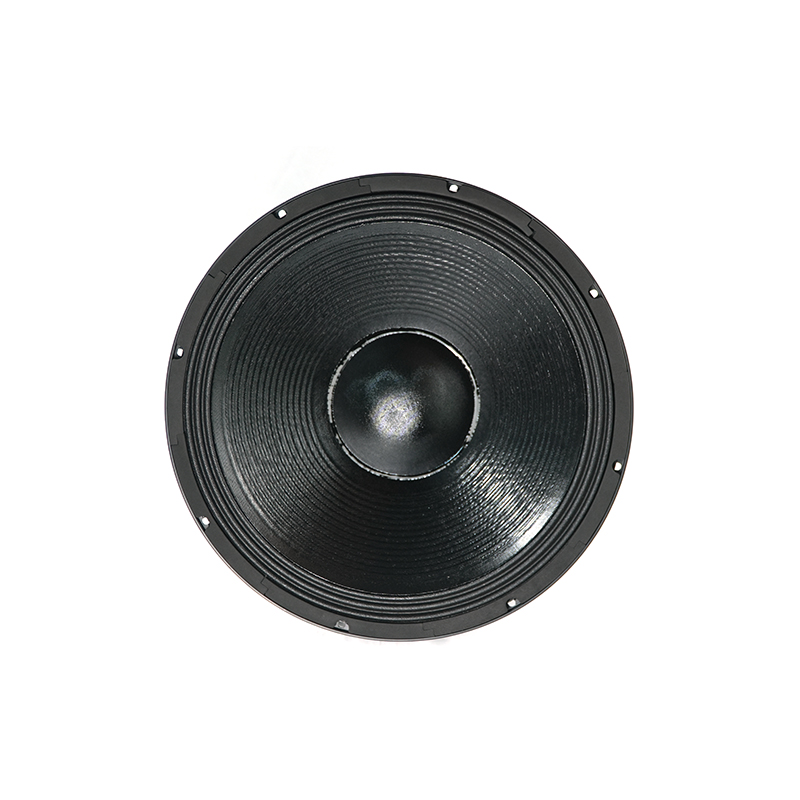
At the bottom end, the 18SW115 18" woofer is the high-power subwoofer unit in the range, and is the reference point in our 18-inch versus 21-inch driver comparison.
| Model | Size | Impedance | Power | Sensitivity | Frequency response | Voice coil | Magnet | Basket |
|---|---|---|---|---|---|---|---|---|
| 10NDL88 | 10" | 8 OHM | 500W RMS, 1000W Peak | 96 dB | 60Hz - 2500Hz | GBF3.5" IN/OUT vioce coil | NEO magnet | Die-cast ALU. basket |
| PW127560A | 12" | 8 OHM | 300W RMS, 600W Peak | 95 dB | 55Hz - 2500Hz | Kapton 3" IN/OUT vioce coil | Ferrite magnet | Steel basket |
| 12BH300 | 12" | 8 OHM | 400W RMS, 800W Peak | 97.5 dB | 55Hz - 5000Hz | TGL3" IN/OUT vioce coil | Ferrite magnet | Die-cast ALU. basket |
| 12BHP300 | 12" | 8 OHM | 400W RMS, 800W Peak | 97.5 dB | 55Hz - 5000Hz | TGL3" IN/OUT vioce coil | Ferrite magnet | Die-cast ALU. basket |
| 12NLD88 | 12" | 8 OHM | 700W RMS, 1400W Peak | 98 dB | 50Hz - 3000Hz | GBF3.5" IN/OUT vioce coil | NEO magnet | Die-cast ALU. basket |
| 15X600M | 15" | 8 OHM | 600W RMS, 1200W Peak | 98 dB | 45Hz - 3000Hz | GBF 4" IN/OUT vioce coil | Ferrite magnet | Die-cast ALU. basket |
| 15NDL100 | 15" | 8 OHM | 800W RMS, 1600W Peak | 98 dB | 45Hz - 3000Hz | GBF 4" IN/OUT vioce coil | NEO magnet | Die-cast ALU. basket |
| 15DS115 | 15" | 8 OHM | 1600W RMS, 3200W Peak | 97 dB | 35Hz - 1000Hz | GBF4.5" IN/OUT vioce coil | NEO magnet | Die-cast ALU. basket |
| 18SW115 | 18" | 8 OHM | 1600W RMS, 3200W Peak | 96 dB | 30Hz - 1000Hz | GBF4.5" IN/OUT vioce coil | NEO magnet | Die-cast ALU. basket |
| 18BHP401DM | 18" | 8 OHM | 1500W RMS, 3000W Peak | 98 dB | 30Hz - 2000Hz | GBF 4" IN/OUT vioce coil | Ferrite magnet | Die-cast ALU. basket |
| 18BH401DM | 18" | 8 OHM | 1500W RMS, 3000W Peak | 98 dB | 30Hz - 2000Hz | GBF 4" IN/OUT vioce coil | Ferrite magnet | Die-cast ALU. basket |
| 18BHP501ND | 18" | 8 OHM | 2000W RMS, 4000W Peak | 98 dB | 30Hz - 1250Hz | GBF 5" IN/OUT vioce coil | NEO magnet | Die-cast ALU. basket |
| 21SW152 | 21" | 8 OHM | 2000W RMS, 4000W Peak | 96 dB | 30Hz - 1000Hz | GBF6" IN/OUT vioce coil | NEO magnet | Die-cast ALU. basket |
High-frequency drivers
| Model | Throat | Voice coil | Diaphragm | Power | Sensitivity | Frequency response | Magnet | Mounting |
|---|---|---|---|---|---|---|---|---|
| CD3601 | 1"/25 mm Throat | 1.42" / 36mm CCAW vioce coil | Titanium diaphragm | 50W RMS, 100W Peak | 106 dB | 1500 Hz - 18 KHz | 134*17 ferrite magnet | bolt-on |
| BH450 | 1"/25 mm Throat | 1.75" / 44mm CCAW vioce coil | Titanium diaphragm | 60W RMS, 120W Peak | 110 dB | 1200 Hz - 20 KHz | 115*15 ferrite magnet | screw-on |
| BH453 | 1"/25 mm Throat | 1.75" / 44mm CCAW vioce coil | Titanium diaphragm | 60W RMS, 120W Peak | 110 dB | 1200 Hz - 20 KHz | 115*15 ferrite magnet | screw-on |
What to specify when ordering replacement drivers from a China manufacturer
Replacement orders go far more smoothly when the RFQ carries the measurable facts rather than a model name alone. The following points keep a replacement enquiry focused on what the factory actually needs in order to quote:
- Nominal impedance — 8 ohm is standard across professional cabinets and across the Audfine range.
- Continuous and peak power — matched to the amplifier channel the cabinet is driven from.
- Target sensitivity — quoted in dB, so the replacement keeps the cabinet's LF/HF balance.
- Nominal frame size and measured cutout — plus bolt circle, hole count and available mounting depth.
- For HF units — throat diameter (1" / 25 mm standard) and mounting style, bolt-on or screw-on.
- Usable bandwidth and crossover point — so the driver hands over inside its published range.
- Motor and moving parts — ferrite or neodymium, voice coil diameter and former, cone and spider type.
- Branding and packaging — private-label graphics and custom cartons, if the units ship under a customer brand.
Frequently asked questions
Can I replace an 8-ohm driver with a 4-ohm one?
Not in a passive cabinet without reworking it. The impedance change alters the load the amplifier sees and shifts the crossover's filter behaviour, so the box will no longer respond as designed. Match the nominal impedance of the original.
Does the same nominal size mean the same cutout?
No. Two 15" drivers from different families can differ in cutout diameter, bolt circle, hole count and mounting depth. Nominal size describes the driver family; the physical dimensions have to be measured on the original unit and checked against a supplier drawing.
Why does a replacement driver sound different even when the power rating matches?
Usually because sensitivity differs. A replacement that is several dB more or less efficient changes the balance between the low and high sections, which is audible immediately in a passive two-way cabinet. Compare the sensitivity figure, not just the wattage.
Is a higher power rating always safer for a replacement?
A higher continuous rating gives more thermal headroom, but it does not by itself fix the cause of the original failure. If the cabinet is being over-driven or the high-pass filter is missing, the replacement will fail in the same way. Check the system settings alongside the driver specification.
Do you supply dimensional drawings for matching?
Yes — dimensional drawings, sample units and private-label graphics are available on request. Send the measured cutout, bolt pattern and depth of the original unit with your enquiry and the factory can confirm a match before production.
Conclusion
A successful driver replacement is four checks, not one: impedance and power handling electrically, sensitivity and bandwidth acoustically, cutout and bolt pattern mechanically, and the crossover that ties them together. Work through them in that order, measure the failed unit rather than trusting the nominal size, and the repaired cabinet will match its partner on the other side of the stage. Contact our engineering team with your measurements for model-specific drawings, sample units and private-label options.