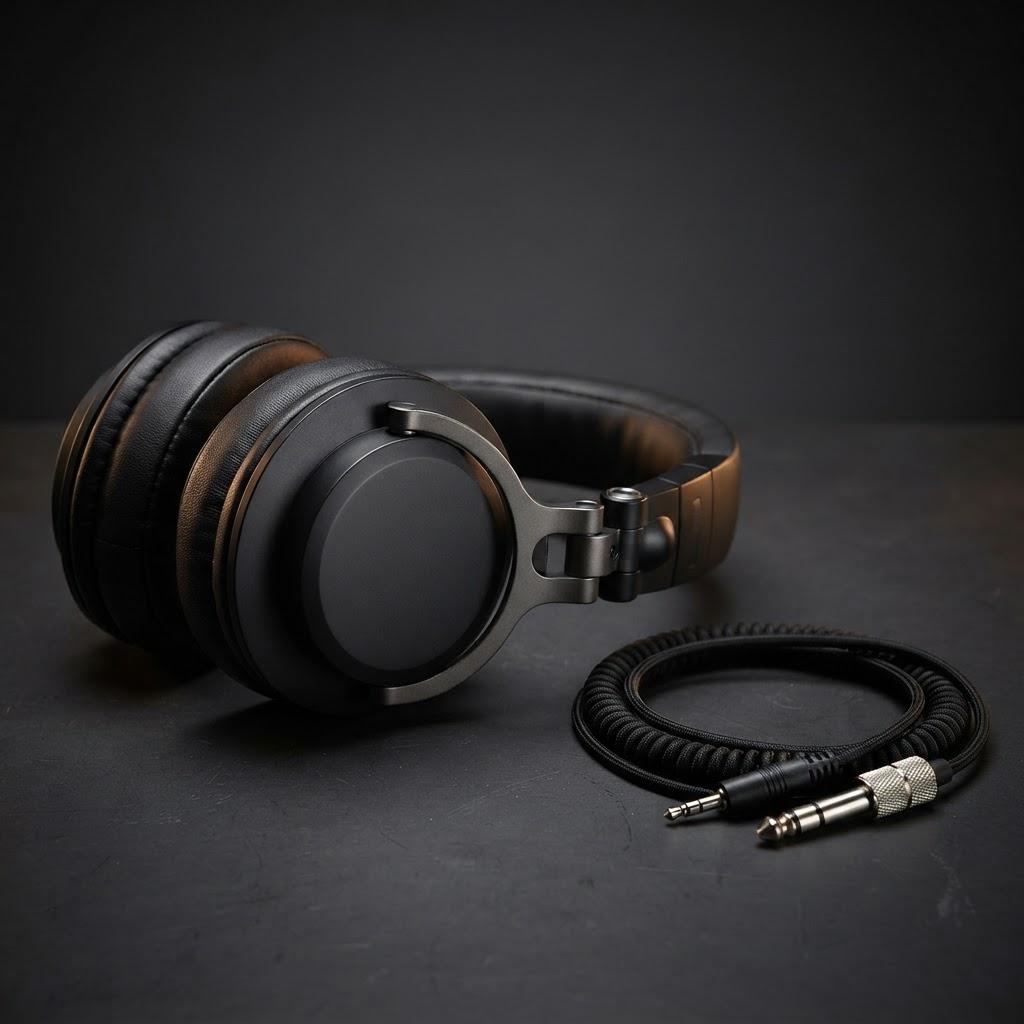
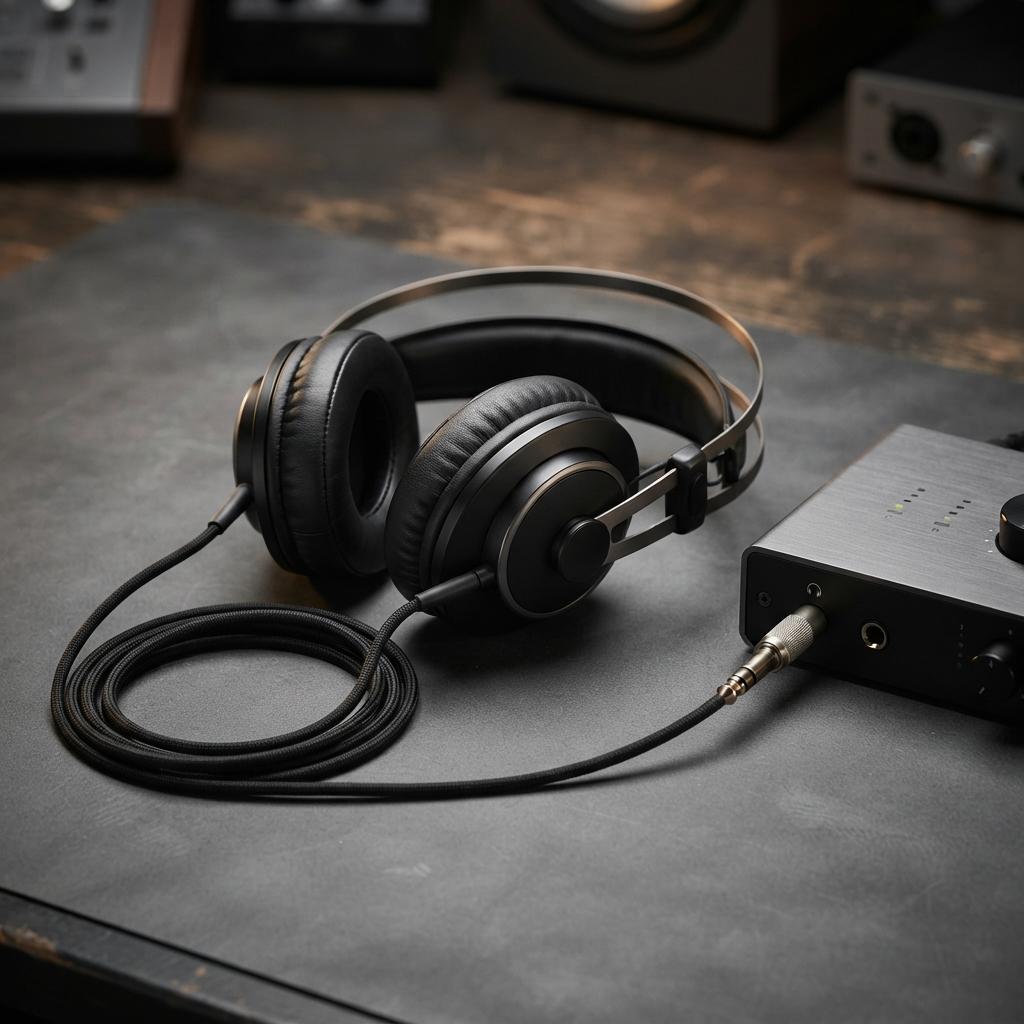
Custom DJ headphones are a closed-back monitoring platform with four things changed at the factory: the cup swivel, the fold joint, the pad interface and the cable. The acoustic core stays fixed — on the DH7400 that means a 50 mm neodymium driver, 32 ohm impedance, 97 ± 3 dB sensitivity, 10 Hz to 40 kHz and a 350 mW rated / 1800 mW maximum power figure. Brand owners who settle the mechanical details before they approve a logo avoid most of the rework that delays a first production run of custom DJ headphones.
This guide is written for the people who have to sign the purchase order: brand owners, distributors, rental fleets and private-label programme managers sourcing from a Chinese headphone factory. It uses the published specifications of three models in the current Audfine monitoring range — the DH7400 foldable DJ headphone, the AH1775 closed-back DJ headphones and the DH1771K open-back studio headphone — so every number below can be checked against the product pages.
- What customisation actually covers on a DJ headphone, and what it cannot change without a new acoustic platform.
- The four mechanical decisions — swivel, fold joint, pad interface, cable — that decide whether a model survives a club residency.
- A side-by-side specification table for three published models, including power handling and THD.
- An eight-item RFQ checklist you can send to a supplier today.
What "custom" actually changes on a DJ headphone
In professional audio, custom is a manufacturing instruction rather than a design exercise. A DJ headphones manufacturer works to two layers, and confusing them is the most common reason a private-label project runs late.
The acoustic platform is the driver, the cup volume, the tuning and the electrical figures. Changing it means new tooling, new measurement and a new sample round. The mechanical and branding layer is the cup swivel, the fold joint, the pad material, the cable, the case, the retail box and the logo. This layer can be varied within an existing platform, which is why it is where most custom made DJ headphones programmes start.
On the DH7400, for example, the published platform is a closed-back, over-ear design with leather earpads and a 50 mm neodymium driver. The customisable layer around it includes 90° swivelling earcups, a fold-up hinge, an adjustable headband, a detachable 3 m OFC coiled cable terminating in a 3.5 mm plug with a 6.35 mm (1/4") adapter, and optional accessories: a solid carrying case, a PU carrying bag and a detachable microphone. Those are the levers a brand owner actually pulls.
The four mechanical decisions that define a DJ model
1. Swivel cups and single-ear cueing
A DJ cues the next record with one ear on the booth monitor and one ear on the headphone. That workflow is only possible if the cup rotates far enough to sit flat against the side of the head or behind the ear. The swivel earcup DJ headphones in this range — the DH7400 and the AH1775 — publish 90° rotation, which is what makes single-ear monitoring practical without lifting the headband off.
What to verify in a sample: the swivel should hold its position under its own weight, feel detented rather than loose at the end stops, and show no visible gap opening at the pivot when the cup is fully rotated. A pivot that flops is a pivot that will wear.
2. The fold joint
Folding is a travel and storage feature, not an acoustic one — but it is a structural one. Every fold joint is a hinge with a wire path running through it, and that is where a headphone usually fails first. The DH7400 is published as a fold-up design that collapses into a compact bundle for a bag; the AH1775 and DH1771K keep a fixed over-ear frame with an adjustable headband instead.
If your channel is travel retail, rental or a touring inventory, ask for the folded dimensions and the number of fold cycles the joint is tested to. If your channel is a fixed studio or broadcast desk, a fixed frame is the lower-risk choice because it removes the hinge entirely.
3. Pad interface and headband
Pads are acoustic components, not upholstery: they set the seal between driver and ear, and the seal sets the low-frequency response. All three models publish over-ear leather earpads, and the DH1771K publishes skin-friendly soft pads on an adjustable headband. Because pads compress and eventually split, the pad interface also decides whether a headphone line stays serviceable in year two — a subject covered in detail in our guide to replacement ear pads and cables.
For a private-label programme, the practical question is whether the pad is a stocked spare with a stable part number. A pad that cannot be reordered turns a warranty repair into a write-off.
4. Cable architecture and strain relief
All three models publish a detachable 3 m OFC auxiliary cable with a 3.5 mm plug and a 6.35 mm adapter; the DH7400 specifies a coiled cable. Detachable matters twice: it lets the user replace a cable instead of a headphone, and it lets the brand ship different cable lengths into different markets without touching the acoustic platform.
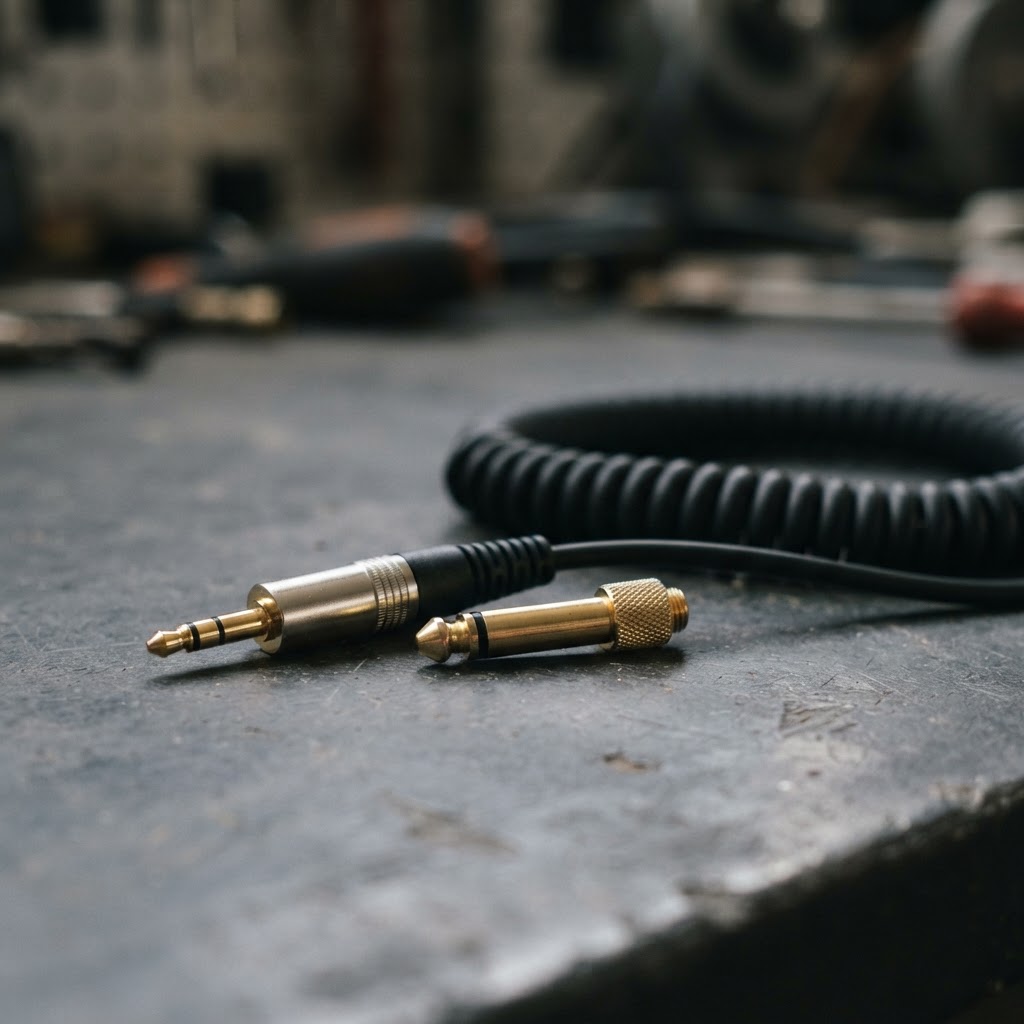
Three metres is the length that reaches from a DJ mixer or a studio interface to a standing position without an extension lead. The 6.35 mm adapter is what makes the same headphone plug into a console or an amplifier headphone output. Check that the connector housing is moulded rather than shrunk-tube, and that the entry point into the cup has a strain relief boot — that boot is what stops the conductor from fatiguing at the exit.
Published specifications: three Audfine models side by side
The table below reproduces only figures published on the product pages. Where a model publishes options, every option is listed.
| Specification | DH7400 (foldable DJ) | AH1775 (closed monitor) | DH1771K (open studio) |
|---|---|---|---|
| Product type | DJ headphone | Monitor headphone | Studio headphone |
| Transducer | Dynamic, 50 mm neodymium magnet driver | Dynamic, 50 mm neodymium magnet driver | Dynamic, 50 mm neodymium magnet driver |
| Operating principle | Closed back | Closed back | Open back |
| Impedance | 32 Ω | 32 Ω | 32 Ω, 80 Ω or 250 Ω |
| Sensitivity | 97 ± 3 dB | 97 ± 3 dB | 98 ± 3 dB |
| Frequency response | 10 Hz – 40 kHz | 18 Hz – 35 kHz | 10 Hz – 35 kHz |
| Power handling | 350 mW rated, 1800 mW max | 350 mW rated, 1500 mW max | 350 mW rated, 1500 mW max |
| THD @ 500 Hz | < 0.15 % | < 0.15 % | < 0.15 % |
| Wearing style | Over-ear, leather earpads | Over-ear, leather earpads | Over-ear, leather earpads |
| Cable | Detachable 3 m OFC coiled, 3.5 mm plug + 6.35 mm adapter | Detachable 3 m OFC, 3.5 mm plug + 6.35 mm adapter | Detachable 3 m OFC, 3.5 mm plug + 6.35 mm adapter |
| Mechanics | 90° swivelling earcup, fold-up design, adjustable headband | 90° swivelling earcups, adjustable headband | Adjustable headband |
Read the table as a map of trade-offs rather than a ranking. The DH7400 buys the widest published frequency response in the range (10 Hz – 40 kHz) and the highest maximum power figure (1800 mW) at the cost of a fold joint. The DH1771K trades isolation for an open-back presentation and offers the only impedance options in the range. The AH1775 sits between them as a closed-back monitor with swivel cups and no fold joint.
Power handling: what 350 mW rated and 1800 mW maximum actually mean
Two power figures appear on every one of these spec sheets, and buyers routinely quote the wrong one. Rated power is the continuous figure the driver is designed to survive; maximum power is a short-term limit. The gap between 350 mW and 1800 mW on the DH7400 is not extra headroom you should plan to use — it is thermal margin for peaks.
In practice, 32 ohm headphones with 97 ± 3 dB sensitivity are efficient enough to reach high output from a DJ mixer, an audio interface or a laptop headphone output without a dedicated amplifier. That is the reason the DJ and closed monitor models publish 32 Ω only, while the open studio model also publishes 80 Ω and 250 Ω for professional devices. The electrical reasoning behind those numbers is set out in our guide to headphone impedance at 32, 80 and 250 ohms.
THD is the third number worth checking. All three models publish < 0.15 % at 500 Hz, which is a clean figure for a monitoring headphone and, just as importantly, a figure you can compare across suppliers. If a quotation arrives without a THD figure, the specification is incomplete. IEC 60268-7:2025 is the international standard that defines how headphone acoustical measurements of this kind are made, and it is the reference to name when you ask a supplier how a number was obtained (IEC 60268-7:2025).
Cases, bags and retail packaging
Packaging is the part of a custom programme that is most often left to the last month, and it is the part that decides whether a container clears retail. The published options across the range are a solid carrying case, a PU carrying bag and a detachable microphone, with a universal white box or a customised colour box for the retail pack and a strong brown carton for transport. In practice that means choosing between a custom DJ headphone case and a custom DJ headphone bag, then specifying the box and the carton configuration behind it.
For a brand owner, that translates into four decisions: whether the headphone ships in a hard case or a soft bag, whether the box is a stock white box or a printed colour box, what the carton configuration is, and whether a detachable microphone belongs in the bundle. Each of those changes the bill of materials, the carton dimensions and the freight calculation, which is why they belong in the first quotation rather than the last.
An eight-item RFQ checklist for custom DJ headphones
- Platform and model number — the exact published model you are customising, so quotations are comparable.
- Operating principle — closed back for cueing and isolation, open back for long mixing sessions.
- Impedance and sensitivity — 32 Ω for mixer and interface use; 80 Ω or 250 Ω only if the end user has a dedicated amplifier.
- Power handling and THD — both figures, with the measurement condition stated.
- Mechanical specification — cup swivel angle, fold joint yes or no, headband adjustment range.
- Cable specification — length, coiled or straight, connector type and whether the 6.35 mm adapter is included.
- Pad and spare parts — pad material plus the part number for the replacement pad.
- Packaging and accessories — case or bag, box type, carton configuration, detachable microphone yes or no.
Add your branding requirements to the same document: logo position for custom logo DJ headphones, colour references and any market-specific labelling. A supplier who can answer all eight items in writing is a supplier who has read their own specification sheet.
Common mistakes when specifying a DJ headphone
- Quoting maximum power as if it were continuous. The 1800 mW figure on the DH7400 is a peak limit; rated power is 350 mW.
- Choosing a high impedance for a mixer. A 250 Ω model on a DJ mixer output is the wrong tool; 32 Ω is the published match for that application.
- Treating pads as consumables with no part number. Without a stocked spare, a split pad ends the product's service life.
- Forgetting the adapter. A 3.5 mm plug without a 6.35 mm adapter will not reach a console or amplifier headphone output.
- Leaving packaging to the end. Box and carton decisions change freight cost and retail compliance.
- Comparing only the logo price. Two quotations with different cables, pads and cases are not the same product.
Frequently asked questions
What can be customised on a DJ headphone without new tooling?
Logo, colour, pad material, cable length and type, case or bag, retail box and bundled accessories can all be varied within an existing platform. Driver, cup volume and tuning changes require a new acoustic design and a new sample round.
Why do DJ headphones publish 32 Ω impedance?
Because a DJ mixer, an audio interface and a laptop headphone output are all voltage-limited sources. At 32 Ω and 97 ± 3 dB sensitivity, the DH7400 reaches usable monitoring level from those outputs without a separate amplifier.
Is 1800 mW the power I should plan for?
No. It is the maximum figure. Continuous operation should be planned around the 350 mW rated figure, with the difference treated as thermal margin for peaks.
Closed back or open back for DJ work?
Closed back. The DH7400 and AH1775 are both published as closed-back designs, which is what provides isolation from booth monitors. The DH1771K is open back and is intended for studio mixing rather than cueing.
Do these headphones include a 6.35 mm adapter?
Yes. All three models publish a 3.5 mm plug with a 6.35 mm (1/4") adapter, and all three publish a detachable 3 m OFC cable.
Can the earcups rotate for single-ear monitoring?
The DH7400 and AH1775 publish 90° swivelling earcups, which allows single-ear cueing. The DH1771K publishes an adjustable headband without a swivel specification.
What is the published frequency response?
The DH7400 publishes 10 Hz – 40 kHz, the AH1775 publishes 18 Hz – 35 kHz and the DH1771K publishes 10 Hz – 35 kHz.
Can I evaluate a sample before placing a production order?
Yes. Sample units are available for quality evaluation, and the published specification sheets state that free samples and high-quality graphics are available on request.
How do I compare two suppliers' quotations fairly?
Put the eight-item checklist above into both requests and compare the written answers item by item. A quotation that omits THD, pad part numbers or carton configuration is not yet a comparable offer.
Conclusion
Custom DJ headphones are decided by four mechanical choices — swivel, fold joint, pad interface and cable — sitting on top of a fixed acoustic platform. Get those four right, confirm the power and THD figures in writing, and settle packaging in the first quotation rather than the last, and the branding conversation becomes the easy part.
Audfine is the monitoring headphone range of Ningbo Lesound Electronics, a professional audio manufacturer established in Ningbo, China in 2009 and exporting to more than 60 countries. The published range covers closed-back DJ and monitor models and open-back studio models, with OEM/ODM support and FOB, CIF, DAP and DDP terms. You can review the foldable DJ headphone, the closed-back monitor headphone and the open-back studio headphone in the catalogue, or see the full monitoring headphone model map for the differences between platforms.
If you are planning a private-label DJ or studio headphone line, send your specification to our team through the contact page and we will match it against the published platform that fits. For a line-by-line reading of the numbers before you write that brief, the monitoring headphone spec sheet guide and our overview of custom headphone programmes cover the rest of the process.