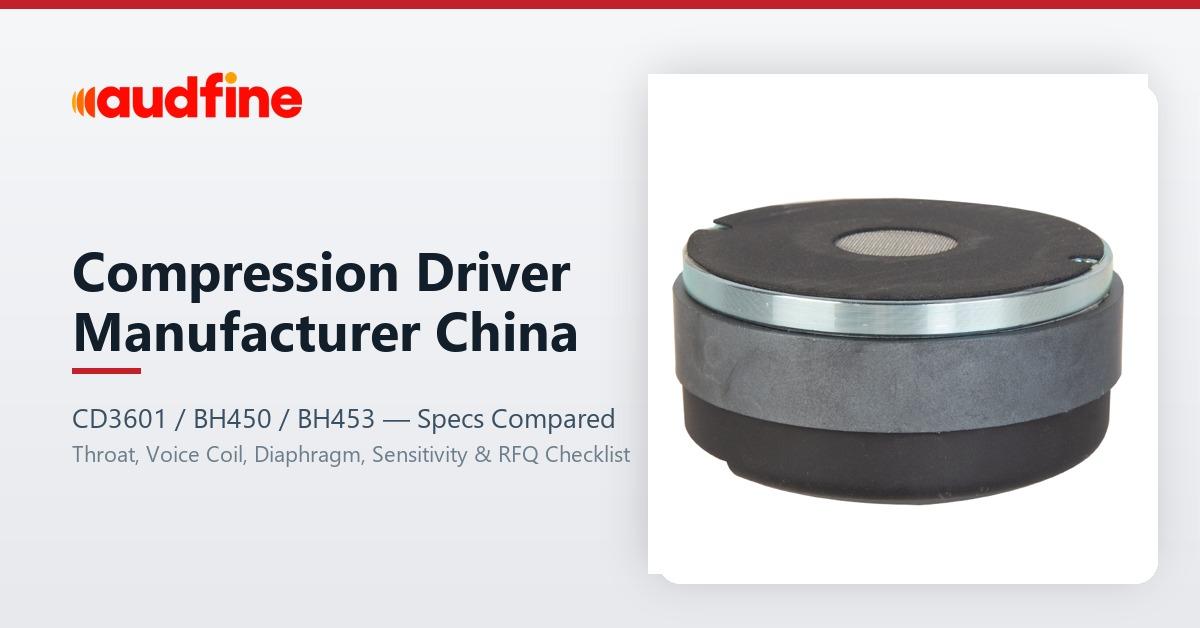
Pick up almost any professional two-way cabinet and the high end comes from the same place: a compression driver loaded onto a horn or waveguide. Buyers searching for a compression driver manufacturer, China usually being the first origin on the shortlist, keep running into the same wall. Every catalogue page claims high sensitivity and long life. Very few show the actual numbers behind those claims.
We take the opposite approach. Every driver we sell has its full specification published — no exceptions, no "ask us for the datasheet" games. This guide walks the three compression drivers in the range through line by line: the CD3601, the BH450 and the BH453. Throat size. Voice coil. Diaphragm. Power, sensitivity, bandwidth, mounting. By the end, you'll know which questions belong in an RFQ — and why two drivers with identical printed numbers can both deserve a place in the catalogue.
What a compression driver does inside a two-way cabinet
A compression driver is not a small tweeter. The diaphragm sits in a sealed chamber behind a phase plug. The plug's channels then squeeze the acoustic output through a throat — a hole much smaller than the diaphragm itself. That compression ratio is the whole point. It lets the driver couple to a horn far more efficiently than a direct-radiating dome ever could. Which is how a 50-watt compression unit keeps up with an 800-watt woofer in a passive box.
The trade-off is discipline. A compression driver only behaves inside the band the horn and crossover give it. Run it below its low-frequency limit and the diaphragm over-excurses. Push it past the top of the published band and the response rolls off — no EQ rescues that cleanly. This is why the printed frequency limits matter more on a compression driver than on almost anything else in the cabinet. And it's why a serious supplier publishes them instead of hiding behind "20 Hz to 20 kHz" marketing ranges. We cover the structural differences in more depth in our compression driver and dome tweeter comparison.
Throat and mounting: the fit you cannot improvise
Two mechanical numbers decide whether a driver even bolts onto your horn. First, throat diameter. All three Audfine compression drivers use a 1" / 25 mm throat — the standard for this class of PA driver. A 1.4" or 2" exit unit belongs to larger-format systems and won't mate with a 1" horn. Simple as that.
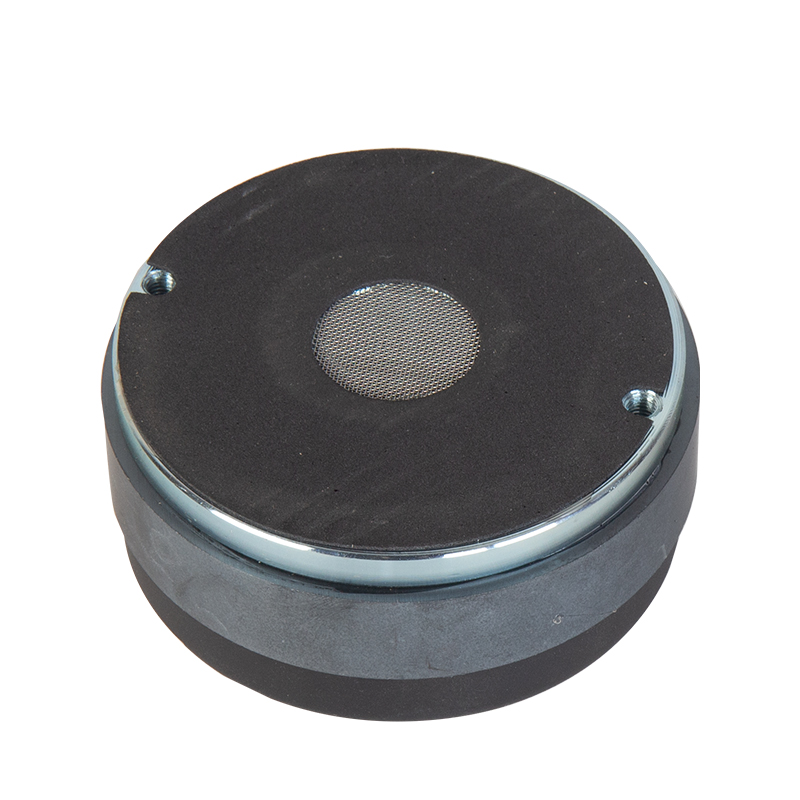
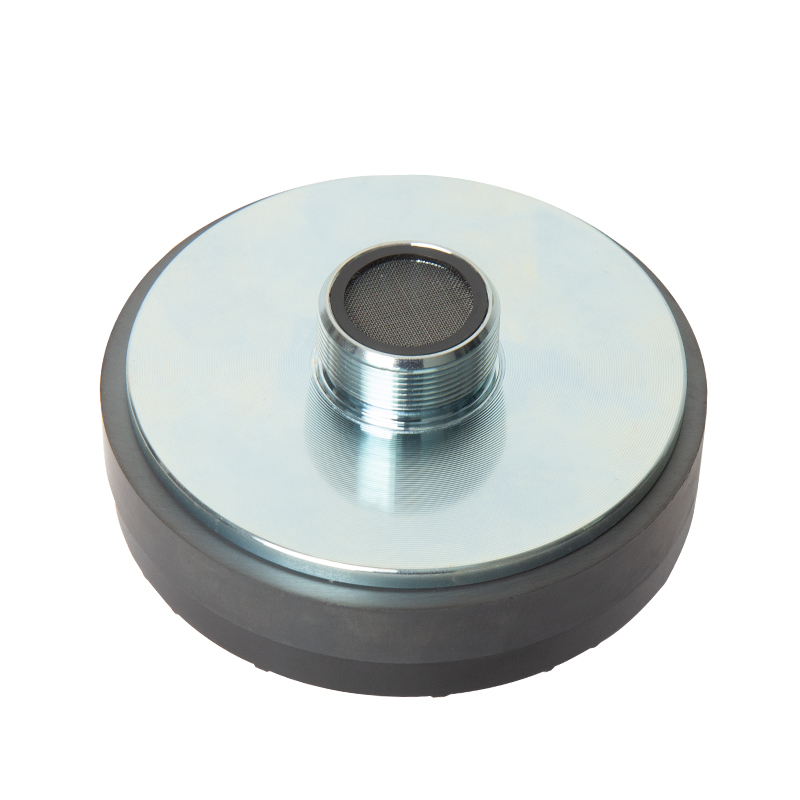
Second, mounting style. This one catches people out, honestly. A bolt-on driver fixes to the horn flange with bolts through matching holes. A screw-on driver threads straight onto the horn's neck, the way most 1-inch pro drivers do. The two are not interchangeable. Got a threaded horn? Then a bolt-on flange is useless to you, however good the driver is. The reverse applies just as firmly.
In the published range the CD3601 is the bolt-on unit, while the BH450 and BH453 are both screw-on. Check the horn before you check the driver — not after the shipment lands.
Voice coil, diaphragm and magnet: where the power actually goes
Open up the two coil sizes in the range and the design split shows clearly. The CD3601 carries a 1.42" / 36 mm CCAW (copper-clad aluminium wire) voice coil in a 134×17 mm ferrite circuit. The BH450 and BH453 step up to a 1.75" / 44 mm CCAW coil in a 115×15 mm ferrite circuit. A bigger coil sheds more heat and takes more continuous power. A shallower, wider magnet keeps moving mass down, so the top end stays usable all the way to 20 kHz.
All three diaphragms are titanium. There's a reason titanium has been the default in this class for decades: it holds its shape at high excursion, shrugs off heat fatigue, and breaks up gracefully rather than catastrophically. Pair it with a CCAW coil — lighter than solid copper for the same conductivity — and you get the sensitivity figures this class is known for.
One note on magnets: all three compression drivers in the range use ferrite, not neodymium. (The woofer side of the catalogue mixes both, with several neodymium 10", 12" and 15" models.) For compression drivers, ferrite trades weight against budget, and for fixed installations and install-grade cabinets it remains the pragmatic choice. If your programme needs neodymium for weight-critical applications, say so in the RFQ — it is a design conversation, not a catalogue line.
Power, sensitivity and bandwidth: read the printed numbers
The published figures separate the two coil sizes cleanly.
- CD3601: 50W RMS, 100W peak, 106 dB sensitivity, 1500 Hz – 18 kHz.
- BH450: 60W RMS, 120W peak, 110 dB sensitivity, 1200 Hz – 20 kHz.
- BH453: 60W RMS, 120W peak, 110 dB sensitivity, 1200 Hz – 20 kHz.
In every case the peak rating is exactly twice the continuous rating — the same convention the whole Audfine driver range follows. Match the continuous figure to your amplifier channel, not the peak. An amplifier that can dump far more than 60 watts of continuous sine-wave power into an 8-ohm load will cook a BH450 eventually, peak ratings or not. We've seen it happen.
Now, the 4 dB sensitivity gap between the CD3601 and the 1.75" pair. Four decibels is roughly two and a half times the acoustic output for the same electrical input. At 1 watt, the BH450 is simply louder — that's what the larger coil and the band up to 20 kHz buy you. It changes the crossover too. The CD3601's published band starts at 1500 Hz, so a two-way cabinet using it should hand over at or above that point with margin. The BH450's band starts at 1200 Hz, which gives the crossover designer a lower, more comfortable handover with most 12" and 15" woofers. Neither number is "better". They're different tools for different boxes.
The published lineup at a glance
The table below reproduces the figures from each product page. The CD3601 product page, the BH450 product page and the BH453 product page each carry the full specification block, dimensional photography and sample information.
| Model | Throat | Voice coil | Diaphragm | Power | Sensitivity | Band | Magnet | Mounting |
|---|---|---|---|---|---|---|---|---|
| CD3601 | 1" / 25 mm | 1.42" / 36 mm CCAW | Titanium | 50W RMS, 100W Peak | 106 dB | 1500 Hz – 18 kHz | 134×17 ferrite | bolt-on |
| BH450 | 1" / 25 mm | 1.75" / 44 mm CCAW | Titanium | 60W RMS, 120W Peak | 110 dB | 1200 Hz – 20 kHz | 115×15 ferrite | screw-on |
| BH453 | 1" / 25 mm | 1.75" / 44 mm CCAW | Titanium | 60W RMS, 120W Peak | 110 dB | 1200 Hz – 20 kHz | 115×15 ferrite | screw-on |
Yes — the BH450 and BH453 show identical published numbers. They are listed as separate catalogue entries because that is how the range is documented, and we will not merge two model designations into one row just to tidy a table. Buyers who standardise on one designation for a programme should name it explicitly in the order; that single sentence prevents most of the "which one did you mean" correspondence.

Pairing the driver with the woofer section
A compression driver is never specified alone. In a passive two-way cabinet, the crossover hands over between the woofer's top end and the driver's bottom end — and that overlap has to exist in the published bands. Take the 15X600M 15" woofer, published to 3000 Hz at the top of its band. Crossed at 1500–2000 Hz, it overlaps comfortably with both compression drivers in the range. The BH450's 1200 Hz floor just gives you more room to place the handover where the woofer's response is still smooth.
Sensitivity matching comes second. A 98 dB woofer and a 110 dB compression driver don't meet at equal loudness. The HF leg of the crossover carries attenuation to pull the driver down to the woofer's level — that's normal, that's designed for. What the network can't fix is a driver that starts several dB below where the cabinet was voiced. So when you re-specify an existing design, ask what sensitivity the original HF unit was published at. Then match it.
For buyers working through a full cabinet build rather than a single component, our speaker drivers explained guide covers the whole range — woofers, compression drivers and how the published figures relate. And if you arrived here because a driver failed and needs a substitute, the replacement matching workflow walks the electrical, acoustic and mechanical checks in order.

Ordering from a compression driver manufacturer: the RFQ that gets accurate answers
Before you award an order to a compression driver manufacturer, China export paperwork is the easy half. The technical annex decides whether the samples that arrive actually fit the programme. Put these eight items in writing and the quotations you get back will actually be comparable:
- Horn interface — throat size (1" / 25 mm, 1.4", 2") and mounting style: bolt-on flange or screw-on thread.
- Target crossover point — the frequency the cabinet hands over, so the driver's published low limit sits safely below it.
- Nominal impedance — 8 ohm is standard across the Audfine range and across professional passive cabinets.
- Amplifier channel power — continuous watts into 8 ohms, so the RMS rating can be matched honestly.
- Target sensitivity — the LF/HF balance of the cabinet depends on it; state the figure, not "high sensitivity".
- Diaphragm replacement availability — a serviceable programme keeps spare diaphragms on the shelf; ask whether they are offered as a part.
- Sample request — sample availability is published on each Audfine driver page; ask for bench measurement against the published figures.
- Documentation — the published specification block and, for fit-out work, dimensional drawings of flange, depth and magnet clearance.
One habit separates smooth programmes from painful ones: buyers who send the horn's make and model, or at least its throat and thread, with the first enquiry. It costs one line in an email and removes an entire round of questions.
Frequently asked questions
Are bolt-on and screw-on compression drivers interchangeable?
No. The flange and the horn neck are different mechanical interfaces. A bolt-on driver needs a horn drilled for its bolt pattern; a screw-on driver needs a threaded horn neck. Converting means changing the horn. So confirm the interface before ordering — not after.
Why do the BH450 and BH453 show the same published figures?
They carry the same published specification: 1.75" / 44 mm CCAW coil, titanium diaphragm, 60W RMS / 120W peak, 110 dB, 1200 Hz to 20 kHz, 115×15 ferrite, screw-on. The two designations exist as separate catalogue entries, and we document them as they are rather than merging them. Standardising on one for your programme? Then name it explicitly in the order.
Which driver should a 1.2 kHz crossover use?
A driver whose published band starts at or below 1200 Hz — here, the BH450 or BH453 at 1200 Hz. The CD3601's published band starts at 1500 Hz, so it belongs to designs that hand over at 1.5 kHz or higher. Cross below a driver's low limit and excursion takes the blame for what is really a spec mismatch.
Can samples be measured against the published specification?
Yes — and it should be part of every first order. Sample availability is stated on each product page. Bench-measure sensitivity and DC resistance on arrival, then compare them with the published block. That comparison is the fastest way to qualify a supplier's documentation as well as its drivers.
Choosing a compression driver stops being a mystery once the printed numbers are on the table. Throat and mounting decide the fit. Coil and magnet decide the power. Sensitivity decides the balance. If you're evaluating a compression driver manufacturer, China-based Audfine will send the published specification for the CD3601, BH450 or BH453 together with sample options — contact our engineering team or send the RFQ checklist above, and the drawings and figures come back with it.