High frequency is the part of a professional loudspeaker that people notice first: the clarity of a vocal, the attack of a snare, the intelligibility of speech across a noisy room. Two transducer designs dominate the high end of PA and installation cabinets, and buyers frequently ask how they differ. This article compares the compression driver — the HF engine mounted behind a horn — with the dome tweeter, a direct-radiating design common in smaller or nearfield boxes. The goal is a factual comparison that helps specify the right HF section, not a verdict that one approach wins in every case.
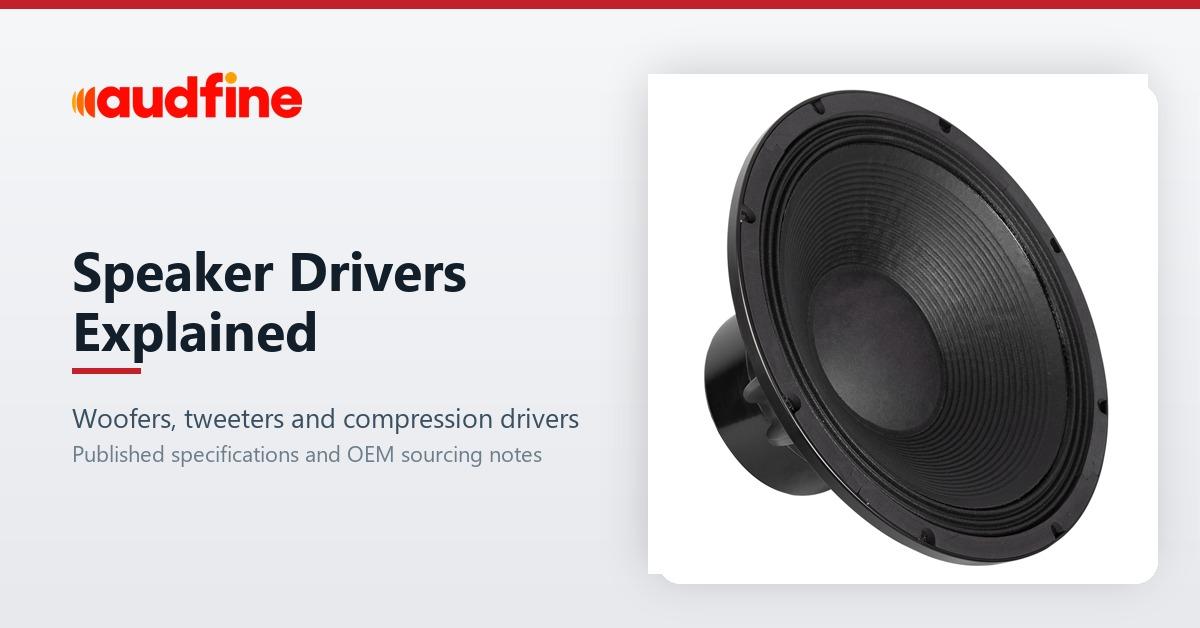
Both belong to the same driver family discussed in our speaker drivers explained guide; here we focus only on the high-frequency choice and what it means for cabinet design, output and pattern control.
How a compression driver works
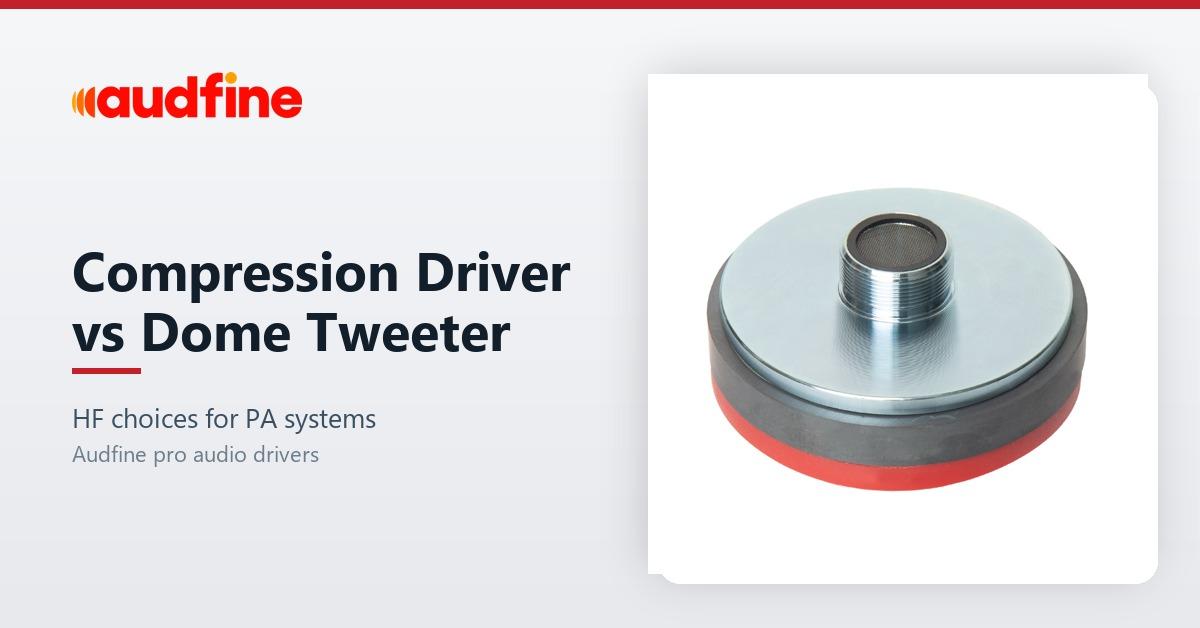
A compression driver is a small, rigid diaphragm — usually titanium — loaded into a chamber that necks down to a narrow throat, which then couples to a horn. A central piece called the phase plug sits in front of the diaphragm and divides the compressed wavefront into paths of equal length, smoothing the response where the diaphragm would otherwise break up. The diaphragm is larger than the throat, so the air is "compressed" as it passes through, raising efficiency dramatically. The horn then does two jobs at once: it matches the small driver to the larger air volume it must move, and it shapes the coverage pattern so sound is directed where the audience is rather than sprayed in every direction.
Because the driver works against a controlled acoustic load, it reaches very high sensitivity (commonly 106–110 dB, 1 W / 1 m) and holds that output at high power. That is why compression drivers are the standard HF choice for touring, installed and line-array PA, where output and directivity both matter.
How a dome tweeter works
A dome tweeter is a direct-radiator transducer: a small dome-shaped diaphragm (often silk or a metal alloy) sits in its own small front chamber and radiates straight into the air, with no horn between it and the room. The mechanism is the same electromechanical principle as any driver — a voice coil in a magnetic field moves the diaphragm — but the loading is light and the radiation is essentially omnidirectional at the frequencies it covers. The dome's low moving mass gives a smooth, extended response, at the expense of how much acoustic power it can radiate before its own resonance and breakup limit the top end.
This simplicity makes dome tweeters attractive for compact, nearfield and studio-style enclosures, where extreme output and tight pattern control are less critical than budget, size and a smooth off-axis response close to the listener.
Key differences that affect specification
The table below summarises the practical differences a buyer should weigh. Neither column is "better" in the abstract; the right choice follows from the cabinet's job.
| Aspect | Compression driver + horn | Dome tweeter |
|---|---|---|
| Efficiency / sensitivity | Very high (106–110 dB typical) | Moderate (lower by a wide margin) |
| Pattern control | Horn sets a defined coverage angle | Wide, increasingly omnidirectional with frequency |
| Power handling at HF | High; designed for sustained high output | Limited; best at modest levels |
| Bandwidth | Starts ~1.2–1.5 kHz, extends past audibility | Broad, but upper limit set by dome mass |
| Cabinet integration | Requires a matched horn and waveguide | Drops into a baffle; no horn needed |
| Typical use | PA, line array, installed sound | Studio, nearfield, compact boxes |
Choosing for the application
The decision is mostly about scale and control, and the crossover point where the HF device takes over from the woofer:
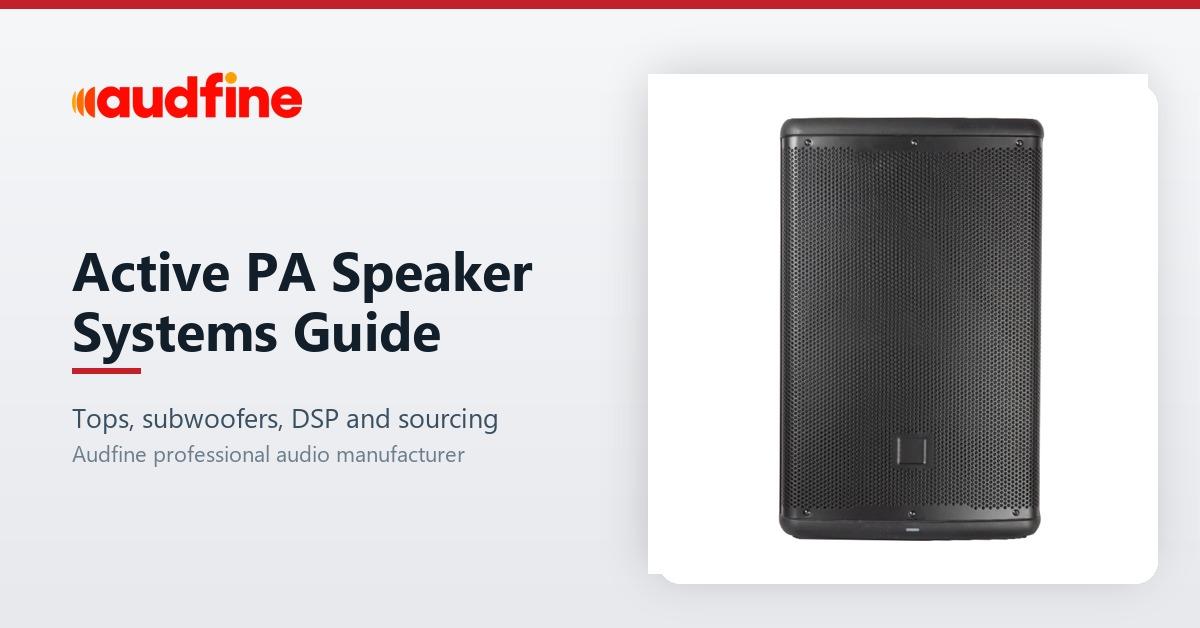
- Large-format PA and line arrays. When you need high output and a predictable coverage angle across a hall, a compression driver on a well-designed horn is the practical choice. The active line array speaker systems guide shows how HF sections are crossed and aimed in real cabinets.
- Installed and fixed venues. Pattern control lets a designer put energy on the audience and not on reflective walls, which matters for reading a spec sheet's coverage angle and crossover point.
- Studio, nearfield and compact enclosures. Where output requirements are modest and the listener is close, a dome tweeter's simplicity and smooth close-field response are well suited.
In short: choose the compression driver when output and directivity lead the brief; choose the dome tweeter when size, budget and nearfield smoothness lead it.
Impedance and system matching
Beyond the driver type, the electrical interface has to fit the system. Compression drivers in this class are built on an 8-ohm voice coil, which keeps them compatible with the amplifier stages and passive crossovers used across most professional tops. The crossover that hands off from the woofer is chosen so the driver starts where it is most efficient — typically around 1.2 to 1.5 kHz for a 1" throat device — and the passive or DSP network must respect both the driver's rated power and its rising impedance with frequency. A dome tweeter is also normally an 8-ohm load, but because it is not horn-loaded its sensitivity is far lower, so the same amplifier delivers much less acoustic output at the top end. Matching is therefore less about a single number and more about how the HF device, the crossover and the amplifier share the programme without overdriving the smaller driver.
Audfine's compression driver range
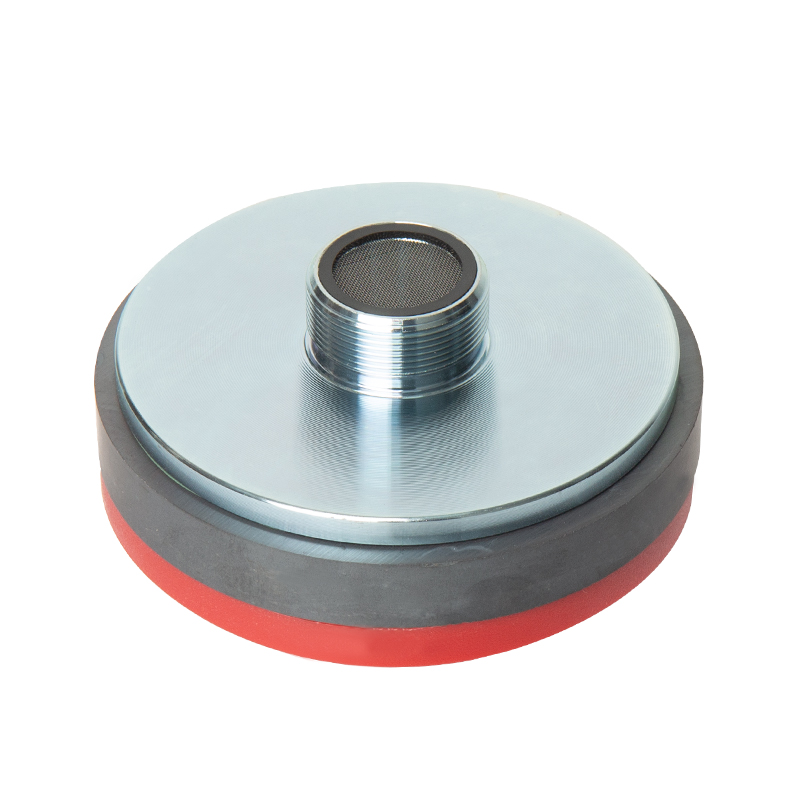
Audfine's published HF line is compression drivers, offered in 1.42" and 1.75" formats with titanium diaphragms and CCAW voice coils. The BH450 1.75" compression driver below is the screw-on, 44 mm coil build used across much of the range.
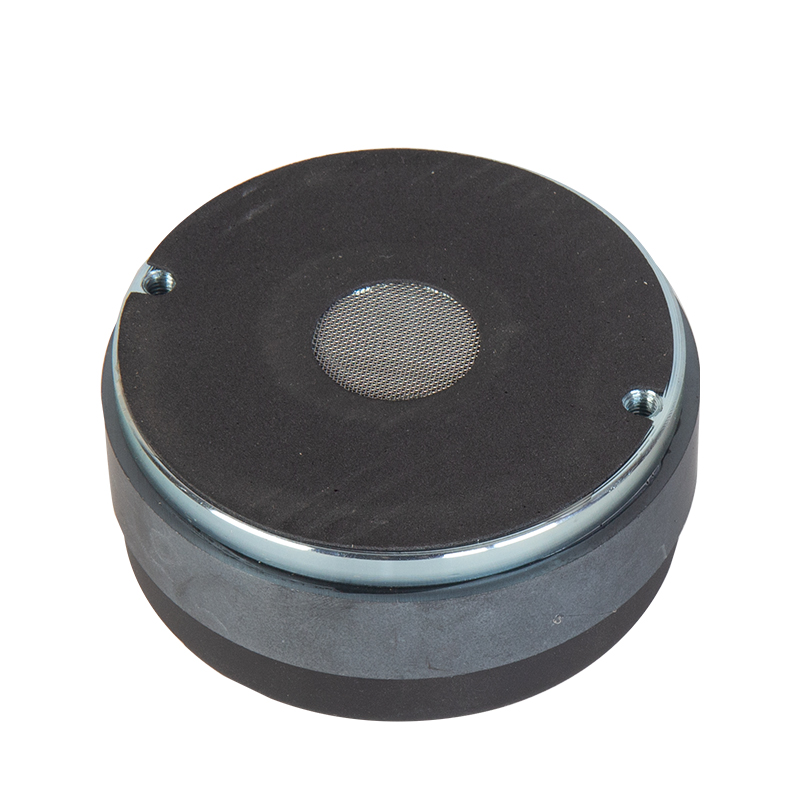
The CD3601 1.42" compression driver uses a smaller 36 mm coil and bolt-on mounting for compact HF chambers.
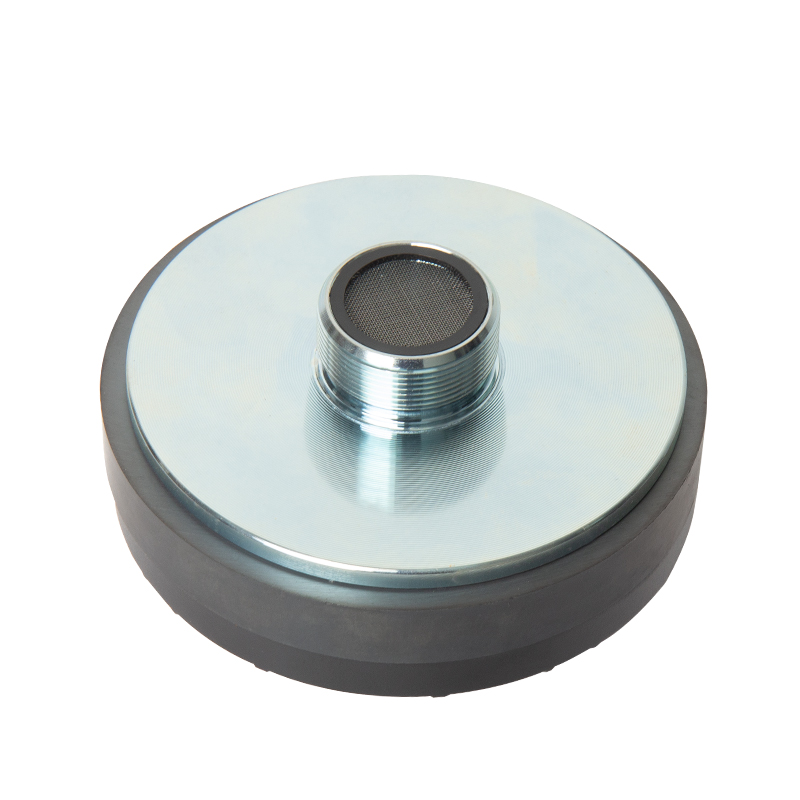
The BH453 1.75" compression driver shares the 1.75" format and screw-on mounting, giving buyers a second source within the same mechanical envelope.
Published specifications for the three models:
| Model | Throat | Voice coil | Diaphragm | Power | Sensitivity | Frequency response | Magnet | Mounting |
|---|---|---|---|---|---|---|---|---|
| CD3601 | 1"/25 mm Throat | 1.42" / 36mm CCAW voice coil | Titanium diaphragm | 50W RMS, 100W Peak | 106 dB | 1500 Hz - 18 KHz | 134*17 ferrite magnet | bolt-on |
| BH450 | 1"/25 mm Throat | 1.75" / 44mm CCAW voice coil | Titanium diaphragm | 60W RMS, 120W Peak | 110 dB | 1200 Hz - 20 KHz | 115*15 ferrite magnet | screw-on |
| BH453 | 1"/25 mm Throat | 1.75" / 44mm CCAW voice coil | Titanium diaphragm | 60W RMS, 120W Peak | 110 dB | 1200 Hz - 20 KHz | 115*15 ferrite magnet | screw-on |
What to specify when sourcing HF drivers from a China manufacturer
When requesting quotes for compression drivers or comparing suppliers, the following points keep an RFQ focused on measurable, build-relevant facts:
- Required HF bandwidth — crossover point and the top frequency the programme demands.
- Target sensitivity and the maximum SPL the cabinet must reach.
- Horn or waveguide type, and the coverage angle the design must hold.
- Throat size — 1" / 25 mm is the common standard for this class.
- Mounting style — bolt-on versus screw-on — matched to the existing chamber.
- Impedance and continuous (RMS) power rating of the driver.
- Diaphragm material and voice-coil former, which set HF behaviour and thermal limits.
- Private-label and graphic requirements, if the unit ships under a customer brand.
Frequently asked questions
Can a compression driver directly replace a dome tweeter?
Not usually. A compression driver is engineered to load into a horn, and its impedance and chamber requirements differ from a free-air dome. Swapping one for the other changes the acoustic load and the crossover, so the cabinet must be redesigned around the chosen HF device.
Does a compression driver need a horn?
Yes. The driver and horn are a matched pair: the horn provides the load and the pattern control that define the device's behaviour. Running the driver without a horn loses both efficiency and directivity.
Is high sensitivity the same as high power handling?
No. A compression driver's 106–110 dB sensitivity means it needs little amplifier power for a given output, but its wattage rating is modest because HF content carries far less energy than bass. Sensitivity and power handling describe different limits.
Does Audfine make dome tweeters?
Audfine's published high-frequency range is compression drivers, which is what this article compares against. Both approaches are valid; the comparison above is meant to help specify the right one for the cabinet in question.
Conclusion
Compression drivers and dome tweeters solve the same problem — reproducing high frequencies — with different trade-offs in efficiency, pattern control and cabinet integration. For PA, line array and installed sound where output and directivity lead, a horn-loaded compression driver is the practical standard. For compact, nearfield and studio use, a direct-radiator dome is often the simpler fit. Specify from the application, confirm the measurable figures such as sensitivity, throat size and mounting, and the choice becomes straightforward. Contact our engineering team for model-specific drawings, Thiele-Small data and private-label options.