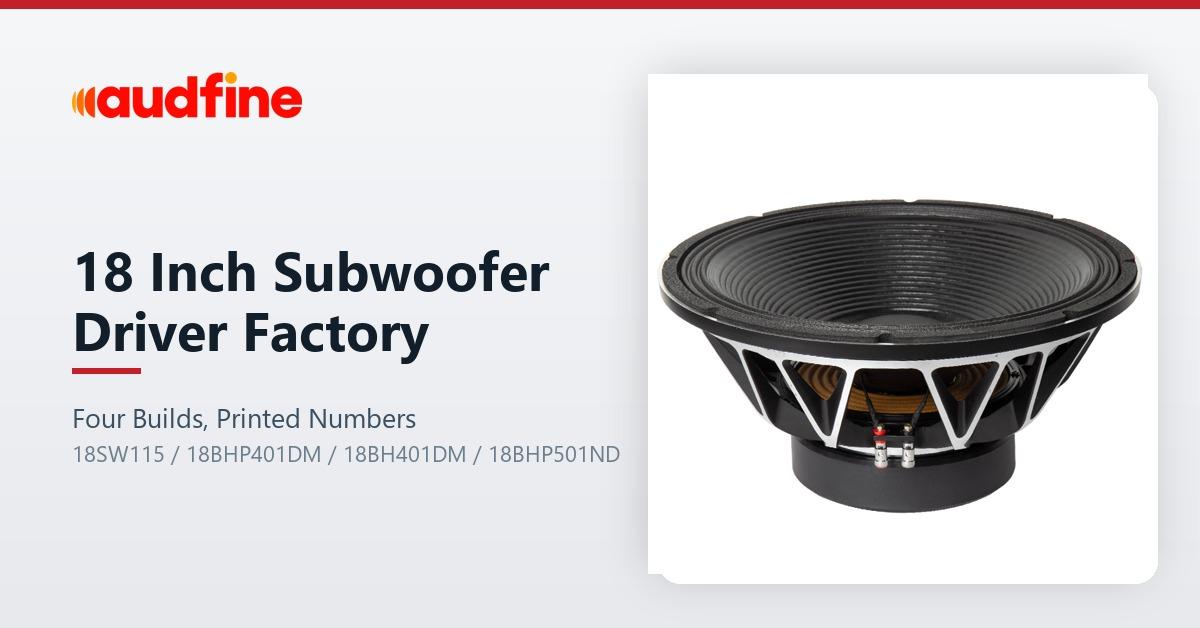
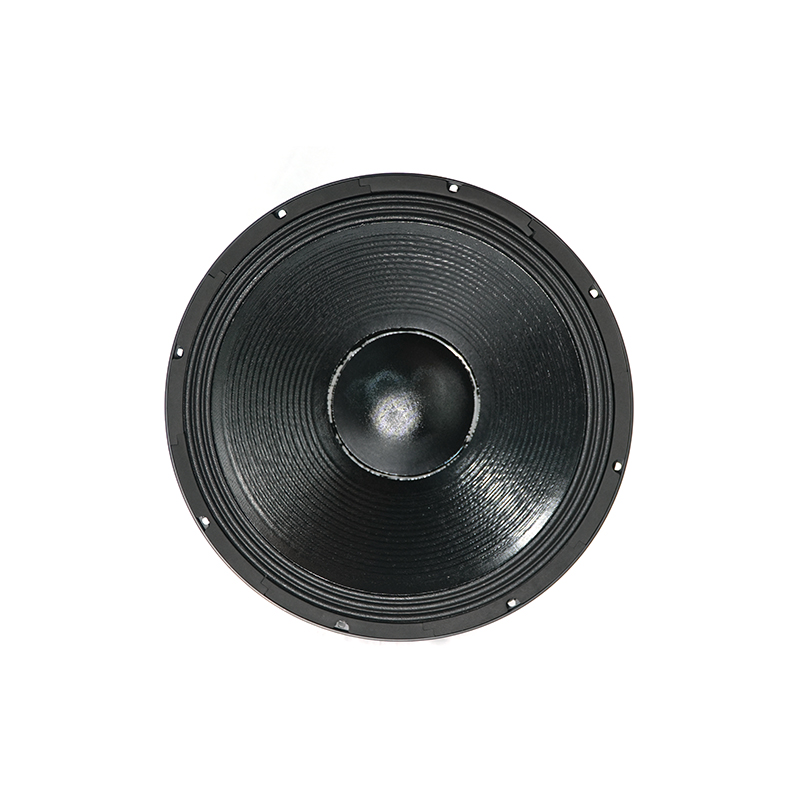
Ask an 18 inch subwoofer driver factory what it actually ships in this size class, and you should get numbers, not adjectives. So here are ours. Four builds. Three published power ratings, from 1500W to 2000W RMS. Two motor technologies, neodymium and ferrite. Coil diameters from 4 to 5 inches, every one of them wound inside and outside. Sensitivity between 96 and 98 dB. Below, the four sit side by side with their printed figures, then we walk through the three decisions that separate them - motor, coil, suspension - and finish with the RFQ fields that get you a quotable answer instead of a guess.
Why the 18-inch class still carries most subwoofer programmes
The 21-inch driver gets the headlines. The 18-inch pays the bills. Walk any club install, any rental fleet, any touring sub rig, and you will count far more 18-inch cones than 21s. Dual-18 cabinets remain the default subwoofer format across the industry, replacement demand in this size never stops, and the cabinet ecosystem - boxes, amp modules, rigging hardware - is built around it.
There is also a practical reason buyers keep coming back to this size: it is the largest diameter that still fits a huge installed base of existing enclosures. A cabinet brand refreshing its range can usually keep the box and change the driver. That single fact makes the 18-inch class the most quoted, most sampled and most re-specified size in our transducer line.
Which build within the class, though? That is where RFQs go vague. Buyers write "18 inch subwoofer" and stop, and the factory has to guess between four genuinely different constructions. We put 18-inch and 21-inch head-to-head in our 18-inch vs 21-inch subwoofer driver comparison, so here we stay inside the 18-inch class itself. Four builds, published numbers, no adjectives.
The four builds: published numbers side by side
Everything in this table comes from our product pages. The 18SW115 neodymium build and the 18BHP501ND carry NEO motors; the 18BHP401DM and the 18BH401DM are the ferrite pair. We publish the same figures on the datasheet and on the site, and we would rather you cross-check both than trust either one.
| Item | 18SW115 | 18BHP401DM | 18BH401DM | 18BHP501ND |
|---|---|---|---|---|
| Nominal diameter | 18 inch | 18 inch | 18 inch | 18 inch |
| Power handling | 1600W RMS, 3200W peak | 1500W RMS, 3000W peak | 1500W RMS, 3000W peak | 2000W RMS, 4000W peak |
| Nominal impedance | 8 ohm | 8 ohm | 8 ohm | 8 ohm |
| Sensitivity | 96 dB | 98 dB | 98 dB | 98 dB |
| Frequency response | 30 Hz - 1000 Hz | 30 Hz - 2000 Hz | 30 Hz - 2000 Hz | 30 Hz - 1250 Hz |
| Voice coil | 4.5 inch GBF, inside/outside | 4 inch GBF, inside/outside | 4 inch GBF, inside/outside | 5 inch GBF, inside/outside |
| Magnet | Neodymium | Ferrite | Ferrite | Neodymium |
| Basket | Die-cast aluminum | Die-cast aluminum | Die-cast aluminum | Die-cast aluminum |
| Spider | Double spider | Silicone spider | Silicone spider | Double spider |
| Cone | Paper | Paper | Paper | Paper |
One housekeeping note before the comparisons. The 18BHP401DM and the 18BH401DM are the same build and share a single datasheet: 1500W RMS, 3000W peak, 98 dB, 30 Hz to 2000 Hz, 4-inch inside/outside coil, ferrite, paper cone. We keep both catalogue entries because buyers reference each code in legacy cabinet documentation. Same construction, two codes, one factory drawing. If a supplier merges them into one row without saying so, ask why.
Neodymium or ferrite: what the motor choice changes
Two of our four builds run neodymium, two run ferrite, and the split is deliberate. Neodymium cuts assembled weight hard - on an 18-inch frame that is several kilograms off every unit your crew lifts, flights, and ships. For a touring sub programme or anything that flies, that weight saving shows up on every single load-in of the year. The trade is well known: neodymium is more sensitive to heat, so the motor design around it has to manage temperature properly.
Ferrite is heavier and it does not care. It sits in a fixed installation for a decade without drama, it holds its flux behaviour predictably across a wide temperature range, and it keeps the material bill of the motor down. For installed cabinets, club builds and any programme where the driver is bolted in once and serviced rarely, the ferrite pair is the honest choice.
Notice what we did not say: that one motor is simply "the good one". Both of our NEO builds and both of our ferrite builds sit on die-cast aluminum baskets with paper cones. The motor is a programme decision - weight and duty cycle versus installed permanence - not a quality ranking. Any factory that tells you otherwise is selling you whatever is on their shelf this month.
The coil line: 4, 4.5 and 5 inches
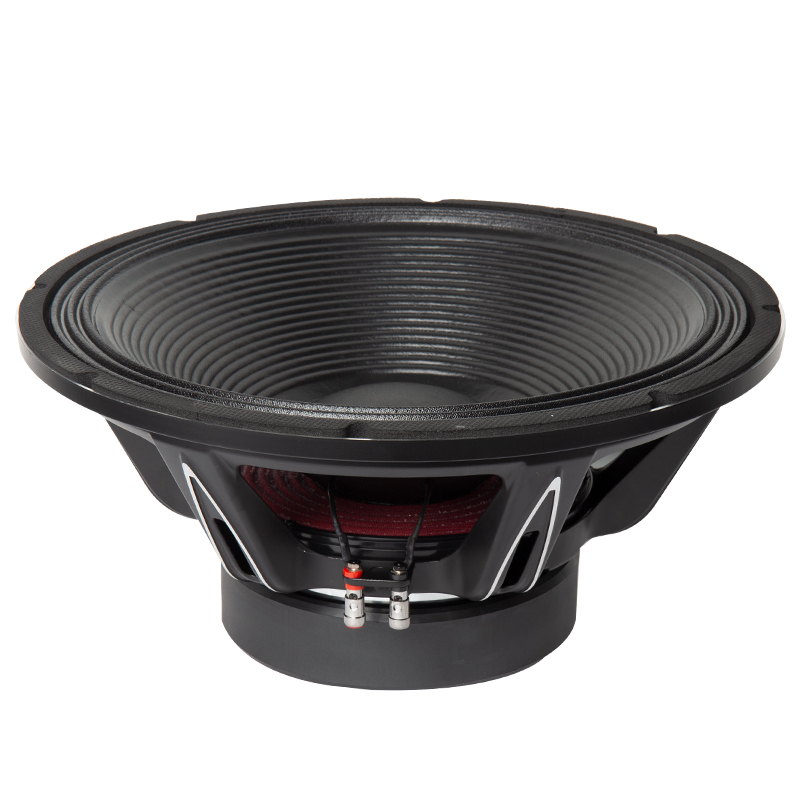
Read down the voice coil row and the power ratings stop being mysterious. The 4-inch coil pair carries 1500W RMS. The 4.5-inch coil carries 1600W RMS. The 5-inch coil carries 2000W RMS. Winding depth and diameter are where thermal capacity actually lives, so the ratings track the coil almost one to one.
Two details matter as much as the diameter. First, GBF on our sheets means a glass fiber former. Glass fiber does not soften the way paper formers can when a hard bass line parks the coil at temperature for an hour. Second, all four builds are wound inside and outside. Wire on both faces of the former doubles the surface shedding heat, and it keeps the impedance curve flatter as the coil warms through a long set.
If you want the full mental model - how coil, magnet and power rating interact and where the marketing numbers hide - our woofer driver basics guide covers it line by line. Here, the short version: for a subwoofer driver, the coil line is a far more honest reliability indicator than the peak wattage figure will ever be.
Sensitivity, and the arithmetic you can run at your desk
Our four builds publish 96 dB (18SW115) and 98 dB (the other three). Two dB looks like nothing on a datasheet. Run the arithmetic and it is not nothing. Sensitivity is specified at 1W/1m, so adding amplifier power moves you up the scale at 3 dB per doubling - in free field, a planning estimate only, before the box and the room have their say.
Worked examples from our printed values. The 18BHP501ND at its 2000W RMS rating: 98 + 10×log(2000) = 131 dB. The 18SW115 at 1600W RMS: 96 + 10×log(1600) = 128 dB. The ferrite pair at 1500W RMS: just under 130 dB. And the 2 dB sensitivity gap runs the other way too: the 96 dB build asks for roughly 60 percent more amplifier power to hold the same level as a 98 dB build.
Three honest caveats, because this arithmetic gets abused. It assumes free-field conditions, which real rooms are not. It treats the published sensitivity as a single number when the response curve is anything but flat. And it says nothing about displacement limits at low frequencies. Use it to shortlist and sanity-check, then confirm with a sample in your own enclosure. When a datasheet in this class claims 101 or 102 dB, ask for the measurement conditions in writing. Vague conditions, vague figure.
Sourcing from an 18 inch subwoofer driver factory: write the RFQ around the build, not the diameter
Here is the part most enquiries skip. An RFQ that reads "18 inch subwoofer driver, please quote" makes the factory guess, and you get quoted whatever is easiest to make. Whether you come to us as a distributor building a wholesale line or as a cabinet brand running an OEM programme, the fix is the same: specify the construction, not just the diameter.
Six fields do most of the work, and you now have every reference value for them from the table above.
- Coil diameter and winding. "4.5 inch, inside/outside, glass fiber former" is a spec. "Big coil" is a wish.
- Motor type. NEO for weight-critical and flying builds, ferrite for installed programmes. State which one your cabinet plan assumes.
- Power target. Give the RMS figure your amplifier stage delivers, not a peak number for the brochure.
- Sensitivity band. If your system design assumes 98 dB, say so - it disqualifies builds early and saves everyone a sample round.
- Frequency window. Our four builds run 30 Hz floors with tops from 1000 Hz to 2000 Hz. If your crossover sits at 800 Hz or 1200 Hz, the window is a real selection field.
- Suspension and basket. Double spider versus silicone spider, die-cast aluminum basket. Mechanical choices with thermal consequences, as the table shows.
What does an 18 inch subwoofer driver factory do with a spec written this way? It quotes against a drawing instead of a guess. Our own driver lines run at roughly 7,000 finished drivers each month, and capacity can be scaled for volume programmes - but the schedule conversation only becomes real once the construction is pinned. Send the six fields, and the reply you get back is a bill of materials, not a catalogue page.
If your programme also spans the larger class, we applied the same published-numbers method to the flagship size in our 21 inch subwoofer driver factory guide, including the ten checks to run before any 21-inch RFQ.
Frequently asked questions
Which build should I shortlist for a touring subwoofer cabinet?
Start with the two neodymium builds, because weight is a touring expense you pay every single day - in crew, in freight, in fly-bars. Between the 18SW115 (1600W RMS, 4.5-inch coil, 96 dB) and the 18BHP501ND (2000W RMS, 5-inch coil, 98 dB), the right answer depends on your amplifier inventory and your enclosure volume. Request the Thiele-Small parameters, run the simulation for your own box, and let the model decide. We review customer simulations before sample orders as part of the standard process.
Why do 18BHP401DM and 18BH401DM share one datasheet?
Because they are the same construction. 1500W RMS, 3000W peak, 98 dB, 30 Hz to 2000 Hz, 4-inch inside/outside coil, ferrite motor, paper cone, die-cast aluminum basket. The two codes exist because cabinet documentation in the field references each one. We would rather keep both entries honest than merge them and leave a buyer wondering which unit arrived.
Can I get these drivers under my own brand?
Yes. OEM and ODM driver programmes are a normal part of our business, from cone and coil specification through to basket casting and finished-goods branding, across the 10 to 21 inch transducer range. The contact page reaches our export engineering team directly. Send the six RFQ fields above and we reply with datasheets, drawings and T/S parameters before anything else.
How do I verify a sensitivity figure before committing to a programme?
Three steps. Ask for the measurement conditions in writing. Compare them across every supplier on your shortlist - same signal, same distance, same enclosure state. Then order a sample and measure it yourself against your own reference driver. A factory confident in its printed numbers encourages all three; one that stalls on the conditions has told you something already.