A sound system is usually judged on the bottom two octaves long before anyone comments on the top end. Kick, bass, floor toms and the low body of a male voice all live down there, and if the low end is thin, uneven or runs out of headroom halfway through a set, no amount of work on the midrange will fix it. That is why the powered subwoofer — also called an active subwoofer — is one of the first items a rental company or an installation contractor specifies, and one of the few items where a specification mistake is expensive to correct after the cabinets have landed.
A powered subwoofer carries its own amplifier and processing inside the enclosure. For a buyer, that removes a class of matching problems: nobody has to decide which amplifier model pairs with which cabinet, how much power to allow per channel, or what happens when a rented cabinet turns up with a different amplifier than the one the system was tuned with. It also means the published figures — power, maximum SPL, frequency response and crossover — describe a complete, self-contained unit rather than a collection of separate parts.
This guide is written for buyers who specify powered subwoofers for live events and for fixed installations, and for sourcing teams who buy them from a powered subwoofer manufacturer in China. It follows the order in which the decisions actually get made: what the cabinet has to do, which driver format fits, how to read the published numbers, how the subwoofers meet the rest of the system, and what to put in the enquiry so the first sample is close to what you expected.
What a powered subwoofer does inside the system
A full-range loudspeaker can only move so much air before its woofer runs out of excursion. Hand the lowest two octaves to a dedicated cabinet and the tops stop fighting the content they are least efficient at producing: they play cleaner and louder, and the system as a whole holds together at levels that would otherwise push a single cabinet into its limiter.
In most professional systems the split sits somewhere between 80 Hz and 120 Hz. The subwoofer handles everything below that point, and the tops are high-passed at the same frequency so they are not asked to reproduce content the subwoofer is already covering. Where exactly the crossover lands depends on the natural roll-off of the tops, the amount of low-frequency energy in the programme material, and how much overlap the system needs to sound continuous through the transition region.
The other thing to keep in mind is that a single subwoofer cabinet radiates low frequencies essentially in all directions. That is convenient when you want even coverage across a wide floor, and inconvenient when the energy ends up on a stage where open microphones are waiting for it. Everything in the deployment section below follows from that one property.
Start with the job: live events versus fixed installation
The same cabinet can be the right answer for a touring company and the wrong answer for a restaurant install, and the difference has less to do with output than with how the cabinet lives its life.
Live events and rental
Rental stock is handled, loaded, stacked, struck and re-loaded, often several times a week and usually by a small crew working against a schedule. The specification questions that matter most here are physical: how many people it takes to move the cabinet, whether it stacks safely on a cart or in a truck pack, whether the handles are in the right places, whether castors and covers are part of the delivery, and how quickly a crew can get a stack built and wired. Output matters, but output that arrives late or damaged is worth nothing.
Rental buyers also think in fleets. A cabinet that fits an existing truck dimension, matches a stacking height already in use, or shares a connector and preset convention with the tops already in stock is worth more than a cabinet with a slightly higher number on the spec sheet. Spare units and serviceability follow the same logic: if one cabinet goes down, how fast can it be back on the road.
Fixed installation
An installation cabinet does a different job. It may run for many hours a day, every day, in a space where nobody is going to move it once it is commissioned. Transport hardware matters less; thermal behaviour over long operating periods, service access after the ceiling is closed, and consistency of coverage across the seating area matter more. The finish, the colour, the grille and the way the cabinet meets the architecture become part of the specification, because the client will look at it every day.
Install buyers also care about what happens over time: whether drivers and amplifier modules can be replaced in the field, whether the spare-part supply is stable, and whether the published performance still describes the cabinet after a year of continuous operation.
Where the two overlap
Both groups need the same two things from the electronics: predictable behaviour at the limit, and protection that does its job without interrupting the show or the service. A limiter that pulls the system back smoothly is far more useful on site than one that either does nothing or mutes the cabinet. Both groups also benefit from a published specification that states its conditions, because that is what makes a comparison meaningful.
Driver size, driver count and cabinet format
Two decisions drive the physical format of a subwoofer: how large the cone is, and how many of them the cabinet carries.
A larger cone moves more air for the same excursion, which is why 18-inch drivers became the working default for professional subwoofers and why 21-inch drivers appear where a design needs more output per cabinet rather than more cabinets. Doubling the driver count in one enclosure raises output and changes the footprint: a dual-driver cabinet delivers more low-frequency energy from a single position in the truck and on the floor, at the expense of weight and of the handling that comes with it.
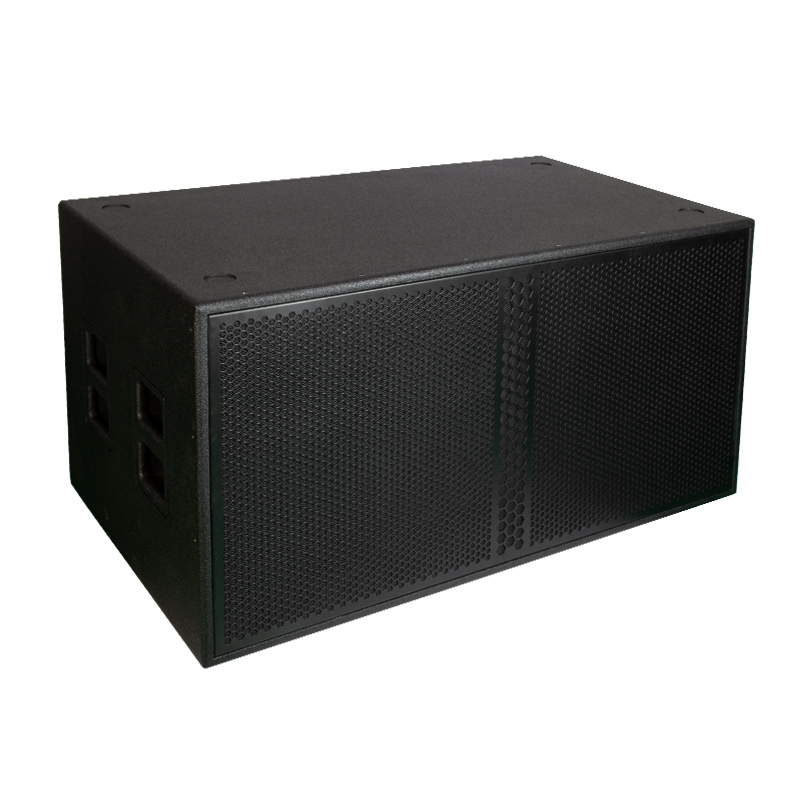
The Audfine active subwoofer range illustrates both approaches. The published figures below are taken from the product pages; they are the reference points used throughout this guide.
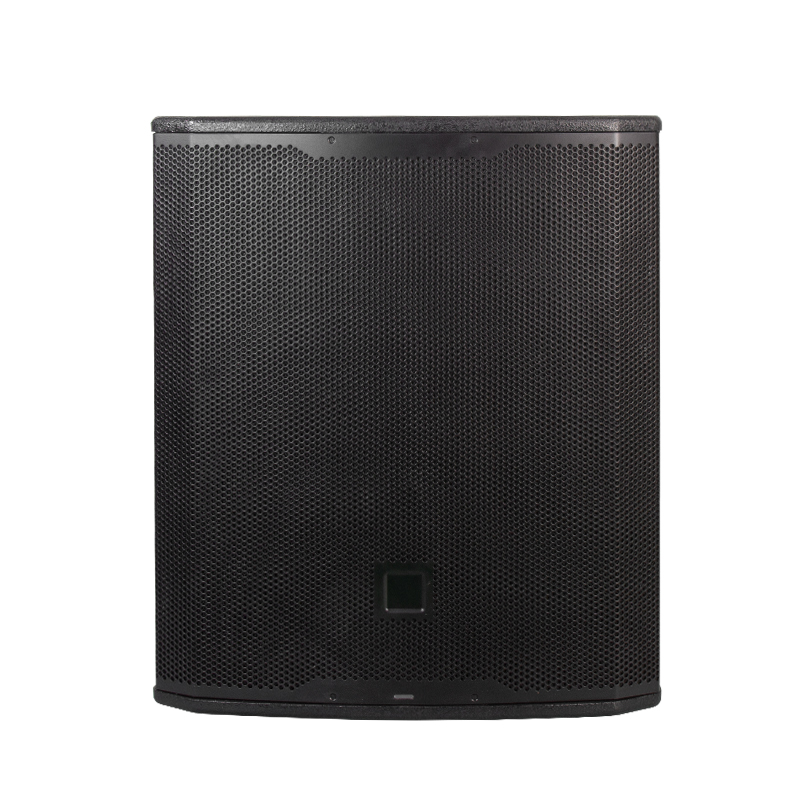
| Model | Configuration | Power | Frequency response | Max SPL @ 1 m | Sensitivity | Crossover | Page |
|---|---|---|---|---|---|---|---|
| PRX918 | 18" subwoofer speaker | 1000W RMS, 2000W Peak | 35Hz - 180Hz | 131 dB | 98dB | - | PRX918 product page |
| SUB-8003 | 18" subwoofer speaker | 1000W RMS, 2000W Peak | 35Hz - 180Hz | 131 dB | 98dB | - | SUB-8003 product page |
| DS218A | Dual 18 inches powered subwoofer | 2000W RMS, 4000W Peak | 35Hz - 180Hz | 131 dB | 98dB | 90 Hz | DS218A product page |
Read across the three rows and one thing stands out: the published sensitivity, maximum SPL and frequency response figures are the same for all three cabinets. What changes is the amplifier power and the driver count. The two single 18-inch models are rated at 1000 W RMS with 2000 W peak; the dual 18-inch DS218A is rated at 2000 W RMS with 4000 W peak. In practice that means the choice between them is made on the amount of low-frequency energy the venue needs and on how the cabinet is going to be moved, rather than on the frequency range it reaches.
Driver-level choice for cabinet programmes
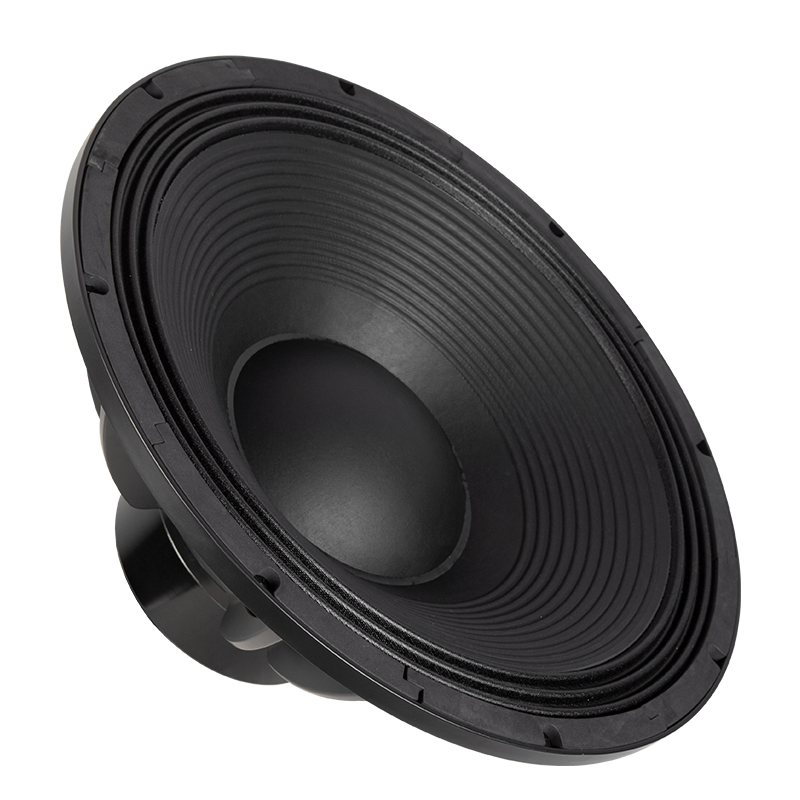
If you are developing your own cabinet rather than buying a finished one, the decision moves down a level, to the driver itself. Cone area, voice coil diameter, motor material and suspension all change what the finished enclosure can do. The four low-frequency drivers below are part of the range supplied from the same factory.
| Model | Type | Power | Sensitivity | Frequency response | Voice coil | Magnet |
|---|---|---|---|---|---|---|
| 18SW115 | 18" speaker woofer transducer | 1600W RMS, 3200W Peak | 96 dB | 30Hz - 1000Hz | GBF4.5" IN/OUT vioce coil | NEO magnet |
| 18BHP501ND | 18" speaker woofer transducer | 2000W RMS, 4000W Peak | 98 dB | 30Hz - 1250Hz | GBF 5" IN/OUT vioce coil | NEO magnet |
| 18BHP401DM | 18" speaker woofer transducer | 1500W RMS, 3000W Peak | 98 dB | 30Hz - 2000Hz | GBF 4" IN/OUT vioce coil | Ferrite magnet |
| 21SW152 | 21" speaker woofer transducer | 2000W RMS, 4000W Peak | 96 dB | 30Hz - 1000Hz | GBF6" IN/OUT vioce coil | NEO magnet |
The trade-offs are visible in the numbers. The 18BHP501ND carries a 5-inch voice coil and a 2000 W RMS rating; the 18SW115 uses a 4.5-inch coil with a neodymium motor and is published at 1600 W RMS with a 30 Hz lower limit; the 18BHP401DM pairs a 4-inch coil with a ferrite motor and a silicone spider; and the 21SW152 moves up to a 21-inch frame with a 6-inch coil for designs where one cabinet has to do more work. Which of them suits a given enclosure depends on the internal volume, the tuning and the amplifier, which is why the driver selection belongs in the enquiry rather than in a catalogue comparison.
How to read amplifier power and headroom
Power ratings on a powered subwoofer come in two figures, and the gap between them matters. The RMS or continuous figure describes what the amplifier can sustain; the peak figure describes what it can deliver for short transients. A 1000 W RMS / 2000 W peak rating means the cabinet is designed around 1000 W of continuous capability with double that available for moments, not that it delivers 2000 W all night.
Sensitivity is the number that puts wattage in context, because it tells you how much acoustic output a cabinet produces for a given input. The single 18-inch models above are published at 98 dB sensitivity with a 2000 W peak rating; applying the 10 log relationship to those two figures lands at 131 dB, which is the published maximum SPL at 1 m. That arithmetic is a useful way to sanity-check a spec sheet — when the published maximum SPL cannot be reached from the published sensitivity and power, it is worth asking how the figure was obtained.
It is also worth asking whether the maximum SPL figure is measured or calculated, and under what condition: half-space loading on the ground, full space, one cabinet or an array, and with which processing preset active. Two cabinets with the same printed number can behave very differently in a room, and the condition is where that difference shows up.
On site, headroom is what protects the programme material. Kick and bass transients are short and demanding; a system running at its continuous limit has nothing left for them, and that is when a cabinet starts to sound strained rather than loud. Specify for the peaks the material actually contains, and confirm how the protection behaves when the cabinet reaches them.
Frequency response: the figure that needs a condition
All three powered subwoofers in the range are published with a 35 Hz to 180 Hz response. That single line raises the question every buyer should ask: at what tolerance?
A response specification without a tolerance says very little. The difference between a −3 dB point and a −10 dB point at the bottom of the range is several hertz and a great deal of audible weight. Ask which one is quoted, whether the measurement was taken in half space or full space, and whether the quoted range is with the internal processing engaged.
The upper figure deserves the same attention. A subwoofer that reaches to 180 Hz overlaps a wider band with the tops, which can be useful when the tops are small and need help, and unhelpful when the overlap region is where the system already sounds uneven. The published 90 Hz crossover on the dual 18-inch model tells you where the manufacturer expects the split to sit; confirm that the figure matches the way you plan to run the system.
Programme material sets the practical target. A speech-led installation in a conference room gains little from extension below 40 Hz and gains a lot from consistency across the seating area. A music venue, a club or a house of worship with a full band puts real energy in the 30 Hz to 50 Hz region, and the specification should reflect that.
Crossover, polarity and time alignment with the tops
Choosing the cabinet is half the job; the other half is making it meet the tops. Three adjustments do most of the work.
Crossover frequency. Start where the tops roll off naturally and where the subwoofer is still comfortable. In most systems that lands between 80 Hz and 100 Hz. Applying a high-pass filter to the tops at the same point keeps low-frequency content out of drivers that cannot use it, which usually improves clarity in the vocal band as well as protecting the tops.
Polarity. At the crossover frequency, the subwoofer and the top are producing the same content from two positions, and whether they add or cancel depends on their relative polarity and on their physical placement. In practice this is settled by measurement: play content through the crossover region, check the response with the subwoofer polarity in one position, then the other, and keep the position that sums. It takes a few minutes and it is the single most common reason a system with good cabinets sounds thin at the bottom of the vocal range.
Delay. When subwoofers sit on the floor at the front and the tops are on stands or flown several metres further back, the two arrivals do not reach the listener together. Aligning them means delaying whichever source arrives first, so the low-frequency arrival lands with the rest of the content. Where a subwoofer arc or a distributed array is used, the same principle applies across the array.
None of these three can be set by ear reliably on a show day; all three are quick to set with a measurement microphone and a processor that offers delay and polarity per output. Build them into the commissioning plan, not into the load-out.
Deployment: ground stack, flown, and cardioid arrays
How the cabinets are placed matters as much as which cabinets are bought. Four patterns cover most professional work.
Ground stacked across the front. The default for portable systems. Cabinets placed close together couple, and a row of coupled cabinets produces more output than the same cabinets spread apart — provided the spacing stays small relative to the wavelength. At 80 Hz a quarter wavelength is roughly one metre, which is the practical reason a spaced pair of subwoofers produces an uneven response across the floor while a tight block does not.
Flown with the line array. Hanging subwoofers with the mains lifts the low end off the floor, reduces the build-up at the front of the audience and improves consistency towards the back of a long room. It also removes cabinets from the sightlines and from the space where the audience stands. Flying requires hardware designed for the cabinet and a check of the structure by a qualified person; the rigging arrangement belongs in the specification, not in an assumption.
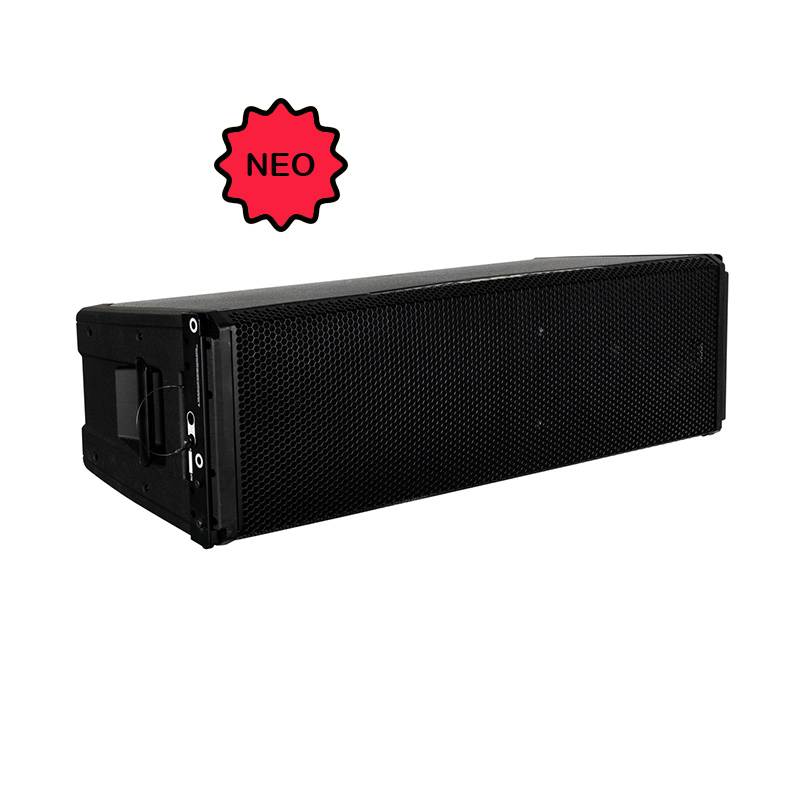
Cardioid and gradient arrays. Reversing one cabinet in a stack, adding delay and inverting polarity on that cabinet, produces cancellation behind the array and keeps low-frequency energy off the stage. It is the standard answer to stage noise and to open microphones, and it depends entirely on the processing available: confirm that the cabinets and the processor support the arrangement before the design is committed.
Distributed and delay fills. Wide or irregular rooms are often better served by several smaller groups of subwoofers, delayed to the main system, than by one large stack at the front. The aim is consistent coverage, and consistency is what the audience notices.
Mains, cabling and the practicalities of the destination market
A powered subwoofer is a mains device, and the mains side of the specification is where projects most often go wrong at the last minute.
Read the nameplate rating rather than the brochure figure, and size the distribution for the number of cabinets actually on the circuit. Long cable runs need adequate conductor cross-section or the voltage at the cabinet sags under load, which shows up as reduced headroom rather than as an obvious fault. Keeping signal and mains runs separated, labelling both ends, and keeping spare mains and signal lines in the truck are unglamorous habits that prevent most of the faults that get blamed on the loudspeakers.
For export orders, confirm the mains configuration the destination market requires — the nominal voltage, the frequency, the plug type and the connector on the cabinet. Two markets that look similar on a map can require different builds, and this item is far cheaper to settle in the enquiry than after production.
Enclosure, hardware and handling
Cabinet construction divides broadly into plywood enclosures, which are stiff and take fixings and repairs well, and moulded enclosures, which resist weather and handling damage and keep weight down. Which suits a project depends on whether the cabinet is going to be repaired or replaced at the end of its life, and on how it is transported.
The hardware list is worth writing out explicitly: handles and their positions, castors, a pole socket if the cabinet will ever carry a top, stacking feet or recesses, the grille and its fixings, and the connector panel. These are the parts that fail first in service, the parts that get replaced, and the parts a crew notices on the first load-in. The Audfine active subwoofer model guide covers the cabinet and transport detail model by model.
What to specify when you source powered subwoofers from a China manufacturer
For buyers working with a China powered subwoofer factory, the specification is the deliverable. A clear one shortens sampling, avoids a second round of samples, and gives both sides something to check the finished goods against. The items below are the ones that most often get left out of a first enquiry.
- Published figures with their conditions. Ask for power (continuous and peak), sensitivity, maximum SPL at 1 m, and frequency response, and ask how each was measured.
- Response tolerance. Confirm whether the quoted range is a −3 dB or a −10 dB figure, and in which loading condition.
- Processing behaviour. The crossover point, whether a high-pass for the tops is available, the limiter strategy, and whether delay and polarity are adjustable per output.
- Mains build for the destination market. Nominal voltage, frequency, plug type and connector type on the cabinet.
- Enclosure and hardware. Material, finish, colour, handle positions, castors, pole socket, stacking features, grille, connector panel.
- Deployment method. Ground stack, flown, or cardioid — and exactly which hardware and processing are included for that method.
- Branding and documentation. Logo treatment, model numbering, packaging, and the documents that ship with the order: specification sheet, connector pinout, service information and the spare-part list.
- Sample and inspection scope. What the evaluation sample should represent, and what will be checked before shipment — serial numbering, functional test, finish, packing list.
Sending the venue type, the programme material, the deployment method and the destination market with the enquiry lets a powered subwoofer supplier respond with a configuration rather than a catalogue. It also makes the first sample far more likely to be the cabinet that goes into production.
Frequently asked questions
What is the difference between a powered and a passive subwoofer?
A powered subwoofer contains its own amplifier and processing, so it needs mains and signal only. A passive subwoofer needs an external amplifier, which gives the system designer more freedom and adds a matching decision. Most portable and event systems use powered cabinets for speed of setup; large installed systems sometimes keep amplification centralized.
Is a dual 18-inch cabinet always the right choice for a larger room?
Not necessarily. A dual-driver cabinet delivers more output from one position, which helps when floor space or rigging points are limited. Several single-driver cabinets placed and delayed correctly can cover an awkward room more evenly. The room shape usually decides it before the output figure does.
Can powered subwoofers be flown?
Some cabinets are designed for it and some are not, and the difference is in the hardware and the enclosure structure. If a design calls for flown subwoofers, state it in the enquiry and have the rigging arrangement reviewed by a qualified person before anything is hung.
Do I need a separate loudspeaker processor as well?
Powered subwoofers carry internal processing, which covers crossover and protection. A separate system processor is still useful when the system needs per-output delay, multiple alignment settings, or different presets for different rooms. Confirm what the internal processing offers before budgeting for an external unit.
Can the cabinet carry our own brand and model numbering?
Branding, model numbering, finish and packaging are handled as part of an OEM or ODM programme and depend on the cabinet and the volume involved. Send the requirement with the enquiry so it can be quoted as part of the specification rather than added later.
What should the first enquiry contain?
The application (event or installation), the room size and shape, the programme material, the deployment method, the number of cabinets, the mains configuration for the destination market, and any branding requirement. Those seven items are enough to start a technical discussion.
Discuss a subwoofer programme with the factory
Whether you are filling out a rental fleet or specifying a fixed installation, the fastest route to a usable quotation is a specification that states its conditions. Send the application, the deployment method, the destination market and the branding requirement, and the technical team will come back with a configuration and the published figures behind it.
Contact the Audfine team to discuss a powered subwoofer programme.