Active PA Speakers for Outdoor Events: What to Check Before Ordering
Outdoor work is where a powered speaker specification is tested. The cabinet that sounds full in a hotel ballroom has to carry across open ground with no wall behind it, no ceiling above it and no mains outlet within a comfortable cable run. For distributors, rental companies and installation contractors sourcing from China, the checks that matter before an order are not the same checks that matter for an indoor installation.
This guide sets out what changes outdoors, which published figures answer each question, and how the active PA speakers in the Audfine range are specified. Audfine is the brand of Ningbo Lesound Electronics Co., LTD., a professional audio manufacturer and exporter established in 2009 in Ningbo, China. The product range covers speakers, speaker transducers, headphones, studio equipment and professional audio accessories, and the company works with overseas brands on an OEM and ODM basis.
What changes when the audience is outdoors
Three differences drive the rest of the specification conversation.
No room gain. Indoors, walls, floor and ceiling add acoustic energy to whatever the cabinet produces, and the low end is reinforced by the room itself. Outdoors a listener hears essentially the direct sound of the cabinet. The practical consequence is that headroom becomes the working constraint rather than tone: the system has to produce the level on its own, without the room helping.
Distance, and no reflective ceiling. Outdoor audience areas are usually wider and further from the source than indoor ones, and there is no ceiling to distribute energy into the back of the space. Coverage angle, cabinet height and the number of boxes per side decide whether the back rows hear the same programme as the front.
Build-up, strike and mains. An outdoor event is typically built and struck the same day, on ground that is not level, in weather that is not controlled. Cabinets are carried by hand, stacked on whatever surface is available, and fed from whatever power is on site. Weight distribution, handle placement, cabinet material and mains flexibility all matter as much as the acoustic figures.
The published figures that answer each of those questions
Power: RMS and peak are two different numbers
Every active cabinet in the range publishes both figures. The HD-15A and the LSA-15A list 400 W RMS and 800 W peak. The EON-915 and the EON-715 list 700 W RMS and 1400 W peak. The RMS figure describes continuous programme material; the peak figure describes short transients. A buyer comparing two cabinets on the peak column alone is comparing the wrong number, because the ratio between the two is not fixed across designs.
Max SPL at 1 m and sensitivity
Max SPL at 1 m is the published output ceiling of the box: 123 dB for the 15-inch models listed here and 121 dB for the 12-inch LSA-12A. Sensitivity describes how efficiently the cabinet turns amplifier power into acoustic output — 96 dB on the HD-15A, 97 dB on the NX-915, and 95 dB on the EON-915, EON-715, LSA-15A and LSA-12A. Two cabinets can share a max SPL figure and still behave differently in use, because sensitivity, crossover point and driver size all interact. What matters for procurement is that both figures are published, so the number can be checked against the drawing rather than assumed.
Coverage angle and mounting height
All six models publish the same 100° x 60° (H x V) coverage. For an outdoor audience that is wide and shallow, a pair of tops aimed correctly from the right height covers more usable ground than a taller stack of narrow boxes aimed down the middle. Because the vertical pattern is 60°, the aiming angle is a decision the installer has to make on site, and the cabinet has to be able to hold that angle.
Pole sockets, handles and cabinet material
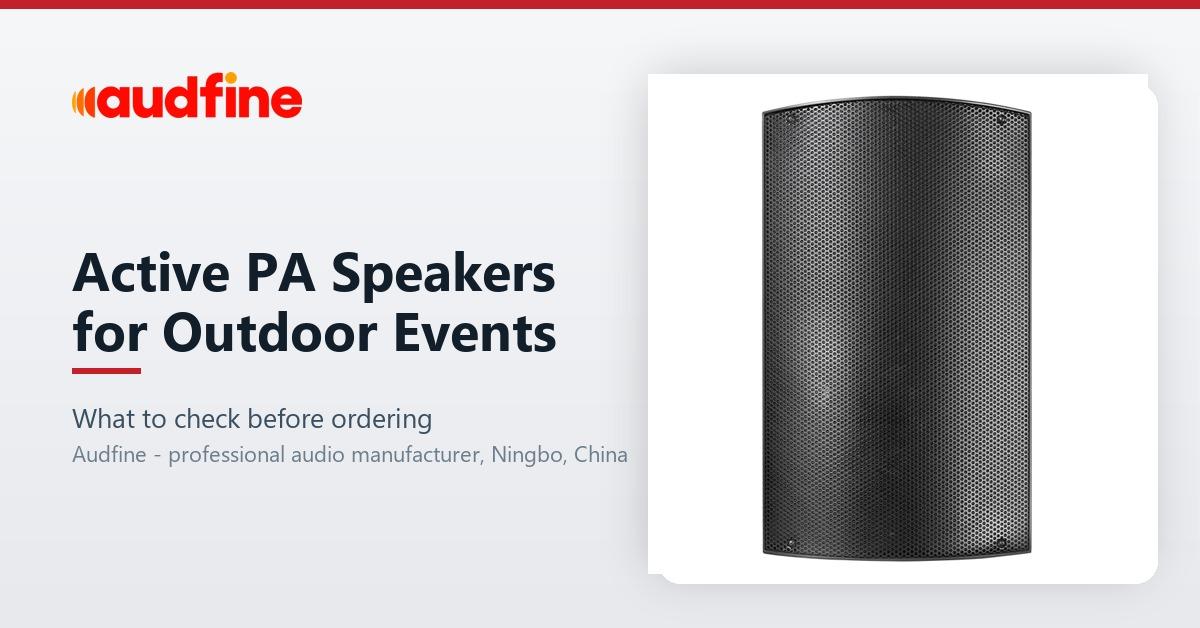
This is where the range separates into two build families. The HD-15A, EON-915 and EON-715 use injection-moulded PP cabinets with steel grilles. The NX-915, LSA-15A and LSA-12A use birch plywood cabinets with steel grilles and a textured coating.
Pole mounting also differs, and it is worth reading the published field rather than assuming. The EON-715, NX-915, LSA-15A and LSA-12A each list a 35 mm insert. The HD-15A published specification lists no pole socket, so it is deployed on the ground or on a riser rather than on a tripod. The EON-915 refers to the figure on the product page instead of stating a socket diameter, which is a point to confirm with the supplier if the plan depends on pole mounting.
Handle configurations differ in the same way: top handle plus two side handles on the HD-15A, top plus two side handles on the EON-915, top plus one side handle on the EON-715, and two side handles on the NX-915, LSA-15A and LSA-12A. For a rental fleet that is loaded by hand twice a day, that detail is worth more attention than it usually gets.
Connectors, processing and protection
There are two input philosophies in the range. The HD-15A offers a female XLR input and a 6.35 mm jack input with EQ and volume control on the rear panel. The EON-915 and EON-715 add DSP with a limiter and per-input control. The NX-915, LSA-15A and LSA-12A accept Combo, 3.5 mm jack and RCA L/R inputs alongside DSP and a limiter. All six provide a male XLR output for linking cabinets, list thermal and RMS protection, and publish an AC 110 V ~ 220 V power supply — a useful characteristic where event power is not consistent between sites.
The Audfine active PA speaker models for outdoor duty
The table below lists the published fields that matter most for outdoor planning. Full specification blocks are on each product page, linked from the model names in the text.
| Model | Cabinet | Amplifier | Power | Max SPL @ 1 m | Frequency response | Sensitivity | Inputs | Pole socket |
|---|---|---|---|---|---|---|---|---|
| HD-15A | PP with steel grille | Class-H | 400 W RMS / 800 W peak | 123 dB | 45 Hz – 20 kHz | 96 dB | Female XLR x1, 6.35 mm jack x1 | Not listed |
| EON-915 | PP with steel grille | Class-D digital | 700 W RMS / 1400 W peak | 123 dB | 45 Hz – 20 kHz | 95 dB | Combo x1, 3.5 mm jack x1 | As shown in figure |
| EON-715 | PP with steel grille | Class-D digital | 700 W RMS / 1400 W peak | 123 dB | 45 Hz – 20 kHz | 95 dB | Combo x1, 3.5 mm jack x1 | 35 mm insert |
| NX-915 | Birch plywood with steel grille | Class-D digital | 400 W RMS / 800 W peak | 123 dB | 45 Hz – 20 kHz | 97 dB | Combo x1, 3.5 mm jack x1, RCA L/R x1 | 35 mm insert |
| LSA-15A | Birch plywood with steel grille | Class-D digital | 400 W RMS / 800 W peak | 123 dB | 45 Hz – 20 kHz | 95 dB | Combo x1, 3.5 mm jack x1, RCA L/R x1 | 35 mm insert |
| LSA-12A | Birch plywood with steel grille | Class-D digital | 400 W RMS / 800 W peak | 121 dB | 50 Hz – 20 kHz | 95 dB | Combo x1, 3.5 mm jack x1, RCA L/R x1 | 35 mm insert |
All six models publish the same 100° x 60° (H x V) coverage angle, thermal and RMS protection, an AC 110 V ~ 220 V supply and a male XLR link output. The two 15-inch powered models with the higher published amplifier rating — the EON-915 15-inch active PA speaker and its EON-715 counterpart, both at 700 W RMS and 1400 W peak — carry the most amplifier headroom of the 15-inch models listed here, which is the figure that matters most when there is no room gain to work with.
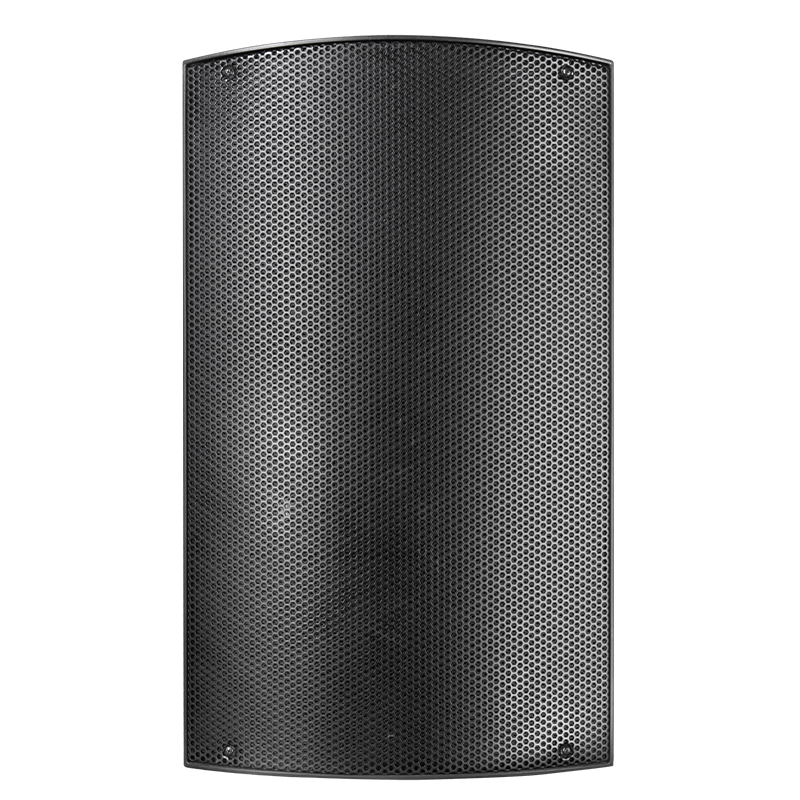
The HD-15A 15-inch powered PA speaker takes a different route: a Class-H amplifier rated at 400 W RMS and 800 W peak, EQ and volume control on the rear panel, 96 dB sensitivity, and the 15-inch woofer with a 3-inch voice coil and 80 OZ ferrite magnet shared with the NX-915. Its published specification lists no pole socket, so it is deployed on the ground or on a riser — a consideration for a rental company planning to put every cabinet on a tripod.
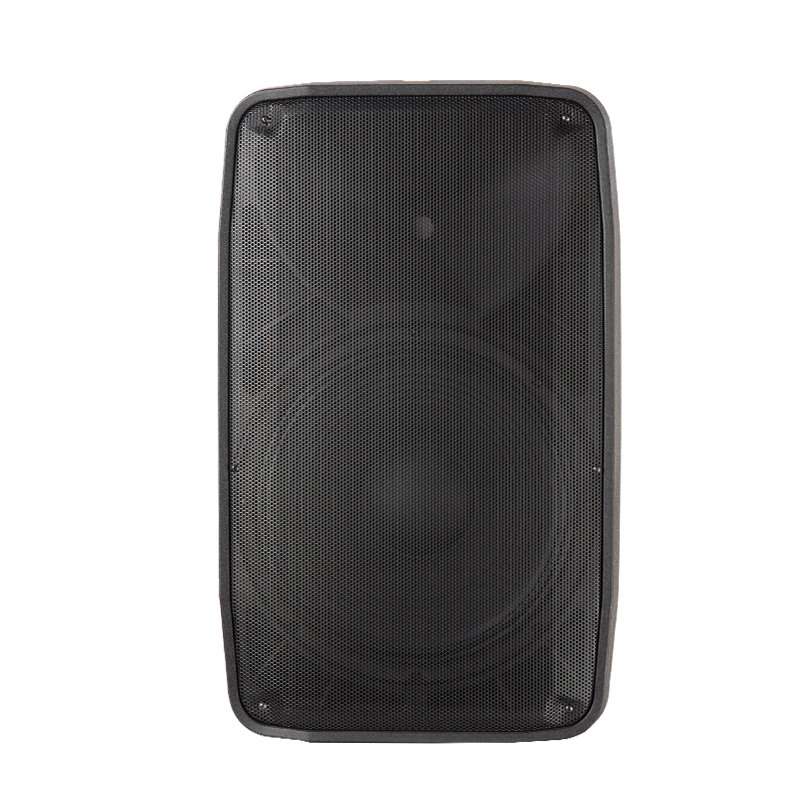
Where a project needs a wooden enclosure, the birch plywood LSA-15A and the 12-inch LSA-12A share the Class-D digital platform, the DSP and limiter, and the 35 mm pole insert. The LSA-12A is rated at 121 dB max SPL and covers from 50 Hz; it is the smaller enclosure of the two, which is often the deciding factor when a one-person crew has to move a pair of tops and a subwoofer alone. The NX-915 birch plywood powered speaker uses the same cabinet family with the higher 97 dB sensitivity and a 1.8 kHz crossover point.
What to confirm with an active PA speaker manufacturer in China before ordering
Most of the risk in an overseas order sits in the gap between what a buyer assumes and what the published specification actually says. The list below is the set of points worth closing in writing with a powered PA speaker supplier in China before the order is confirmed.
- Which power figure is quoted. Ask for RMS and peak separately. A quotation that gives one number without saying which it is cannot be compared with another supplier's sheet.
- The exact cabinet material and finish for each size in the order, since a single range can mix moulded and wooden enclosures.
- Pole socket diameter, or confirmation that there is none. This decides how the tops can be deployed.
- The connector set on the rear panel, including whether a Combo socket, RCA pair or jack input is fitted, and whether an XLR link output is present.
- Rear-panel controls: whether the cabinet has DSP with a limiter, and whether each input has its own level control.
- Mains range and plug type for the destination market, plus the power cable length supplied.
- Protection circuitry — which protections are published (thermal, RMS) and under what conditions they engage.
- Spares and service parts that will be available with the shipment, so a fleet can be kept running rather than replaced.
- Branding and packaging: whether the OEM programme covers the logo, the grille badge, the carton print and the manual, and what artwork the factory needs from the buyer.
For a factory working on an OEM or ODM basis, these points are normally settled at sample stage. Audfine builds cabinets for overseas brands, which means the specification is negotiated rather than fixed — the published figures above are the starting position, not the limit of what can be produced.
Weather exposure: what the published specification does and does not state
Outdoor use raises a question that buyers are right to ask early: how much exposure the cabinet will tolerate. The published specifications for these models describe amplifier class, power rating, max SPL, frequency response, sensitivity, crossover point, coverage angle, connectors, cabinet material, protection circuitry and mains supply. They do not declare an ingress-protection class.
That is a normal position for a powered cabinet at this level, and it has a practical consequence for planning rather than a marketing one. Where a project involves permanent outdoor mounting, salt air, driven rain or dust, that requirement has to be raised with the supplier as a project-specific question and answered per project. For event work, the working assumptions remain the usual ones: overhead cover for the cabinets, cable entries dressed so water cannot run into a socket, dry storage between events, and a check of the enclosure and grille at each load-in.
Matching the tops to subwoofers and line arrays
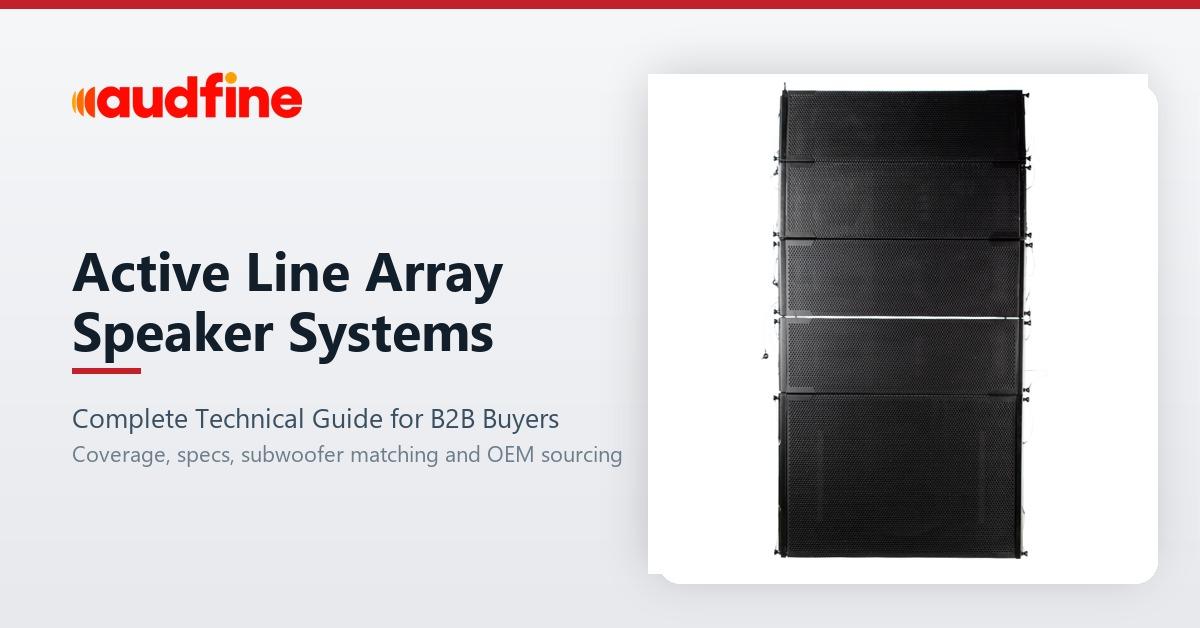
A pair of 15-inch tops covers the vocal and mid-band range on its own, but outdoor programme material usually needs low-frequency support that no single 15-inch cabinet can provide. The Audfine range includes three active subwoofer models, and the PRX918, SUB-8003 and DS218A matching guide covers their published specifications and how they pair with the tops. Where the audience area is larger than a single pair of tops can cover, a line array is the route, and the array models are specified separately from the point-source cabinets covered here. The full range of powered cabinets is listed on the active speakers product page.
Questions buyers ask before an outdoor speaker order
Is a 15-inch cabinet enough for an outdoor event?
For a few hundred people with speech, playback and a small band, a pair of 15-inch tops on stands is a workable starting point, provided the audience area is not deeper than the coverage pattern covers at the mounting height available. Beyond that the answer depends on the subwoofers added and on how many boxes are flown or stacked per side.
Should the cabinets be powered or passive?
Powered cabinets remove the amplifier rack from the system and arrive with the amplifier, limiter and crossover already matched to the drivers. That shortens setup and reduces the number of things that can be mis-cabled on site. Passive cabinets make sense where an existing amplifier inventory has to be reused.
What is the difference between an 800 W and a 1400 W cabinet here?
The 1400 W models (EON-715 and EON-915) publish 700 W RMS and 1400 W peak, against 400 W RMS and 800 W peak on the 800 W models. Both families publish 123 dB max SPL at 1 m in the 15-inch size, so the difference shows up as amplifier headroom rather than as a different output ceiling.
Can the cabinets be supplied with custom branding?
Yes — the company works on both OEM and ODM programmes for overseas brands. The scope of what can be customised, and the artwork required, is normally confirmed at sample stage.
Next step for your outdoor PA programme
If you are specifying powered cabinets for outdoor events, the fastest way to a usable answer is to send the audience size, the type of programme material, the deployment plan and the destination market. That is enough to identify which models in the range fit and which additional low-frequency support is needed. Audfine is a professional audio manufacturer in Ningbo exporting to more than 60 countries, and enquiries from distributors, rental companies and installation contractors are handled directly by the factory.
Contact the factory with your outdoor PA speaker requirement.