Choosing an OEM headphone manufacturer is not simply a matter of comparing unit prices. The decision determines whether your launch sample can be repeated in mass production, whether the cable and ear pads survive real use, whether the impedance matches your customers' equipment, whether packaging arrives retail-ready, and whether the documentation supports the markets in which you plan to sell.
The most dependable selection method is evidence-based. Define the listening application first. Translate that application into measurable product requirements. Ask every shortlisted factory to answer the same RFQ. Evaluate samples against a written approval standard. A polished showroom sample tells you little about repeatability; inspect the controls used on the production line. Break every quotation into the same buckets—unit, tooling, packaging, accessories, testing, freight, and commercial terms—so differences stay visible.
Direct answer: Look for a factory that can explain the chain from the intended listener to the controlled specification, approved sample, production checks, market documents, packaging records, and revision history. If a low unit price leaves gaps in that chain, the buyer is simply accepting cost somewhere else.
✉ Request an OEM Headphone Quote
This is a working document for the people who actually have to sign off a headphone PO: brand teams, importers, distributors, music retailers, studio suppliers, gaming-accessory teams, and sourcing managers. The examples come from wired, over-ear professional headphones, where engineering choices and supply risks are unusually easy to see. Buyers can reuse the checklist for related headset and accessory programs.
What an OEM headphone manufacturer actually does
An OEM project starts with an existing or partly existing manufacturing platform and adapts it to a buyer's commercial specification. The changes may include the brand mark, color, ear-pad material, cable, connector, impedance, acoustic tuning, carrying case, retail box, manuals, and carton markings. The buyer owns the market requirement and final approval standard. The manufacturer controls the production process needed to reproduce the approved sample.
ODM is different in degree, not merely in name. An ODM project normally involves more development work, such as a new mechanical structure, acoustic target, tooling package, microphone module, cable architecture, or accessory system. Call the work what it is at the RFQ stage: a platform adaptation, a new ODM build, or a phased program that starts with a standard shell and gains proprietary parts later.
Audfine belongs to Ningbo Lesound Electronics Co., Ltd. The company began operating in Ningbo in 2009. Its 2026 catalog runs from studio, DJ, monitor, and gaming models to the less glamorous but commercially critical extras—cables, cases, pads, adapters, and retail packs.The same catalog offers OEM and ODM work. Treat that as a starting point, not a blanket promise: confirm each project's MOQ, schedule, tests, certificates, and exclusivity in the written quote and quality agreement.
OEM, private label, and ODM compared
| Sourcing route | Starting point | Typical buyer input | Development risk | Best use |
|---|---|---|---|---|
| Private label | Existing production model | Logo, box, artwork, color, bundle | Lowest when the base model remains unchanged | Fast market test or distributor range extension |
| OEM adaptation | Existing mechanical and acoustic platform | Performance options, cable, ear pads, branding, packaging | Moderate; every change needs validation | Differentiated product without full new tooling |
| ODM development | New or heavily modified product | Target user, acoustic goal, industrial design, tooling, validation plan | Highest; more engineering gates and change control | Proprietary range with a longer product roadmap |
Do not ask a supplier only, “Can you customize this?” Ask what changes the existing platform supports, which changes require new tooling, which changes affect compliance, which changes reset the sample schedule, and which characteristics the factory will guarantee in production. The answers reveal whether the supplier is treating customization as a controlled engineering project or as artwork applied to an unknown product.
Start with the listener, not the catalog
Product selection becomes much easier when the target user and listening environment are explicit. A vocalist tracking in the same room as a microphone has a different priority from a mix engineer working in a quiet control room. A touring DJ needs different mechanics from a student using headphones at a desk. A gaming headset buyer must specify microphone and platform behavior that a passive studio headphone does not need.
Write a one-sentence job statement before choosing a model:
The product is for [user] who needs [listening task] in [environment], connected to [source equipment], for approximately [session duration], with [service and price position].
That sentence forces useful choices. If the environment is noisy or microphones are open, isolation and leakage matter. If the source is a phone or laptop, electrical sensitivity and impedance need to suit limited output voltage. If the user wears the product for hours, pad geometry, clamp distribution, mass, heat, and replaceability matter. If the channel is rental or education, cable and pad serviceability may matter more than decorative finish.
Translate the use case into a product brief
| Buyer question | Requirement to write | Evidence to request |
|---|---|---|
| Who will use the headphone? | User profile, head-size range, glasses use, skill level | Fit assessment protocol and sample panel notes |
| Where will it be used? | Quiet room, tracking room, stage, DJ booth, office, classroom | Isolation/leakage method and realistic use test |
| What will drive it? | Phone, laptop, interface, mixer, headphone amplifier | Impedance option, sensitivity statement, source compatibility test |
| What will it reproduce? | Tracking, cue mix, editing, casual listening, DJ monitoring | Acoustic target, approved reference tracks, measurement report |
| How will it be serviced? | Replaceable cable, pads, adapter, carrying case | Spare-part list, connector drawings, compatibility matrix |
| Where will it be sold? | Countries, channels, age group, packaging language | Current compliance file for the exact configuration |
This discipline prevents a common sourcing error: selecting a visually appealing headphone first and attempting to justify it for every channel later. One platform can support several variants, but each variant still needs a clearly defined job.
Build a comparable technical RFQ
A useful RFQ is short enough for a supplier to answer, but precise enough to expose assumptions. Send the same version to every supplier. Number every requirement.Ask the factory to mark each line as standard, optional, new development, not available, or subject to testing. Require written exceptions rather than treating silence as acceptance.
Product identity and commercial scope
Begin with the basics: intended selling countries, annual forecast by region, launch window, sales channel, target wholesale position, and expected product life. State whether forecasts are planning estimates rather than purchase commitments. Define the number of SKUs, colors, impedance variants, packages, and accessory bundles. If the product will be exclusive, describe whether exclusivity concerns artwork, color, tuning, molds, a region, a channel, or an entire platform.
Ask the supplier to identify the legal manufacturer, factory location, quotation entity, exporter, and payment beneficiary. They may be the same company, but do not assume that they are. Record the factory's internal model number and your proposed SKU. This avoids confusion when several cosmetic variants share one mechanical platform.
Acoustic requirements
Avoid treating a published frequency range as a complete acoustic specification. “10 Hz to 35 kHz” does not tell a buyer the response shape, matching between left and right channels, fixture used, smoothing, level, seal condition, or production tolerance. A responsible brief combines measurement and listening approval.
Ask for:
- driver type and nominal diameter;
- nominal impedance and allowed tolerance at the stated test frequency;
- sensitivity definition, unit, reference voltage or power, and test frequency;
- frequency-response test setup and pass limits;
- left/right channel balance limits;
- distortion measurement conditions and limits where relevant;
- polarity and wiring convention;
- acoustic golden sample and retention method;
- production sampling plan and record retention.
The international standard IEC 60268-7, Sound system equipment — Part 7: Headphones and earphones, provides established terminology and measurement guidance for headphone evaluation. It is not a substitute for your product-specific acceptance limits, but it is a better common reference than an undefined test screenshot. See the IEC publication page when aligning terminology with a laboratory or manufacturer.
The Audfine DH-1772 offers a useful example of why the source device must appear in the RFQ. Its catalog lists a 50 mm neodymium driver, a 10 Hz–35 kHz stated frequency response, 99 ± 3 dB sensitivity, and 32, 80, or 250 ohm impedance options. Those options can serve different system contexts, but none should be described as universally “better.” The appropriate version depends on source voltage, required level, noise floor, cable loss, use environment, and the buyer's listening target.
Mechanical and comfort requirements
Mechanical failures are often more visible to customers than small acoustic differences. Specify the headband extension range, hinge or swivel movement, cable exit direction, plug geometry, ear-pad attachment, replaceable parts, surface finish, logo position, and color tolerance. If the headphone folds, define the intended fold sequence and shipping position. If it swivels, define the movement needed for one-ear monitoring and the stop points that must survive repeated use.
Comfort needs a reproducible review method. Record the test panel, session length, ambient temperature, whether users wear glasses, and what constitutes a failure. Comments such as “comfortable” are too vague to approve mass production. A better approval note might state that no panel member experienced a pressure hotspot during a two-hour desk session and that pad openings remained centered around the ear. The exact protocol should reflect your market rather than copying a generic duration.
Cable, plug, and accessory requirements
Cable specifications should identify conductor arrangement, outer jacket, total length, straight or coiled format, detachable or fixed connection, strain relief, source-end plug, headphone-side plug, adapter, microphone wiring if present, and packaging method. State whether the plug must fit recessed phone cases or professional equipment panels. If a locking or anti-loss feature is used, ask for mating drawings and a replacement-cable plan.
For example, the DH-1772 catalog lists a detachable 3 m braided OFC cable and a 6.35 mm to 3.5 mm gold-plated adapter.It also shows options that can include a solid carrying case, soft bag, customized box, plug-in microphone cable, extra ear pads, or cable. A buyer should not assume every option is included in the base quotation. Put each item on a separate RFQ line with quantity, color, logo, pack method, spare-part forecast, and approval sample.
Choose closed-back or open-back architecture deliberately
Closed and open earcups solve different shop-floor problems. A closed cup is usually the safer starting point when the buyer needs cue isolation, lower leakage, or reliable monitoring in a busy room. Open cups behave differently: the vents let room sound in and headphone sound out. That trade can work well in a quiet control room, yet it is risky beside a live microphone.
Do not predict the tuning from the label on the box. Pad seal, damping, enclosure volume, driver behavior, fit, and fixture coupling can change both the measurement and the listening result. Audition and measure the actual approved sample in the intended application.
| Application | Likely starting architecture | Primary reason | Validation focus |
|---|---|---|---|
| Vocal or instrument tracking | Closed-back | Reduce cue leakage into microphones | Leakage, seal consistency, comfort, cable noise |
| DJ cue monitoring | Closed-back, often with swivel | Isolation and one-ear handling | Hinge durability, swivel control, loud-environment usability |
| Mixing in a quiet room | Open-back or validated closed-back | Evaluation preference and long-session use | Translation, channel matching, comfort, leakage constraints |
| Education or shared workstations | Closed-back | Limit disturbance and simplify use | Cleanability, cable replacement, connector compatibility |
| Mobile content production | Efficient closed-back | Work with limited-output sources | Achievable level, sensitivity definition, portability |
Audfine's catalog includes the closed-back DH-1772 and DH-1771, as well as the open-back DH-1771K. The DH-1771K catalog lists a 50 mm driver, 10 Hz–35 kHz stated response, and 32, 80, or 250 ohm options. The presence of related platforms can help a buyer compare architectures without changing every other decision at once, but each version still requires its own approved sample and controlled bill of materials.
Understand 32, 80, and 250 ohm options without shortcuts
Impedance is an electrical characteristic, not a quality score. Headphone level depends on the interaction among source voltage, source impedance, headphone impedance, sensitivity, music crest factor, and the level the application requires. A high-impedance model can be appropriate with suitable professional equipment. A lower-impedance model can be more practical with portable devices, but sensitivity and source behavior still matter.
Ask the supplier to state sensitivity with its measurement basis. Sensitivity figures only become comparable after the reference is clear. A number measured at 1 mW and one measured at 1 V require conversion using the headphone impedance; lining up the raw values is misleading. Also ask which test fixture, coupler, frequency, and sample condition were used. If a brand wants several impedance variants under one model family, require a version-control table so labels, cartons, cables, manuals, and test limits cannot be mixed.
A practical source-matching procedure
- List the weakest source device the customer is expected to use.
- Record its rated headphone output where reliable data is available.
- Define the maximum listening level needed for the application, including headroom.
- Compare sample variants at matched level rather than matched volume-knob position.
- Check noise, channel tracking, and frequency response at realistic settings.
- Confirm the same driver and impedance version appears in the approved sample, purchase order, box label, unit label, and test plan.
Do not publish claims such as “250 ohm is more detailed” unless controlled evidence supports that conclusion for the specific products being compared. The buyer's task is to choose a system match, not to turn one electrical number into a ranking shortcut.
Evaluate the sample as a production standard
Treat every sample as a proposed production standard, not a beauty piece. First identify what arrived: a regular production unit, a hand-tuned engineering build, or an appearance-only prototype. Give it a sample ID and log the date, driver revision, pad, cable, artwork, package, and firmware when relevant.
Run the approval in three passes:
Engineering approval covers the measurable product—acoustics, dimensions, materials, and safety-related limits. Commercial approval signs off what the customer sees and opens: finish, logo, included accessories, pack-out, and fit with the sales channel. Only after those checks should production approval begin. The factory must prove repeatability on the line with the agreed material list, station instructions, fixtures, and inspection limits.
Keep matching, signed reference units: one with the buyer and one with the factory. Seal or label them so parts cannot be borrowed without a record. If an approved detail cannot be measured easily, photograph it under controlled lighting and describe the inspection method.A golden sample should resolve ambiguity; it should not become a substitute for a missing specification.
Sample comparison scorecard
| Area | What to compare | Reject or investigate when |
|---|---|---|
| Acoustic | Response, channel balance, distortion, polarity, level | Results lack conditions, channels differ materially, or listening result cannot be repeated |
| Fit and comfort | Extension, clamp distribution, pad opening, heat, glasses | Fit works only for one evaluator or discomfort appears in the intended session |
| Mechanics | Hinge, swivel, headband, screws, pad retention | Movement is loose, noisy, asymmetric, or changes after limited cycling |
| Cable and connectors | Contact stability, strain relief, microphonics, adapter fit | Intermittent contact, poor retention, or replacement cable is unavailable |
| Cosmetics | Color, gloss, texture, gaps, logo, printing | Approval depends on uncontrolled lighting or undefined visual tolerance |
| Packaging | Protection, labels, manuals, barcode, carton | Product moves, cable marks surfaces, label data conflicts, or drop risk is unknown |
Audit the factory's process, not its presentation room
A supplier audit should follow the flow of one product from incoming material to shipment. The point is not to collect attractive photographs.The point is to discover where product identity is established, where variation can enter, how defects are detected, and who has authority to stop production.
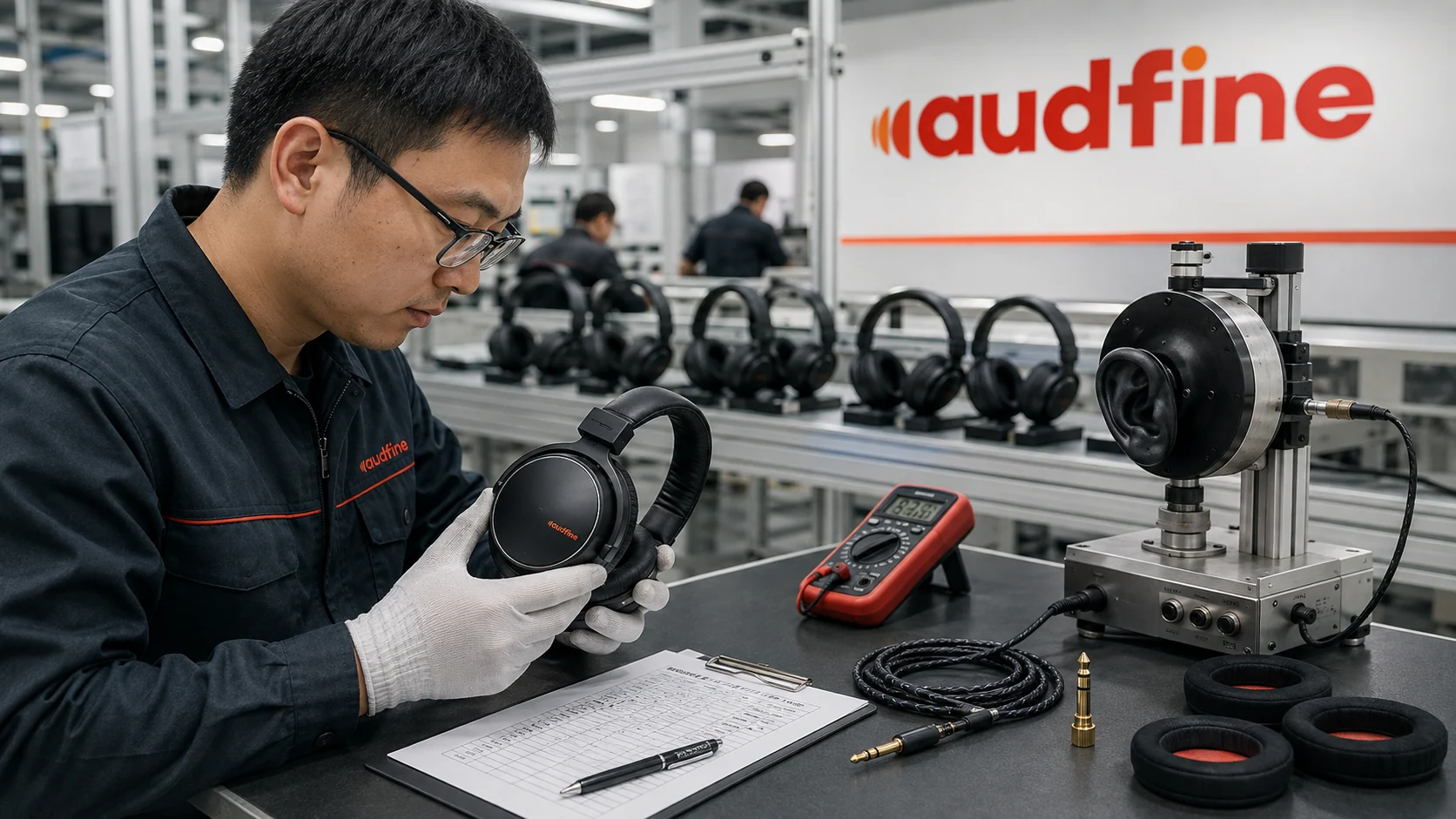
Ask to see how incoming drivers, cables, plugs, magnets, plastics, pads, and packaging are identified. Review whether lot numbers remain connected to production records. Observe driver pairing or channel matching if required. Check how soldering polarity is controlled. Review fixture calibration status. Look at work instructions at the station where operators actually use them. Sample finished inspection records and confirm that failed units have a defined disposition.
ISO 9001 offers a useful lens for the audit, even when the visit is limited to one headphone line. Look for work that is defined, documents that are under control, decisions backed by records, problems that trigger corrective action, and changes that can be followed over time. When a certificate appears in the file, read it rather than counting it. Check the expiry, scope, named legal entity, production site, and issuer. A certificate alone does not prove that your exact headphone is controlled; production evidence still matters.
Twelve audit questions that reveal operational control
- How does the factory prevent two impedance variants from being mixed?
- Which characteristics are checked on every unit, and which are sampled?
- How are acoustic fixtures verified and calibrated?
- How are left and right drivers identified before assembly?
- What happens when an operator finds a polarity or channel-balance failure?
- Can the factory trace a finished carton back to component lots and inspection records?
- Who approves a substitute material, supplier, adhesive, pad foam, cable, or coating?
- How is the buyer notified before a process or component change?
- Which defects caused rework or customer returns during recent comparable production?
- How are logo, label, manual, and carton artwork revisions controlled?
- How are spare pads, cables, adapters, and cases checked for model compatibility?
- Which records will be provided with the shipment, and how long are they retained?
Vague answers are a risk signal. No responsible buyer should ask for another brand's confidential records. The factory can still explain its process and provide redacted examples or generic records that demonstrate how the control works.
Design a headphone quality-control plan around failure modes
Quality control should begin with product risk, not a copied checklist. Start with failure in the real world.What sends the unit back? What could create a safety problem, break source compatibility, or embarrass the brand even though sound still comes from both cups?
At incoming inspection, the checklist might include part identity, critical dimensions, cable continuity, connector geometry or plating, pad material, molding color, and the current packaging artwork. In-process checks may cover polarity, soldering, screw torque where specified, routing, pad fit, hinge assembly, and cosmetic protection. Final checks may cover channel function, acoustic limits, visual defects, cable movement, plug fit, accessory count, label accuracy, and pack-out.
Example control-plan structure
| Process stage | Failure mode | Control method | Record needed |
|---|---|---|---|
| Driver receipt | Wrong impedance or revision | Lot identity, sample electrical check, approved-part comparison | Incoming report and lot label |
| Cable preparation | Intermittent conductor or wrong wiring | Continuity and wiring check, strain-relief visual standard | Station check record |
| Acoustic assembly | Reversed polarity or channel mismatch | Polarity check and acoustic limit test | Unit or lot test result |
| Mechanical assembly | Loose hinge, screw, or pad | Defined assembly method plus movement/retention check | In-process inspection |
| Cosmetic finish | Wrong color, logo, gap, or scratch | Approved limit sample under defined lighting | Visual inspection record |
| Final pack | Wrong manual, adapter, barcode, or SKU | Barcode/label reconciliation and accessory checklist | Pack-out record |
| Shipment release | Nonconforming lot shipped | Release authority, sampling result, deviation approval | Final inspection and release file |
Durability tests should relate to the actual design. A detachable cable suggests connector insertion and cable-flex risks. A swiveling DJ mechanism suggests cycle and stop-load risks.Replaceable pads suggest retention and repeated-removal risks. A folding product suggests hinge and pinch-point risks. Define the fixture, cycle count, force, speed, sample size, acceptance rule, and preconditioning rather than asking whether the product “passed a life test.”
Treat compliance as configuration-specific evidence
Compliance requirements depend on the product, power architecture, wireless functions, materials, packaging, age grading, selling countries, and claims. A passive wired headphone has a different regulatory profile from a powered USB headset or wireless model. Adding a microphone, control circuit, battery, radio, LED, or new material can change the applicable evidence.
For European markets, buyers often need to consider restrictions on hazardous substances and chemical obligations. The European Commission maintains official information on the Restriction of Hazardous Substances Directive, while the European Chemicals Agency explains the REACH framework. These pages help define the regulatory context, but the usable evidence is a current, product-specific file that matches the components and supplier chain of the ordered configuration.
Do not publish or accept a broad statement such as “all certificates available” without checking:
- exact legal entity and factory covered;
- exact model or product family covered;
- report and certificate numbers;
- issue and expiry dates where applicable;
- standard or regulation edition;
- critical component list;
- laboratory identity and accreditation relevance;
- whether the marketed configuration differs from the tested sample;
- whether artwork, manuals, importer information, or local-language obligations remain open.
Audfine's 2026 catalog emphasizes product quality but does not, by itself, provide a complete current certification file for every configuration. Therefore, compliance evidence should be requested and reviewed for the exact model, market, and option set before commercial claims are made. That transparent boundary protects both buyer and supplier.
Make packaging part of engineering
Packaging is not the last decorative step. It protects the headband, pads, hinges, cable, plugs, and finished surfaces. It also carries product identity, importer information, warnings, recycling marks where applicable, barcode data, manuals, and warranty instructions. A packaging error can stop a shipment even when every headphone works.
Spell out every layer of the pack: retail box, tray, bags, protective film, cable tie, accessory pocket, master carton, units per carton, shipping marks, barcode, origin statement, manuals, and languages.Name the role that checks artwork against the SKU, then name the person authorized to approve the first printed sample. Confirm whether the carton test represents the final pack-out weight and arrangement.
The Lesound catalog shows hard cases HC-01 through HC-04, soft bags, multiple cables, 3.5 mm and 6.35 mm connection options, replacement ear pads, adapters, and custom boxes. Use these as selectable components, not assumptions. Make the bundle matrix practical. For each accessory, show compatible models, standard or optional status, pack method, and the spare-part SKU when one exists.
Packaging and accessory matrix
| Item | Decision to lock | Approval evidence |
|---|---|---|
| Retail box | Structure, dimensions, finish, artwork revision | White sample, printed sample, signed artwork proof |
| Carrying case or bag | Material, fit, zipper, logo, protection | Fit check with final headphone and cable |
| Ear pads | Shape, foam, cover, color, attachment | Material sample, fit test, replacement instruction |
| Detachable cable | Length, jacket, plugs, wiring, lock | Drawing, continuity test, fit and flex evaluation |
| Adapter | 3.5/6.35 mm arrangement, plating, thread/fit | Mating test with specified equipment |
| Manual and labels | Languages, legal text, model, importer, barcode | Controlled PDF and first-article inspection |
| Master carton | Quantity, dividers, marks, gross weight | Pack-out photo and shipping validation |
Compare quotations by total project cost
Two quotations are comparable only when they describe the same product and commercial boundary. A lower unit price may exclude a cable, printed box, adapter, acoustic testing, tooling maintenance, spare pads, export packing, or inspection. It may also depend on a different payment term, quantity, Incoterm, or material specification.
Ask suppliers to separate:
- base headphone configuration;
- impedance or driver variant;
- cable and adapter;
- microphone cable or headset option;
- ear pads and spares;
- carrying case or bag;
- retail packaging and manuals;
- artwork setup and printing plates;
- molds, fixtures, samples, and engineering charges;
- testing and third-party compliance work;
- inspection, carton, pallet, and logistics assumptions;
- replacement parts and after-sales allowance.
Do not invent a universal price or MOQ for an OEM headphone project. Both change with the platform, materials, customization depth, packaging, testing, forecast, and production plan. Ask for price breaks at realistic quantities and request the assumptions behind each break.A quote that states its boundaries is more useful than a low number that creates disputes later.
Landed-cost questions that belong in the RFQ
Which Incoterm and named place apply? Is the export carton included? Are pallets required or prohibited? What are the carton dimensions, net weight, and gross weight for the approved pack-out? Does the price include inspection? Tooling needs an owner and a recorded storage location. The change procedure should also say how outdated printed packaging is quarantined and disposed of. How are spare parts priced and packed? What currency and validity period apply? What production quantity supports the quoted rate?
These questions reduce commercial ambiguity without forcing the supplier to disclose confidential cost details.
Control changes from sample to mass production
Many launch failures are not caused by a poor original design. They are caused by uncontrolled change. A driver vendor changes, pad foam density moves, adhesive changes, a cable plug is replaced, a coating supplier is substituted, or artwork is printed from the wrong revision. Treat a drawing revision as a possible product revision. Before anyone calls it minor, engineering should check the sound, fit, finish, service life, compliance impact, and user instructions.
The notification clause needs named triggers. Include component or material swaps, a new sub-supplier, moved tooling, a different production site, a revised test, a software or firmware update, and any change to artwork, packaging, or the specification. Mark each trigger N, S, or A: notice only, new sample, or written approval from the buyer.Use revision codes on the bill of materials, drawings, artwork, work instructions, test limits, packaging files, and purchase order.
For multiple impedance variants, treat identity control as a critical requirement. Use distinct unit labels, package labels, SKUs, barcodes, test programs, and ideally visible production controls. A technically correct 250 ohm unit packed in a 32 ohm box is still a serious failure.
Protect intellectual property without vague promises
An NDA is only the cover sheet. During the audit, follow one unreleased file and see who can open it, copy it, print it, or send it outside the team. Repeat that check for artwork, CAD, tuning targets, tooling records, forecasts, prices, and photographs of products that have not launched. Define who may access files, where approved versions are stored, how external suppliers receive only necessary information, and how obsolete files are removed from production use.
Tooling ownership should be written. Record the mold or fixture number, owner, location, maintenance responsibility, production-use restriction, and return or disposal process. If the project uses a shared base platform, define precisely what is exclusive and what is not. Overbroad exclusivity language creates conflict; narrow, testable definitions are easier to enforce operationally.
Build a launch schedule with evidence gates
A schedule showing only the ship date is not a working schedule. Ask the supplier to date the RFQ close, platform decision, cosmetic and engineering samples, packaging sample, compliance review, pilot run, final sign-off, production, inspection, and shipment.Beside those dates, add what the buyer owes. The next step may be waiting for logo art, a color chip, translated copy, barcode data, importer details, or payment—not factory capacity.
Recommended approval gates
| Gate | Buyer decision | Supplier evidence | Do not advance if |
|---|---|---|---|
| Requirement freeze | Target user, market, scope, options | Completed requirement response and exceptions | Assumptions remain hidden |
| Platform selection | Base architecture and model | Standard sample and data package | Source compatibility or fit is unresolved |
| Engineering approval | Acoustic, electrical, mechanical specification | Traceable engineering sample and test results | Sample identity or test conditions are unclear |
| Appearance approval | Color, texture, logo, workmanship | Signed limit sample and artwork | Lighting, tolerance, or revision is undefined |
| Packaging approval | Protection, labels, manuals, bundle | Printed sample and pack-out | Legal text, barcode, or accessory count is open |
| Pilot build | Production readiness | Pilot records and corrective actions | Process cannot repeat the approved sample |
| Shipment release | Lot acceptance | Final inspection and configuration records | Deviations lack written approval |
Lead time should start from a defined event, such as deposit receipt plus approved artwork and frozen specification. Otherwise, buyer and supplier may be measuring different clocks. Ask what can proceed in parallel and which item sits on the critical path.
Use a supplier scorecard that rewards evidence
Avoid selecting the factory through price alone or through an unweighted list of impressions. Score the areas that matter to your business. If the project is a professional monitoring headphone, acoustic repeatability and serviceable parts may outweigh a minor cosmetic saving. If it is a fast private-label test, platform readiness and packaging execution may carry more weight.
| Category | Suggested weight | Evidence examples |
|---|---|---|
| Product and acoustic fit | 20% | Relevant platforms, traceable samples, defined measurements |
| Engineering response | 15% | Clear exceptions, drawings, option impact, change control |
| Quality system in practice | 20% | Records, traceability, nonconformance control, calibrated fixtures |
| Compliance readiness | 10% | Current configuration-matched documents and gap plan |
| Commercial clarity | 15% | Comparable price breakdown, terms, ownership, validity |
| Delivery and capacity planning | 10% | Realistic gates, bottleneck explanation, contingency |
| Communication and project ownership | 10% | Named owner, response quality, revision discipline |
Score only evidence you have reviewed. Mark missing information as missing rather than assigning an average.Record critical failures separately: incorrect legal entity, refusal to identify the factory, unverifiable sample identity, unsupported certification claims, mixed specifications, or unexplained substitutions should not be hidden by a high total score.
Red flags when selecting a headphone factory
Every requested customization is described as “no problem.” Real engineering has trade-offs. A credible supplier explains what changes, what must be tested, and what may not be practical.
The sample cannot be identified. If the factory cannot state whether a unit is normal production, hand tuned, or built with temporary parts, it cannot serve as a reliable approval reference.
Specifications lack definitions. A frequency range, sensitivity value, power number, or distortion result without test conditions is marketing data, not a complete acceptance standard.
The quotation changes scope silently. Price revisions should show the reason: quantity, material, package, accessory, Incoterm, currency, or specification. Silent substitutions prevent fair comparison.
Compliance evidence is generic. A report for another model, legal entity, component set, or wireless version may not support the product you intend to sell.
The factory discourages a pilot or inspection. A pilot build is where process assumptions become visible. The purpose is learning and correction before the commercial lot is exposed.
No one owns change approval. Without a named owner and written process, urgent substitutions can become permanent, undocumented product changes.
How Audfine platforms can support different B2B programs
The correct starting model depends on the application. The following examples are based on information stated in the 2026 Lesound product catalog and should be confirmed in the project quotation and approved sample.
DH-1772 closed monitoring platform
DH-1772 catalog baseline
- Impedance choices: 32, 80, or 250 ohms
- Driver: 50 mm neodymium
- Stated response: 10 Hz–35 kHz
- Stated sensitivity: 99 ± 3 dB
- Cable and adapter: detachable 3 m braided OFC cable; 6.35-to-3.5 mm adapter
Studio, education, monitoring, and pro-audio buyers can use this baseline to test source matching and field service on the actual sample.
Cases, soft bags, a customized box, a plug-in microphone cable, spare pads, and an extra cable appear as possible additions. None should hide inside the base-unit assumption; put every selected item on its own quotation line.
DH-1771 DJ and musician monitoring platform
DH-1771 is aimed at DJs, musicians, and instrument monitoring. Its catalog entry calls out a 50 mm driver, 32-ohm load, detachable cable, 98 ± 3 dB sensitivity, and a stated 10 Hz–35 kHz response. The around-ear build is intended for use where isolation matters. For a DJ version, take the sample into the booth: check the swivel stops, one-ear handling, pad replacement, cable behavior, and hinge cycling before sign-off.
DH-1771K open-back monitoring platform
The DH-1771K is an open-back alternative with a catalog-listed 50 mm driver, 10 Hz–35 kHz stated response, and 32, 80, or 250 ohm choices. It may be relevant to quiet-room monitoring or mixing programs where leakage is acceptable. The open structure should be disclosed clearly to distributors and end users so it is not purchased for isolation-sensitive recording by mistake.
DH-3400M headset platform
Need a boom microphone? DH-3400M is the catalog's 50 mm monitor/gaming headset starting point.
Catalog baseline
- Impedance: 32 ohms
- Stated sensitivity: 98 ± 3 dB
- Stated headphone response: 10 Hz–30 kHz
- Shown bundle: detachable microphone cable and splitter
Add to the headset RFQ
- Microphone pattern and measurement references
- Wiring convention and supported platforms
- Inline-control logic and cable-noise limit
- Boom durability method and acceptance limit
Use every model entry as a shortlist, not a blanket availability promise. Color, options, pack-out, and compliance evidence belong in the project quote. Choose the likely family, attach the requirement sheet, and let the factory answer line by line.
✉ Send Your Headphone RFQ to Audfine
B2B headphone sourcing topic map
The topics below help buyers move from supplier discovery to a controlled product decision. Each term links to the most relevant current Audfine headphone product category or company page for further evaluation.
| Topic | When a buyer needs it |
|---|---|
| OEM Headphone Manufacturer | Compare factory capability, project control, samples, QC, and quotation scope. |
| Private Label Headphones | Launch an existing platform with controlled branding, packaging, and bundle changes. |
| Custom Headphone Manufacturer | Evaluate deeper mechanical, acoustic, cable, material, and identity changes. |
| Studio Headphone Manufacturer | Source professional models for recording, monitoring, education, or music retail. |
| DJ Headphone Manufacturer | Specify isolation, swivel handling, cable serviceability, and touring durability. |
| Professional Headphone Manufacturer | Build a pro-audio range with documented performance and replacement parts. |
| Monitor Headphone Manufacturer | Compare monitoring applications, acoustic targets, and source compatibility. |
| Wired Headphone Manufacturer | Control plugs, cables, wiring, adapters, durability, and device interfaces. |
| Over Ear Headphone Manufacturer | Define circumaural fit, pads, headband range, comfort, and acoustic seal. |
| Wholesale Headphones Supplier | Plan distributor assortments, stock models, cartons, spares, and price tiers. |
| Bulk Headphones | Compare volume pack-out, inspection, barcode, logistics, and replacement needs. |
| Low MOQ Custom Headphones | Reduce development exposure by choosing feasible changes on an existing platform. |
| ODM Headphone Development | Manage new design, tooling, engineering validation, and ownership decisions. |
| Private Label Studio Headphones | Create branded studio products from a validated professional platform. |
| Custom DJ Headphones | Combine brand identity with mechanical requirements for DJ use. |
| Closed Back Studio Headphones | Prioritize practical isolation and control leakage in recording environments. |
| Open Back Studio Headphones | Evaluate quiet-room listening where isolation is not the primary requirement. |
| Recording Studio Headphones | Select tracking and cue products around leakage, comfort, cable, and service. |
| Headphones for Music Production | Match monitoring architecture and source equipment to production workflows. |
| Mixing and Mastering Headphones | Compare translation, matching, comfort, open/closed design, and validation. |
| High Impedance Headphones | Assess source voltage, sensitivity, target level, and professional interfaces. |
| 32 vs 80 vs 250 Ohm Headphones | Choose an impedance option using the actual playback system rather than myths. |
| 50mm Driver Headphones | Review driver implementation, acoustic targets, matching, and platform options. |
| Detachable Cable Headphones | Plan field replacement, connector retention, spares, and cable-life validation. |
| Foldable Swivel DJ Headphones | Specify one-ear handling, hinge cycles, fold sequence, and transport protection. |
| Gaming Headset with Microphone Manufacturer | Add microphone, wiring, platform compatibility, splitter, and boom requirements. |
| Headphone Quality Control | Build incoming, in-process, final, pilot, and shipment-release controls. |
| Headphone Certification Requirements | Match current evidence to product configuration and target selling country. |
| Custom Headphone Packaging and Accessories | Lock boxes, cases, pads, cables, adapters, labels, manuals, and cartons. |
| China Headphone Factory Sourcing | Audit legal identity, site capability, traceability, production, and export scope. |
The information to send before requesting a quote
A supplier can respond faster and more accurately when the buyer provides a compact, complete brief. You do not need a finished engineering specification on day one.You do need enough information to prevent the supplier from guessing the product and commercial scope.
Send:
- Company, brand, website, and primary contact.
- Selling countries and channels.
- Target user and listening application.
- Preferred product architecture or reference model.
- Source devices and impedance preference, if known.
- Required cable, connector, microphone, adapter, pads, case, and box.
- Logo file, color references, and approximate artwork locations.
- Initial order estimate and twelve-month forecast, clearly labeled as estimates.
- Sample quantity and evaluation deadline.
- Required compliance markets and documents.
- Target launch date and any fixed retail event.
- Incoterm and destination for quotation comparison.
- Quality, inspection, and traceability expectations.
- Any confidentiality, tooling, or exclusivity requirements.
- Open questions that require the manufacturer's recommendation.
If a requirement is unknown, write “supplier to propose” and request the reason for the recommendation. When the answer is unknown, ask for the factory's recommendation and its reasoning. The buyer can test a proposal; nobody can test a blank box.
RFQ desk notes: quick answers for headphone buyers
Factory or trading company: what should the buyer verify?
An OEM manufacturer controls or directly manages product engineering and production processes for the offered headphone. A trading company primarily coordinates sourcing and commercial service. Both business models can serve a buyer.What matters is visibility: who controls production, who keeps specifications and records, who signs changes, and which legal entity stands behind the quote and product. Check the factory floor, process records, samples, and documents. The word “manufacturer” on a website proves very little by itself.
What is a reasonable MOQ for custom headphones?
There is no responsible universal number. MOQ depends on whether the project uses a standard model, custom color, printed box, molded parts, new driver, special cable, supplier component minimums, production changeover, and testing. Ask for separate minimums for samples, the base product, each color, printed packaging, accessories, and spare parts. An existing platform usually offers more flexibility than a new-tooling project, but the actual number must be quoted.
How long does OEM headphone development take?
Time depends on development depth and on how quickly requirements and artwork are approved. A private-label program on a stable model may need fewer gates than a new acoustic or mechanical development. Ask the manufacturer for a gate-based schedule showing buyer inputs, supplier outputs, sample rounds, packaging, compliance review, pilot production, inspection, and shipment. A lone ship date belongs in the notes, not the master schedule, until its dependencies are visible.
32, 80, or 250 ohms: what is the decision rule?
Choose by system match. List the intended phone, computer, audio interface, mixer, or headphone amplifier. Compare sensitivity definitions and test actual samples at matched listening level.Confirm adequate output, headroom, noise, and user behavior. A larger impedance number is not automatically more professional, and a smaller number is not automatically louder without the sensitivity and source context.
Are 50 mm drivers better than smaller drivers?
Driver diameter alone does not determine quality. The result comes from the whole acoustic system: diaphragm, motor, damping, pad seal, cup geometry, tuning choices, production tolerance, and even the measurement method. Several Audfine models use a 50 mm platform, which can be a sensible engineering choice. Approve the finished headphone, though; driver diameter is not a league table.
Would an open cup work during vocal tracking?
Usually, no—the live microphone may hear the cue leaking from the open cup. A closed-back design is a more practical starting point for tracking. Open-back headphones may be appropriate for quiet-room evaluation where leakage and external noise are acceptable. Test the exact sample at the cue level, microphone position, and room conditions expected in use.
Which records belong in the quality file?
The quality file should let a new reviewer reconstruct what was ordered, built, checked, and released.
- Current product specification and bill-of-material revision
- Identity of the approved sample
- Incoming, in-process, and final inspection controls
- Test conditions, limits, and retained records
- Lot or serial traceability
- Nonconformance and change-notification procedures
- Shipment release report
Scale the file to the product and market risk; do not collect paperwork with no decision value.
Which headphone certifications are required?
Requirements vary with market and configuration. A passive wired headphone, USB headset, wireless product, and battery-powered device are not equivalent. Confirm the selling countries, electronics, radio functions, materials, packaging, age grading, and claims with a qualified compliance professional. Review current reports for the exact ordered model and do not rely on a logo or generic certificate.
Can the logo, color, cable, pads, and packaging all be customized?
Existing platforms often allow several of these changes, although the practical minimum is different for a printed logo, molded color, cable, pad, or carton. One alteration can spill into another area: a thicker pad changes fit and may change tuning; a new plug changes cable sourcing; fresh artwork can reset the packaging schedule. Have the factory classify every request as standard, custom process, new tooling, or unavailable. Then approve the combined build as one SKU, not as a pile of unrelated options.
How do buyers protect an approved sample from silent changes?
Use signed golden samples, controlled specifications, revision codes, bill-of-material control, written deviation approval, and a supplier change-notification clause. Link the purchase order to the current revision. Require new validation when a component, process, site, sub-supplier, material, artwork, or test method changes in a way that can affect the approved product.
What should be included in the first message to Audfine?
Include your target market, buyer type, listening application, estimated quantity, preferred Audfine model or architecture, impedance and cable needs, logo and color idea, packaging and accessory list, required selling countries, sample deadline, launch target, and quotation Incoterm. If some choices are open, ask Audfine to propose a configuration and explain the trade-offs.
Final decision checklist
Do one final walk-through before releasing the PO. Can the team point to the written use case and exact model revision? Are the acoustic and electrical numbers tied to test definitions? Has the intended user tried the fit and mechanics? Check the cable and spare-parts plan, SKU artwork, market-specific compliance evidence, sample traceability, risk-based QC, change approval, comparable quote scope, and the evidence gates in the launch schedule.
Anything still open goes onto the action list with a named owner and a date. Do not hide it inside a general promise to “confirm later.” The best OEM relationship begins with transparent questions, documented choices, and a product both sides can reproduce.
Audfine can use an existing studio, DJ, monitoring, or headset platform as the starting point for a structured OEM discussion. Send the application, expected order range, preferred model, target markets, cable and impedance needs, branding, packaging, accessories, and launch window. The team can then identify which choices are standard, which require samples or development, and what evidence is needed for a responsible quotation.
✉ Start Your OEM Headphone Project
Ready to brief the factory? Start with six things: the listener, selling countries, likely model or architecture, quantity range, changes you need, and the date you want samples on your desk. Audfine can answer with the missing questions and a practical next step.